Mussel Soup – A hearty bowl of mussels cooked with garlic and tomatoes

A Rare Sunny April Day in the Garden

Well, it´s been a while since I posted anything at all, let alone a recipe.  It´s been a hectic 5 or 6 weeks with 3 lots of visitors, which was wonderful.  Also, a fall down the patio steps (am still feeling rather delicate in the nether regions) and a broken camera which meant that I couldn´t take any pictures.  All very frustrating but the derrière is now on the mend and we´ve bought a new camera.  Hurrah!

Fish Man came by this morning, and I decided to see what he had tucked in the back of his little van.  I´d been fancying a warming soup as we´ve had the worst (and wettest) Easter here in Andalucía for 80 years, and the rain and storms are set to last for a few days more.  Combine this with the most dreadful hay fever and I feel like I have a bad dose of flu with a serious hangover on top.  I don´t actually have a hangover, although it might have been fun putting in the work to achieve it, just the pain! Fortunately Fish Man had some beautiful mussels, not of the bicep kind you understand, so I bought a kilo.

I was torn between doing them in a creamy, oniony, white wine base or a garlicky, tomatoey one.  The tomato won – I felt that my nose needed a good assault of powerful smells! This is a very easy and quick to cook dish that looks as though you spent hours in the kitchen creating something “gourmet”.

The serving I made would feed two as a main course or four as a starter.

Ingredients used were:

    • A kilo of mussels
    • 3 fat cloves of garlic, crushed
    • Half a medium onion finely chopped
    • About a cup or half a tin of chopped peeled tomatoes
    • Olive oil for frying
    • Small glass of white wine
    • About 2 tablespoons of finely chopped parsley
    • Salt and pepper
    • Water (optional)
Rinse the Mussels Several Times
    Start by cleaning the mussels.  Not as tricky as it may seem.  I usually rinse them three or four times in cold running water.  Throw away any that are cracked or open.  You then need to remove the “beard” which is the small strand of seaweed looking stuff which usually just pokes out of the straighter side of the mussel.  Hold the mussel in one hand with the point facing down and the curved part into the palm of your hand.  Grab the seaweedy strand with your thumb and forefinger of the other hand and pull it upwards – it will slide out and you´re done!
Cleaned and De-Barnacled!

If your mussels have any barnacles attached, you can pop these off with the blade of a flat (butter) knife.  Finally a quick scrub (I use a metallic pan scrubber for this) and a final rinse and they´re done.

Put the mussels to one side and start on the base.  In a deep saucepan which has a lid, heat some olive oil (enough to sweat the onion and garlic).  On a low heat, sweat them off for a few minutes until soft and transparent. I used a red onion today as it was what I had, but it´s just as good, if not better, with a stronger tasting white onion.

Gently sweat the onion and garlic

Now add your tomato (you can also add a teaspoon of tomato puree if your tomatoes are a bit pale or lacking in flavour).  Keep on a low heat and put the lid on and leave to simmer for about 5 minutes.  Remove the lid, add your wine and seasoning and bring to a bubble then reduce to a simmer and leave to cook gently for 5 minutes.
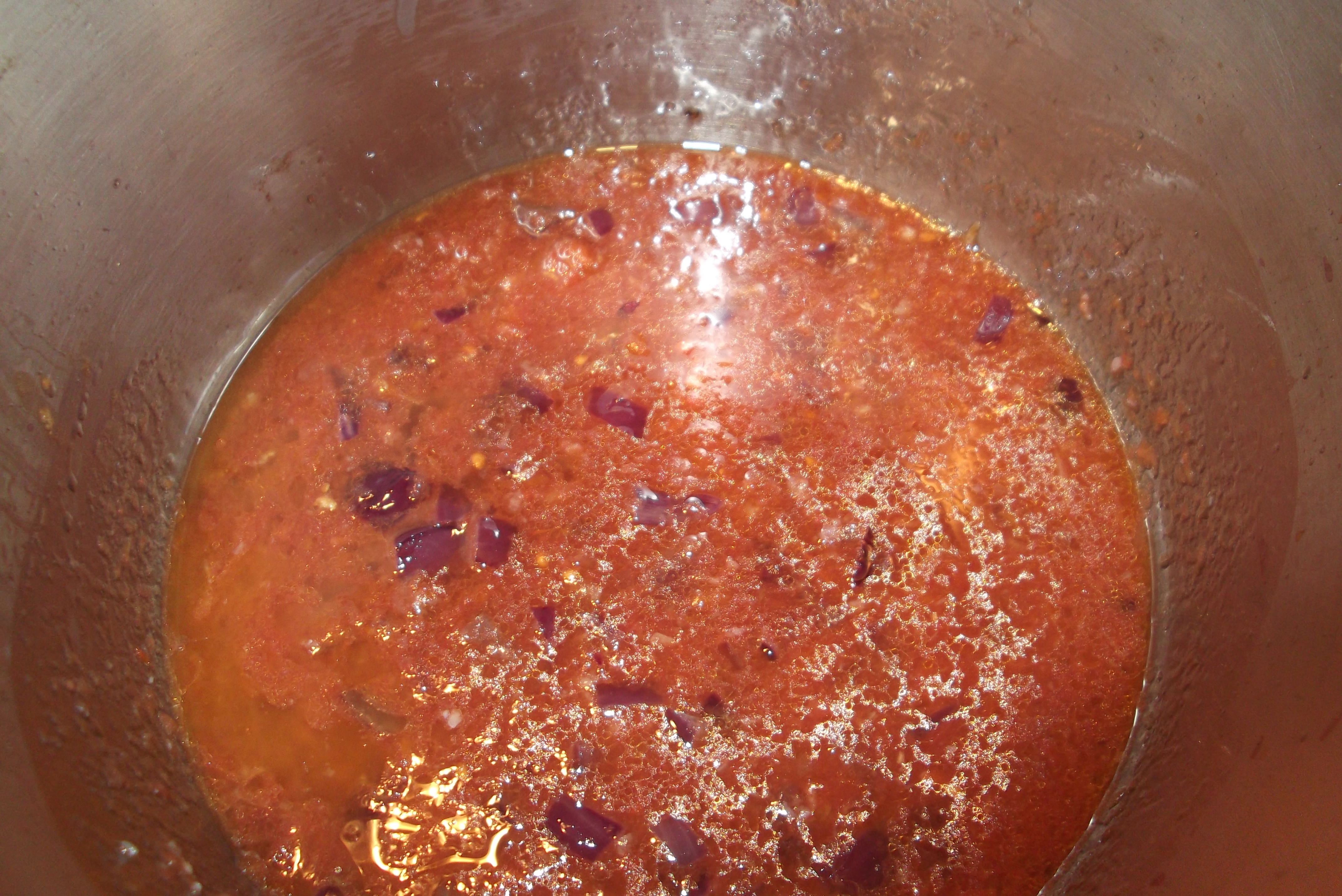
Make the tomato base for the soup


The base is now ready and you can stop here until you´re ready to eat – the final stages will only take you about another 5 minutes, so this is a good “prepare ahead when you´ve got guests” dish.
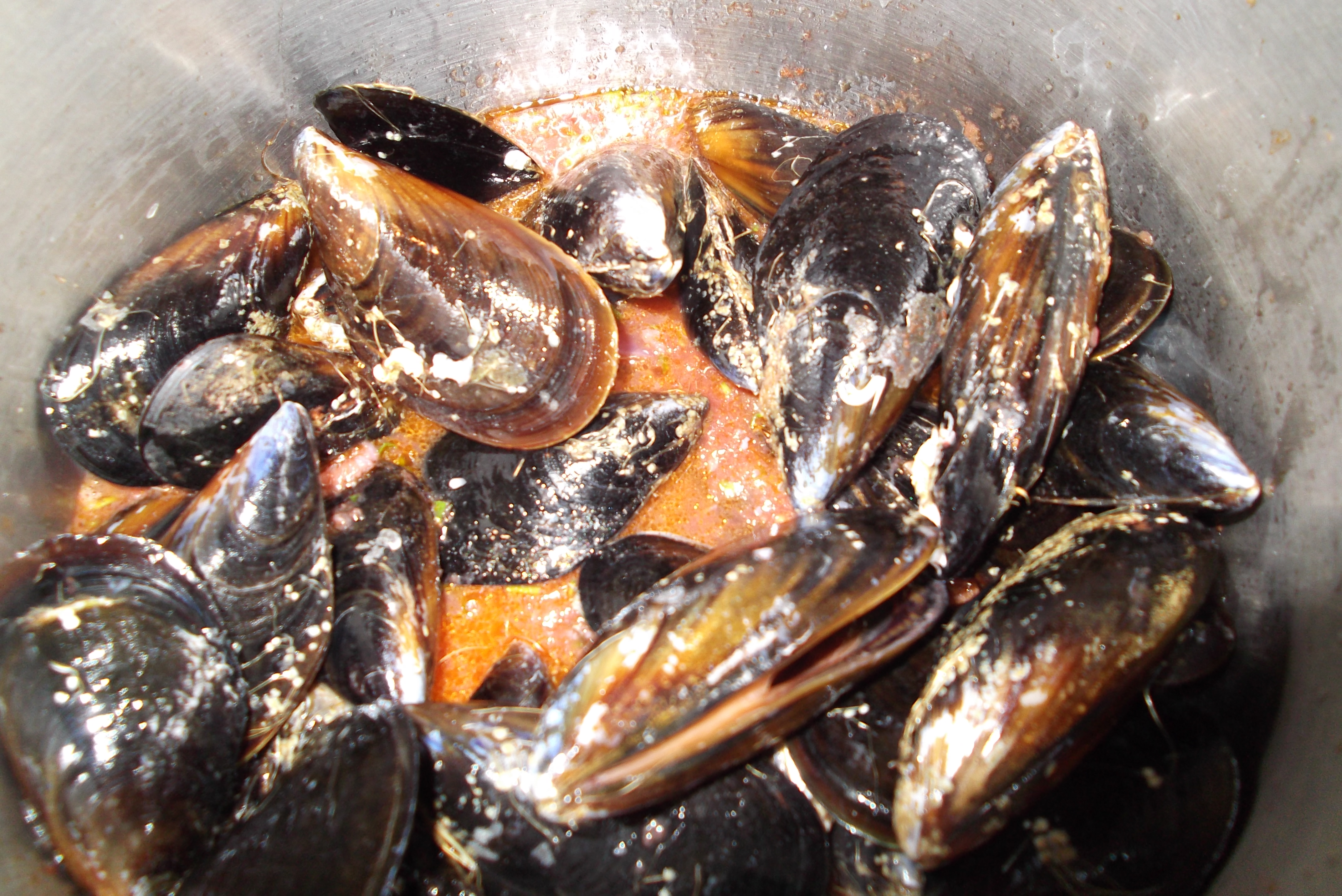
Finally...add the mussels and parsley

When you´re ready to eat, warm the tomato sauce, add the mussels and the chopped parsley and put the lid on.  I usually do this on a medium heat and after about 2 minutes check and see how the mussels are doing.  You may need to put the lid on and give the pan a shake to move the mussels around a little.

Once they´re all open they´re ready to eat.  The mussels will release their juices so see how much you have in the pot.  If you feel you´d like a little more liquid, add a glass of water (or fish stock or wine), if not, they´re fine as they are. I don´t usually add more liquid, these measurements give two large bowls of mussels and enough stock for two good bowls of soup.
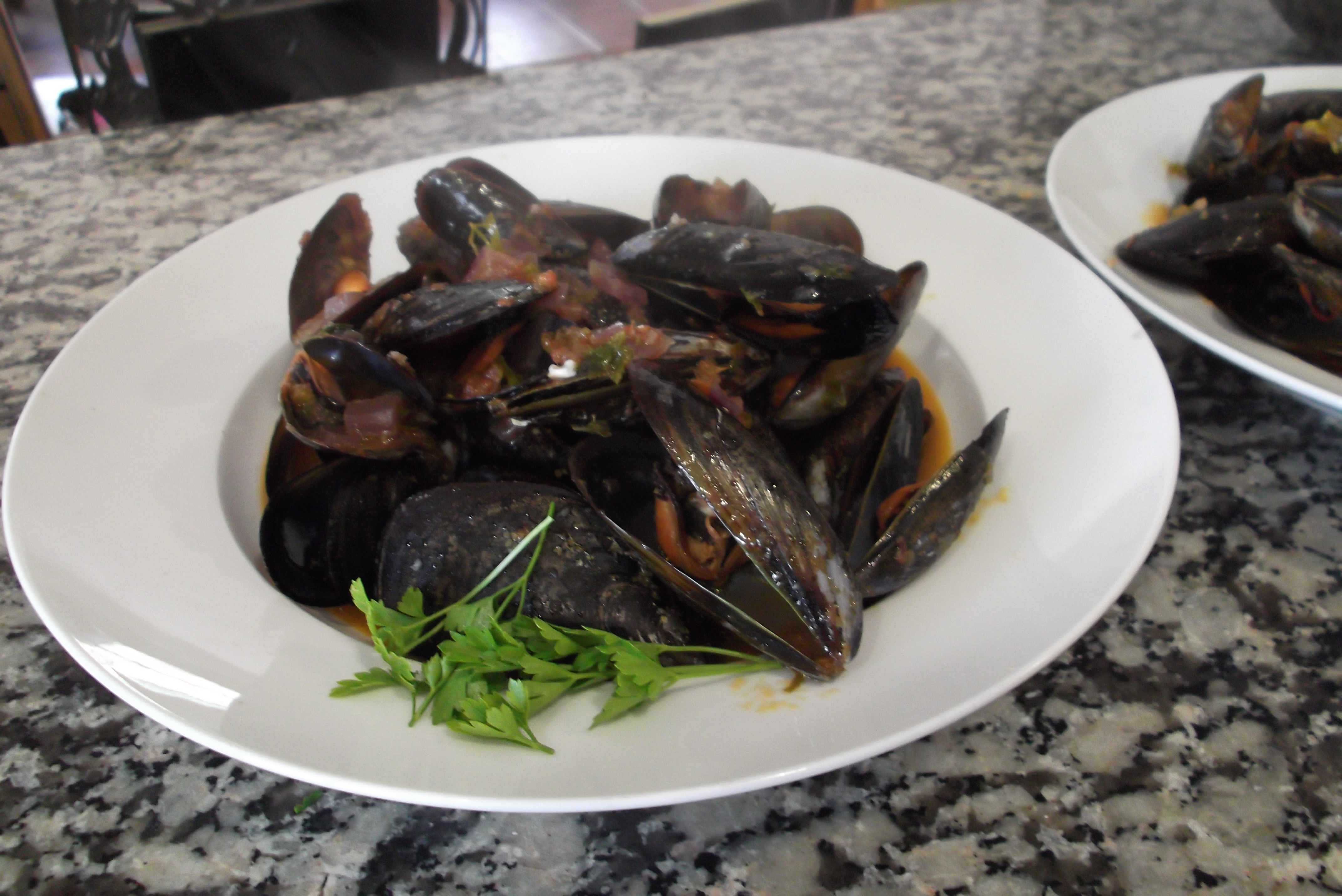
Enjoy - but don´t forget the wine!

You can serve with a salad and plenty of crusty bread to mop up the juices.  I recommend serving with a spoon and fork.  The fork is for getting those mussels out of their shells for those guests who don´t want to use an empty shell to do this, and the spoon is for the soup part.  They´re also nice, particularly if you serve them with less liquid, with crispy chips and garlicky mayonnaise.  Don´t forget to put an empty bowl on the table to chuck the shells into and a bottle of chilled white, rosé or red wine.  Yes, I do mean chilled red, believe me, it works! It´s one of those dishes that works with any wine.  A bit like me really…

Ruby Jewel Jam – Mixed Berry (Fruits of the Forest) Jam

The Colour of Rubies!

A day when I feel like an exhausted mother who has been given an hour´s respite while her partner takes the children to the park for an hour.  Big Man has taken the dogs out for a walk and I´ve just made myself a cup of Lady Grey tea and plonked myself down on the sofa.  I´m sure real mums have it a lot worse, as it´s constant, but I have spent a lot of time with little people today and it´s worn me out!  Probably because I´m not used to it, at least that´s my excuse. 

Having said that, it´s been a fun day.  Tomorrow in Spain it´s the feast of San José, Saint Joseph, which means it´s Father´s Day here.  One of Big Man´s sisters is a teacher at the local primary school and I went along to help her out with classes today to get gifts and cards sorted out for the Dads. 

The day was focused on healthy eating, balanced diets, and talk about vitamins, minerals, calcium, protein etc.  All pretty advanced for 7 year olds I thought, but they loved it.  We made Fruit Salad, which is called Macedonia here, and the children ate this in their morning break.  We also squeezed some oranges that one of the dads grows and made a Moroccan dessert of sliced oranges sprinkled with a little sugar and cinnamon.  All were made with much laughter and consumed without a single cry of “I don´t like fruit”.

Cards with hearts and sunshine were also made and finally we moved on to some Moroccan pastries (a recipe from one of the mums who comes from there) made with ground almonds, eggs, butter, grated lemon and coated in icing sugar.  Good, sticky, messy fun. 

This afternoon was spent with Big Man´s niece who is studying English at the University of Malaga and we had a conversation class.  To get the ball rolling, I asked her to help me prepare some jam, which she happily did, and we covered a whole new cooking vocabulary which is not usually studied in a typical language class!

A few weeks ago I bought a bag of frozen mixed berries.  I think they´re called Fruits of the Forest sometimes.  We only used a little which I had whizzed up with yogurt, but I think the fruit had been picked very much out of season and was eye wateringly sour.  There was nothing for it but to convert the remaining 600g from a 1kg bag into a delicious, and beautiful, mixed fruit jam.  Here´s how we went about it:

  • 600g berries
  • 600g sugar (any amount if fruit and sugar will do, but they need to be equal quantities)
  • 2 apples, peeled, cored and finely chopped
  • The juice of 1 large lemon
  • 2 tablespoons of water
  • A large, deep saucepan
  • Wooden spoon
  • A saucer
  • 2 or 3 clean jars and lids

Start by putting the apple and water into the saucepan and bring to a simmer.  As it simmers, mash with a fork or potato masher.  This will only take a few minutes. 

If you´re going to sterilize your jars in the dishwasher, put them in now as this jam doesn´t take long to make.  Put your saucer in the freezer for testing the setting point of the jam later.

Warm gently until the sugar has dissolved

Add the lemon juice, fruit and sugar to the pan and warm gently until the sugar has dissolved.  Once the sugar has dissolved, turn the heat up and bring the jam to a boil.  This only needs to boil for 5-10 minutes to reach setting point which you can test with either a jam thermometer or by putting a teaspoonful onto your icy cold saucer.  If the jam wrinkles when it has gone cold and is pushed slightly with your finger, it´s ready.  If not, boil for a couple more minutes then retest.  Be really careful with the boiling jam as it burns incredibly if it splashes onto you.

When it´s at the right point, leave to cool down a little while the dishwasher finishes its cycle and then pot your jam, screw the lids on while still hot but label the next day when the jam has cooled down completely.

Now all you need to do it bake some delicious scones to go with your beautiful jam!

Spread that on your toast...

Croquetas de Jamon – Spanish Ham Croquettes

Love ´em or hate ´em – my friends and family seem to be divided in their opinion of croquettes.  I´m most definitely in the “Love” camp, as is one of my god daughters who can eat them non stop.  Big Man sits in the other camp and every now and then I try a new batch on him to see if I can convert him.  He loved the Falafel I made recently, which are pretty “croquettey” in my view, so I haven´t given up hope.

Love, love, love ´em!

Croquettes in Spain are generally made with a béchamel base to hold them together, rather than potato, which is the way I´ve always done them.  I´ve never tried to make them Spanish style, but after making a fish pie the other day I had a small bowl of béchamel sauce left over and I thought I´d give them a go.  What with having dogs and chickens, it´s unusual now for me to have many leftovers in the fridge.  The chickies get the sad vegetables, salad and fruit (if I haven´t already turned them into soups or jams) and the dogs get bones and scraps of meat.  Anything else should go onto the compost heap, but there never seems to be enough left!

Croquettes can be made from any filling, but I really recommend searching through your fridge and using up any little scraps of leftovers.  I had a small bowl of cubed jamon which hadn´t gone into the soup and a few leaves of chard which were looking a bit floppy, so my decision was made.  Other suggestions could be cold veg, tuna, leftover chicken, cheese, hard boiled eggs…ooh, I could go on, but I´ll just get on with telling you how they were made.

Not a lot of photos today as my hands were getting mucky (despite wearing latex gloves) when making the croquettes and Big Man wasn´t around to take snaps for me.

Ingredients used were:

  • About 2 cups of cold béchamel which had gone quite solid.  If you need to make it from scratch, use about 250-300ml of milk for your béchamel and then leave it in the fridge to get really cold.
  • About a cup and a half of filling – I had a cup of very finely chopped Spanish jamon and a cup of shredded chard which, when cooked, reduced to half its volume
  • A tablespoon of plain flour
  • Salt and pepper
  • A beaten egg
  • Dried breadcrumbs for coating the croquettes
  • Oil for deep frying
  • A pair of latex gloves if you don´t want to get too mucky and a couple of tablespoons
Mix it all up


Start by mixing your filling into the béchamel and season to taste. Add the flour to bind together slightly.

Beat your egg in a shallow bowl and prepare another bowl with some breadcrumbs.

Take heaped spoonfuls of the mixture and shape either by hand or with the spoons into croquettes.  I went for the traditional cylinder shape but this is really up to you.  As soon as you start to work with the béchamel it will soften (hence my recommendation of using gloves!) but persevere as things will get easier once you get to the breadcrumb stage.

Roll your croquette in the beaten egg mixture.  Using a spoon to lift it in and out and spoon the egg over seems to help here, then drop it into the breadcrumb mix.  Roll it around and then put onto a plate. 

When all your croquettes are ready, and I got eight pretty big ones from the above mixture, pop them back into the fridge for at least an hour or until you are ready to cook them.

Get your oil nice and hot, once it starts to smoke, turn it down a little and gently drop the croquettes in.  They probably take less than a minute to cook – just enough time for the outside to turn a golden brown and the centre to warm up.  Lift them out with a slotted spoon onto some greaseproof paper and then to a serving plate.  You can make them in advance and then gently warm them up for a few minutes in the oven if you are not serving straight away.

Pour yourself a nice cold glass of white wine or dry Spanish sherry and imagine a hot Andalucían summer´s evening in a noisy tapas bar while you enjoy your Croquetas de Jamon!

Falafel – Chick Pea Patties

My birthday falls at the end of January.  A month of cold and damp here and after the excesses of Christmas, it feels like a time to shy away from more celebration.  Especially when you´re suffering from bronchitis like I was.  Big Man asked me what I wanted to do to celebrate my birthday and I told him I wanted to be like the Queen of England and celebrate on a second date, preferably when the weather was warmer.  Anyway, last year he surpassed himself and surprised me with our rescue puppy, Luna, so I didn´t think a bottle of perfume or a box of chocolates was going to tick the boxes for me. Selfish moo that I am.

The local town hall often organises “cultural activities” for the village folk, not something I have ever been interested in.  Probably a bit of smug self importance creeping in, thinking I´m already culturally aware enough already and mixed with a healthy dose of a severe fear of group activities of any kind.  When Big Man surprised me (again!) on my birthday by telling me that we were going to join 35 other villagers on a three day trip to Tangier at the end of February, I wasn´t really sure what to think.  It´s a destination I´ve always wanted to visit, but Big Man had always said it didn´t interest him, and we both hated anything that involved coaches and tour guides.  I decided to keep an open mind about the whole thing, dose myself up with cough medicine and make Falafel to get us in the mood.

Here´s how we got into the Moroccan vibe and made six Falafel.  Enough for 2 as a light lunch or 6 “tapas” sized servings:

  • 1 tin (400g) or jar of cooked chick peas
  • 2 spring onions
  • 1 large clove of garlic
  • Salt
  • Half a teaspoon of ground cumin
  • Half a teaspoon of ground coriander
  • Large pinch of chili powder (optional) or a chopped fresh green chili
  • 2 level tablespoons of flour plus extra for dusting.
  • Parsley (enough to chop down to about 2-3 tablespoons according to taste)
  • Oil to fill a frying pan to a depth of about 1cm (I used olive oil)

Serving Suggestion

  • Pitta or flat bread and chopped lettuce and mint, a squeeze of lemon juice (optional)

This is a dish which is very fast to prepare if you have a food processor.  It took me longer to wash up than to whizz the ingredients.  It can also be done by hand with a potato masher and a bit of fine chopping and mixing in a large bowl.

Put all of the ingredients apart from the oil and serving suggestions in a food processor and whizz them up for about 30 seconds then pulse until they reach the texture of grainy, wet cement. If it looks really sloppy add a little more flour but it will still be fairly wet when it´s ready.  Add salt to your taste.

Put a couple of tablespoons of extra flour in a bowl and drop in a heaped tablespoon full of the chick pea mixture and using two spoons get it lightly covered in flour.  If you can work quickly just drop this straight into your frying pan of hot oil, or if you prefer to work more slowly, prepare the falafel first and put them onto a plate, then heat the oil and drop them in.

Sizzle those Patties!

Make sure your oil is hot, let is start to smoke then turn the heat down slightly.  You only want to get a nice crust to the outside, the chick peas are already cooked.  Flatten the balls of mixture down as you put them into the pan and after about a minute flip them over (but make sure they´re nice and browned first).

The second side will take slightly less time, so just check on them, take them out and place onto kitchen paper to blot the excess oil and you´re ready to serve.  They´re great with a squeeze of lemon juice then stuffed into pitta bread with some finely chopped lettuce and mint and a spoon full of natural yogurt mixed with an equal quantity of mayonnaise.  I´m not sure how authentic that is – but it´s delicious!

The Missing Falafel was Eaten By The Chef!

Slow Cooked Ox Tail – Rabo De Toro

So, the damp weather was looking like it was going to continue, and my yearning for comfort food followed the same pattern.  I love casseroles and braised dishes with lots of sauce to be slurped up with a spoon or soaked up with bread or creamy mashed potato.  It was time to make something warm and comforting.  A hug in a casserole dish.

Hearty Winter Food

Oxtail used to be, I understand, a cheap and cheerful cut of meat to buy.  It needs long and slow cooking, so this probably influenced the price.  It now seems, from my recent visits to the UK, to be a bit of a “gastro pub” highlight and the price has correspondingly increased.  Even in Spain, where it´s sold as “Bull´s Tail” it´s no longer that cheap a cut of meat to buy.  But hey, sometimes you´re worth that little bit extra and it´s that delicious, it´s worth all the love and long cooking it needs.

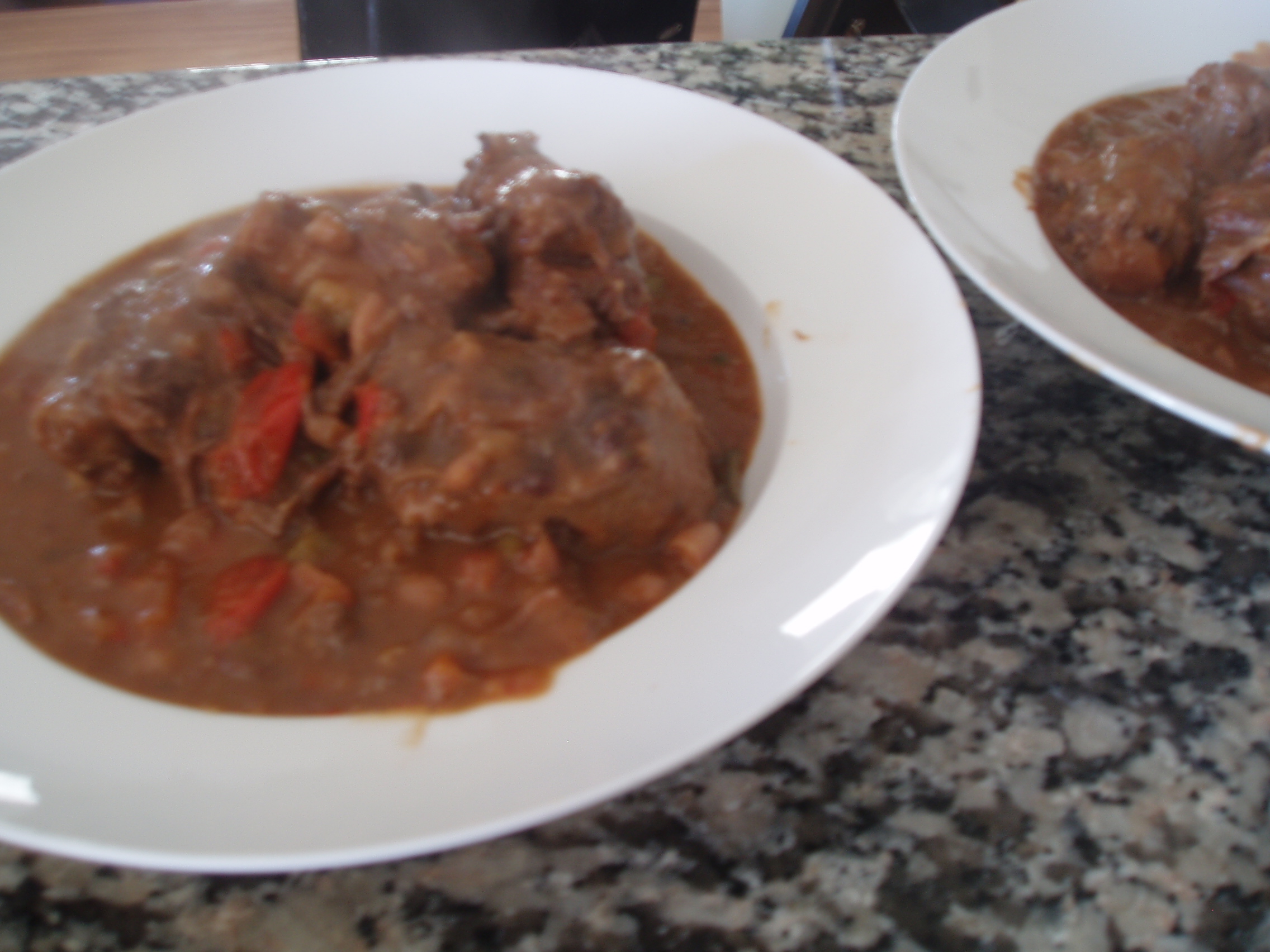
I made a large pot of this delicious casserole which gave me 2-3 main portions plus enough meaty sauce left over to give me a further 2 hearty bowls of oxtail flavoured soup.

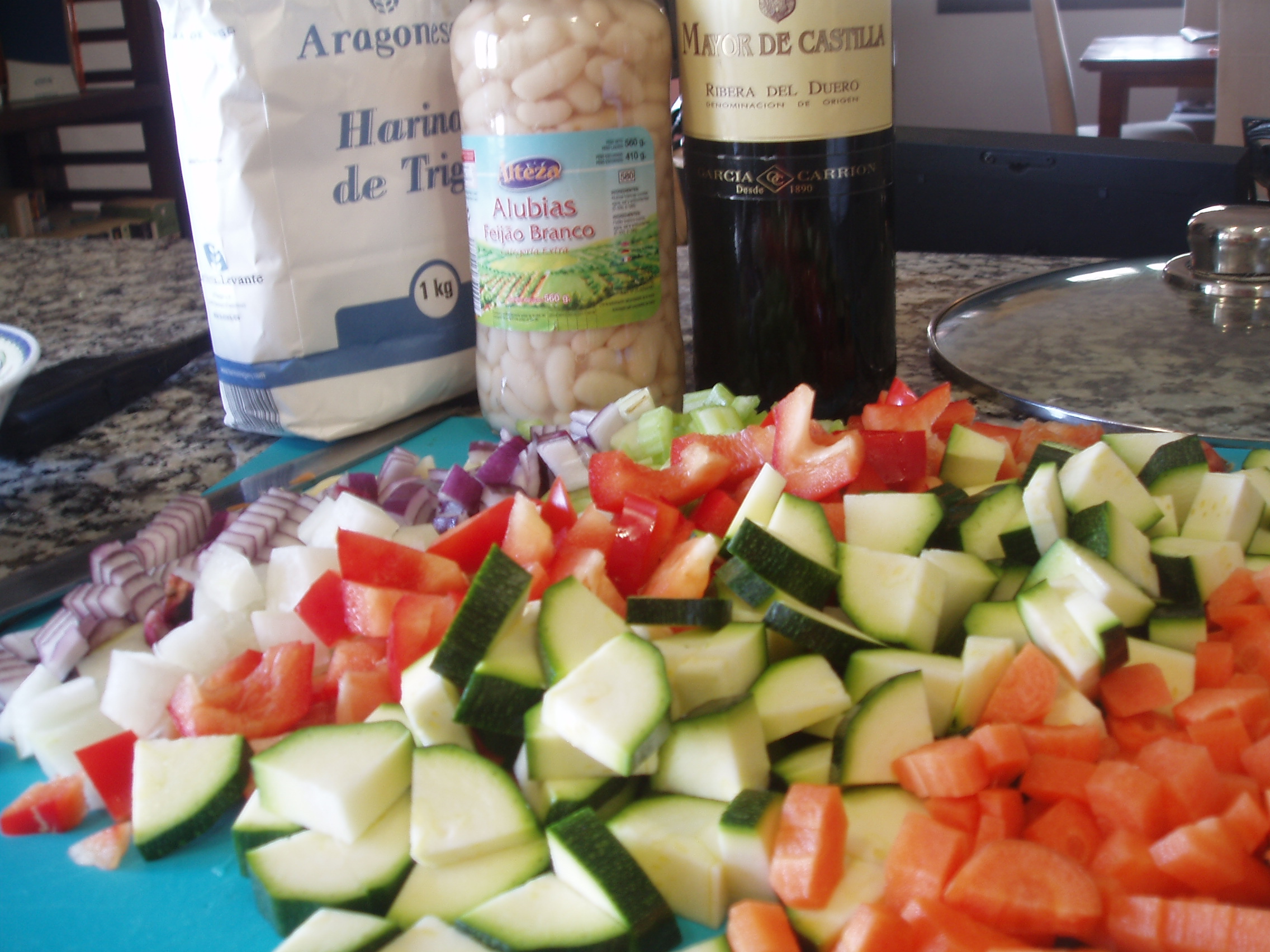
Here´s what you need:

  • 1 ox tail, cut into slices. Your butcher should do this, or it will come ready prepared.  Mine weighed about 1.2kg
  • 3 medium carrots, diced
  • 1 medium onion, diced
  • 2 medium courgettes, diced
  • 2 sticks of celery, diced
  • 3 fat cloves of garlic, finely chopped
  • 1 jar or tin of cannellini beans
  • 1 tin of tomatoes, crushed or chopped
  • 2 heaped teaspoons of tomato puree
  • 1 bottle of red wine, less a glass for the cook
  • 1 mug of water or stock (beef, chicken or vegetable)
  • Salt and pepper
  • Approx 2 tablespoons of plain flour
  • 2-3 tablespoons of olive oil
  • A large, deep, ovenproof dish with a lid


Take One Ox Tail...


Chop. Chop

First prepare all your vegetables and put them to one side.  No need to keep them separate as they´ll be cooked together.

Now coat your pieces of ox tail in flour and after heating the olive oil in the ovenproof dish, brown them on all sides.  Don´t rush this part as, if you over crowd the pan, the meat will steam and not brown.  Put the ox tail to one side.

Start to brown...

In the same pan, and with the oil that remains, add the diced vegetables and make sure they all get coated in oil.  Put the lid on and let them sweat for about 5 minutes.

Turn your oven on low (about gas mark 2).

Put the meat back into the pot, add the beans, tomatoes and tomato puree, stir and bring it up to a simmer. 

Bring to a simmer

Now add the wine and water, season lightly (you can adjust this when the dish has finished cooking) and bring it to a simmer once more.

Put a lid on the pot, and the whole thing now goes into the oven where it will cook slowly for at least 4 hours. I like the sauce to thicken a little so it usually ends up cooking for 5-6 hours.  It won´t dry out, you have plenty of liquid in there.  Every couple of hours check on it and give it a stir.  If it does look like it´s getting too dry for your taste, add a mug of boiling water.

When the cooking time is up (and it´s a very forgiving dish), take it out and check for seasoning.  If it´s too liquid, simmer on the hob to reduce a little. You can eat it immediately if you wish, but it´s a dish which really does improve if left until the next day.  Leave to cool completely.  If you find your have a layer of fat on the top the next day, you can remove this before heating up and serving.

It looks like a lot of meat, but it´s nearly all bone.  How many it serves depends on how hungry you are and how much sauce, vegetables and potatoes you serve it with. Any leftover sauce and can be diluted slightly with stock or water and served as a filling soup another day.

Onions and Rainbows – Onion Soup for a Rainy Day

That´ll Warm You Up!

We´ve had some amazing mild, sunny February weather, but yesterday things changed and the rains came down.  The temperature dropped and made me yearn for warming soups. I had bought a couple of kilos of red onions from a lady in the market a few days previously.  They were probably home grown as she had a wheelbarrow full of them and nothing more.  The onions were eye wateringly strong, as I had found out when I used some in a salad, so I thought that perhaps they would have a gentler flavour if cooked slowly in a chutney or soup.

Memories of a romantic week in Paris with Big Man reminded me of French Onion Soup. I went to the top of the Eiffel Tower for him, despite a severe dislike for heights.  After returning to ground level, pale, shaking and cold, we found a little bistro where we warmed ourselves up with Onion Soup and a bottle of red wine shared on one of those tiny Parisian Bistro tables which lend themselves to knees and hands touching over a romantic meal.

If you fancy a bowl of cockle warming Onion Soup, with or without the Gallic Romance, open yourself a bottle of white wine, pour yourself a glass and get ready to chop and cry.  For two, you´ll need:

  • Half a kilo (or more if you don´t mind chopping them) of onions, finely sliced.  French if you have them, but otherwise any nationality of onion – it doesn´t even need a French accent
  • Two tablespoons of olive oil
  • A thick slice of butter
  • A level teaspoon of sugar
  • Two heaped teaspoons of plain flour
  • 750mlof beef stock or chicken stock with  a teaspoon of marmite or Bovril (or you can use stock made with a beef stock cube)
  • A glass of dry white wine
  • Salt and pepper
  • A slug of brandy (optional)

It´s not a difficult dish to make.  It´s cheap too, but needs a bit of patience.  No rushing this one I´m afraid!

Cry Me A River...

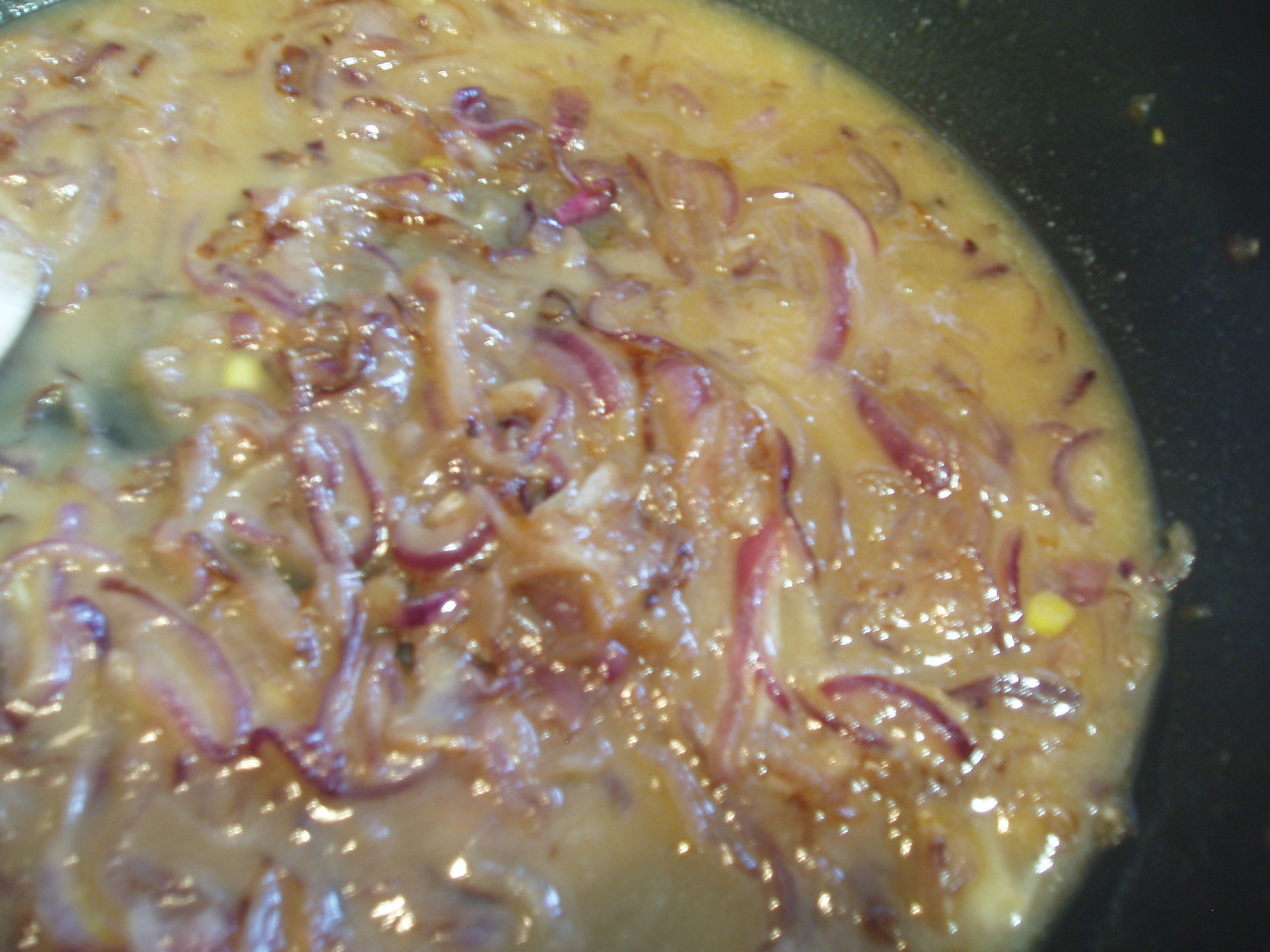
First you´ll thinly slice those onions, then you´ll blow your nose, wipe your eyes and melt the butter with the oil in a large frying pan.  Add the onions, mix them around to coat them and turn the heat down to low.  These will now cook very gently until they start to caramelize but still remain soft. 

This can take at least half an hour, sometimes double that.  It just depends on the time of year and how much water the onions have.  Stir them with a wooden spoon from time to time and when they start to turn brown, sprinkle the sugar on top and keep cooking until they are dark brown.  This can take another 10-20 minutes. 

Starting to caramelise
Add flour and wine

Now sprinkle over the flour and cook gently while stirring for a minute. 

At this point you can add your wine and then your beef stock (if you have it, but it´s very hard to buy good beef, let alone find beef bones to make stock in Southern Spain).  I use chicken stock (if I have some made) otherwise water and a stock cube and I add a good teaspoon of marmite to give it a beefy taste.  I know it´s salty, but you haven´t seasoned yet, and depending on how much salt you like to use, you can leave this part of the seasoning out at the end.

Add stock and simmer

Today I used homemade chicken stock, and because our chickens are corn fed, my stock is very golden in colour.  This means that unless I add loads of marmite to darken it, it won´t be as dark as it usually turns out.  Too much marmite makes it super salty, so I live with golden coloured soup sometimes!

Simmer gently for about 15 minutes and you´re almost ready to serve.  Taste to check and add salt and pepper if you like.  If it´s a touch sweet from the caramelized onions, I find a sprinkle of salt and a slug extra of white wine usually balances the taste out.

If you like you can serve with little rounds of melted cheese on toast at the bottom of the soup bowl, or floated on the top, but what really gives it that extra warming hit is a small hit of brandy poured in just as you serve. Bon Appétit!

Just as I finished making my soup, the sun broke through the clouds and rain, and I had a beautiful rainbow to look at and brighten my day.  Lucky me, Onion Soup and a Rainbow – life can be full of the most unexpectedly lovely moments.

A Pot Of Golden Soup At The End Of My Rainbow

Just call me Lady Marmalade

Felix´s Oranges and Their Wonderful Marmalade

Sunshine in Winter

February normally brings cold and rain here.  What it also brings is trees heavy with beautiful, juicy oranges.  Now, those lovely bitter Seville Oranges do exist.  You see them lining the streets of that stunning city and pretty much every other city in Andalucía.  What happens next is that they get picked and sent off to England where excited cooks turn them into delicious marmalade.  We can´t buy them here!

Fortunately, our lovely friend Felix the Baker, grows oranges, lemons and avocadoes behind the old flour mill.  He grows so many that he´s always giving them away.  Luckily for me, I´m one of the lucky recipients and February oranges mean Orange Marmalade.  I don´t think my recipe is any different from standard ones.  How it turns out depends on how juicy the oranges are, how much pith (and therefore pectin, which is what makes the marmalade set) they have, how much “shred” you want to have or if you prefer a “jelly”.

What you´ll need if you want to give it a go

  • For every kilo (or just over) of oranges, two kilos of sugar and 2.25 litres of water
  • The biggest, heavy based, saucepan you have
  • A wooden spoon
  • A large square of muslin (or a clean, large, cotton handkerchief)
  • String (not coloured, or you´ll end up with rainbow coloured marmalade!)
  • About 6 regular sized jams jars and lids per kilo of oranges

Making marmalade is a labour of love if you are going to do it by hand.  Even if you take a short cut and mince the peel in the food processor, you´ll only cut the time down by a little.  I made marmalade with 2 kilos of oranges, and on and off it took me the whole day.  The rewards?  My house smelt wonderful, and still does the next day, and 11 jars of delicious homemade, organic orange marmalade.

You´ll start by washing and drying the oranges, cutting them in half and juicing them.  If you have a gadget to help you do this, so much the better. The juice goes into your super size pot. Any pips or pith that start to clog up the juicer will go onto your square of muslin, or piece of cloth.  It´s a good idea to line a sieve with the cloth and rest it over a bowl to catch any precious juice that may still drip out.

It will be worth the effort!

The half shells are now cut into four slices, for ease of handling, and with a sharp knife (I use a small serrated one) you need to cut away more of the pith that remains.  This is done rather like cutting melon flesh from the skin.  The pith also goes onto the cloth.  Don´t worry too much if you can´t pare it right back as any pith that still remains on the skin will boil away, whilst doing it´s magic, with the skin.  The oranges I used had lots of pith, so I saved half and will use it to make an orange jelly later in the week.

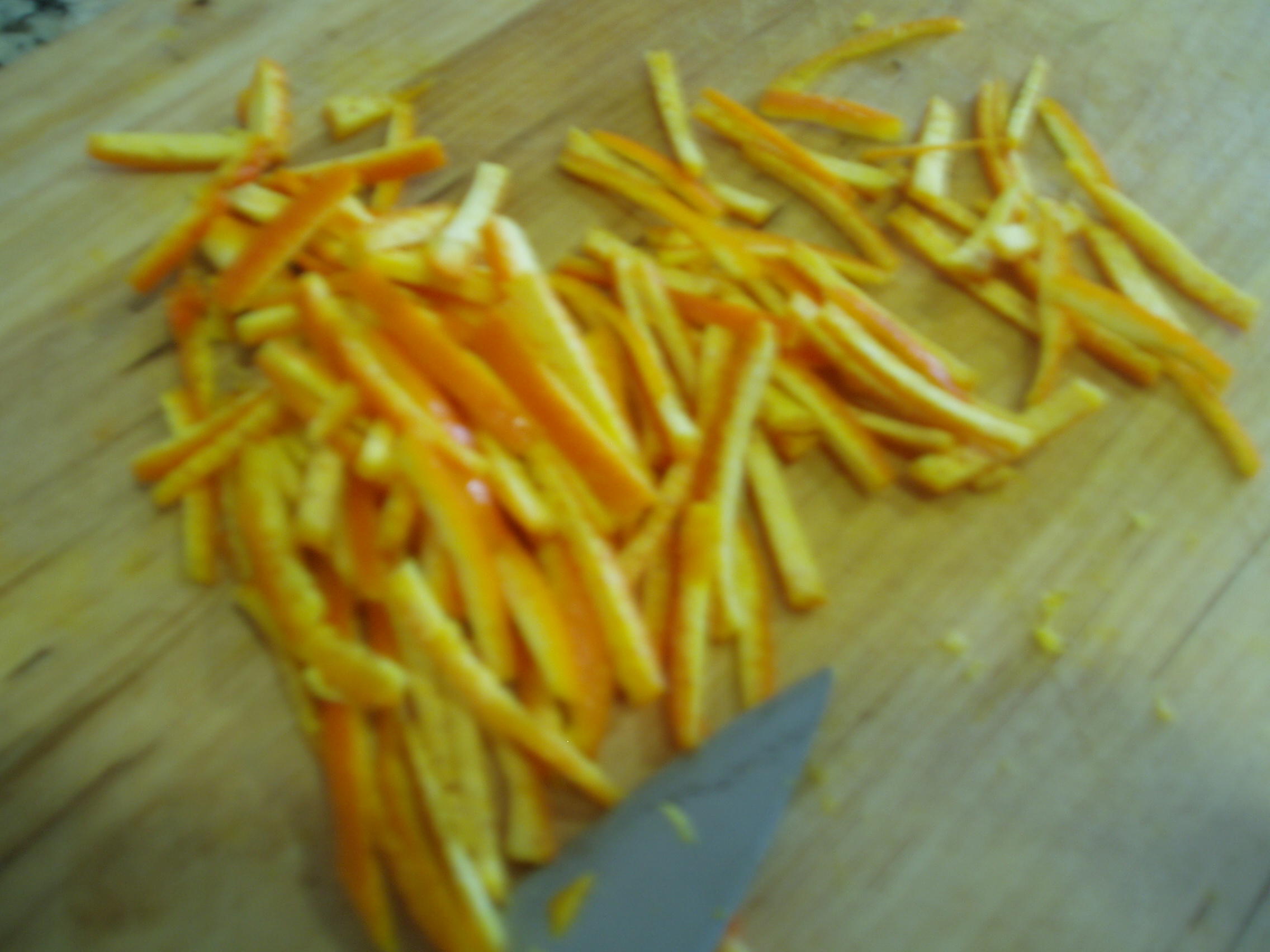
The orange skins now need to be cut into shreds.  How thick or thin is down to you. One year I did this in the food processor, which leaves you with small chunks rather than shreds, but the taste was still wonderful. This year I patiently sliced, and sliced…and then sliced some more to end up with beautifully thin shreds of orange.  You can relax a little now as the hardest part is over.  You may find that getting to this stage takes you a few hours.  Ignore cookery books that tell you it takes 45 minutes.  All lies!

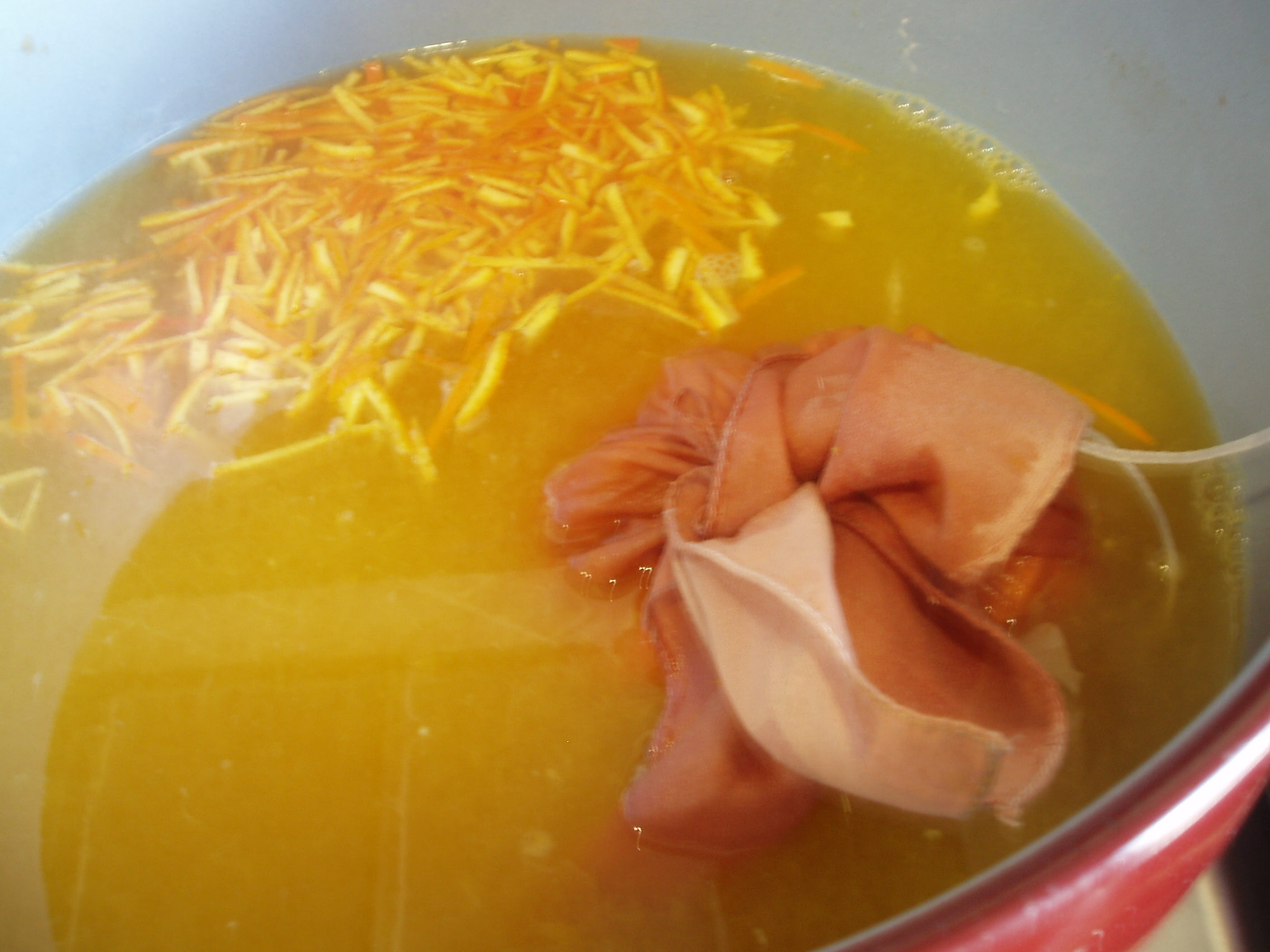
Now, take the cloth square and tie it up.  I usually leave the string quite long, put the bag into the pot and then tie the other end of the string to the pot handle.  This helps you to press on it gently now and then to remove the pectin which will be forming, and then to remove the bag easily at the end.

The Magic Begins…

Put the shreds of orange and your water in to the pot and bring to a simmer.  You will leave this simmering for about 2 hours, pressing the cloth bag occasionally with a wooden spoon whilst enjoying the wonderful smell that fills your house.

Once the two hours are up and you´ve recovered from all that juicing and shredding, it´s time to start boiling.  Remove the bag from the pot, put it into a bowl to cool down a little and when you can handle it comfortably (I recommend rubber gloves for this) squeeze it as dry as possible, putting all the juice that comes out into your pot.

At this point, put a couple of saucers in the freezer…all will be explained.

Add your sugar to the pot and gently dissolve it. You need to think now about sterilizing your jam jars.  At this point I normally put them into my dishwasher with the lids.  Otherwise you need to wash them in hot soapy water, rinse them and put them, upside down, into a very low oven.

Back to the marmalade. Once no sugar crystals remain, turn the heat up and get that jam boiling.  This is why you now understand the rationale behind such a huge pot.  When jam boils fast, it rises, so you do need to keep an eye on it.  I let mine boil over yesterday which meant taking it off the heat, cleaning the caramelized jam off the stove, and losing about a jar of marmalade.  Damn!  Real life cooking.  If you have a sugar thermometer, check that the jam has reached the correct temperature (which I´ve just checked and it´s 105°C or 220°F).  Fear not if you don´t have a thermometer.  I didn´t until earlier this year, and it´s never been a great problem.  Boil the jam until it starts to rise (the froth will look white) and keep it at a boil for a few minutes, lower the heat and put a teaspoon full (be careful, boiling jam really does hurt) onto one of those saucers you put into the freezer.  Leave it to cool for a minute then push the jam gently with your finger and the surface should wrinkle – that´s setting point.

If it´s not ready, then boil for another five minutes and repeat. Getting to this point can take about 45 minutes, it depends on the quantity you´re making.  I´d recommend doing the saucer test even if you have a jam thermometer.  I, being an impatient sort of person, didn´t do this when I made my most recent batch of marmalade, and had to unpot and reboil it the next morning as the marmalade had not set and the shreds of orange had all floated to the top of the jars leaving me with pots half full of jelly and half full of marmalade.  Lesson learnt.

Once the marmalade has reached setting point, remove from the heat and leave to stand for about 20 minutes.  If there is any scum remaining, skim it off.  Take your jam jars out of the dishwasher or oven, they should still be warm, and get ready to fill them.  I find it easiest to ladle the marmalade into a large jug and then pour into the jars.  If you have a waxed disk to put onto the surface of the marmalade before screwing the lid on tightly, then fine.  If not, don´t worry!  Make sure those lids are tight and as the marmalade cools down, a seal will be formed and you can keep that marmalade (if you can resist) until you make next year´s batch.

If you want to label the jars, and why wouldn´t you, wait until the next day when they have cooled down.  Right, I´m off to see Felix and give him a jar of marmalade.

Chicken with Mushrooms and Artichokes

Once you´ve planted a couple of artichoke plants, they seem to last for a couple of years.  As long as you keep cutting the “fruit”, more keep on growing.  A couple of weeks ago we cut more than we needed, so stop them from getting too big and tough and a peeled off the outer leaves to reveal the hearts, blanched them in water with lemon juice to stop them turning black and then froze what we didn´t use.

As we now have more artichokes blooming, I thought I should use up the batch from the freezer (although a tin of artichoke hearts would do just as well).  I also had some chicken breasts which would go well with the artichokes in a lovely dish with a thick sauce.  Neither Big Man nor I are huge fans of the chicken breast, but when you rear your own chickens for eating, you´re always going to have them!

Ingredients for this dish for two are

  • One large or two small chicken breasts, cut into small cubes
  • A tin of artichoke hearts or about 8 fresh ones (prepared as above), sliced into quarters
  • Half a dozen medium sized mushrooms, thickly sliced
  • Two fat cloves of garlic, thickly sliced
  • Two cloves, ground (or about a quarter of a teaspoon of ground cloves) with about 5 peppercorns (or use half a dozen twists of freshly ground black pepper)
  • Half a teaspoon of paprika
  • A pinch of saffron soaked in a tablespoon of water (if you have a packet of paella spices, you can use half a packet in place of the cloves, pepper, paprika and saffron)
  • Two thick slices of day old bread, crumbled roughly
  • A bay leaf
  • A sprig of thyme (optional)
  • Salt
  • Olive oil
  • Water
  • A glass of white wine (optional) plus one for drinking while cooking (not optional in my kitchen)

Start by lightly browning the chicken in a little olive oil in a deep frying pan or a wide saucepan.  Then add the garlic, artichokes and mushrooms and fry gently until the mushrooms and artichokes start to brown.

Browning Nicely

Add the spices and herbs and season with a little salt.  Pour over the wine and enough water to comfortably cover everything and simmer, without a lid, for about 15 minutes. 

When the liquid has reduced by about half, but is still watery, remove the herbs and then add the bread crumbs, stirring as you do this.  You will simmer this for another 5 minutes stirring a couple of times.  The sauce will come together and will look smoother, with some texture from the bread after a couple of minutes.  You want to end up with a sauce roughly the texture of a thick gravy.  If it looks too runny near the end of cooking, add another half a slice of bread.  If it´s too liquid, just simmer until it gets to the consistency you want – it´s down to you! Check and adjust the seasoning, and you´re ready.

This can be prepared ahead and reheated, and takes about 40 minutes to prepare from scratch.

Looking Rustic

Delicious served either as a “spoon dish” (as they call dishes the consistency of stew which are served in bowls and eaten, as expected, with a spoon) if you prefer the sauce more liquid with bread and a side salad or with some green beans,  mashed potato or rice.

My Favourite Spanish Breakfast

Pan Con Tomate y Aceite

A beautiful sunny, Sunday morning.  All the more surprising because it´s the penultimate day of January.  But just warm enough to brew a pot of coffee while I feed the dogs and get myself a little breakfast sorted out before Big Man and I head off for a walk.  It´s been dry for two days with rain before that.  Perfect weather for heading up the mountain and looking for wild asparagus.  I have to confess I´m not the biggest fan of these beautiful fronds.  Although I love strong flavours, they´re just too bitter for me.  But Big Man loves a little tortilla made from these for a light supper and I enjoy a simple poached egg on toast – so everyone is happy and minimal cooking for those evenings when you just don´t fancy spending time at the stove.

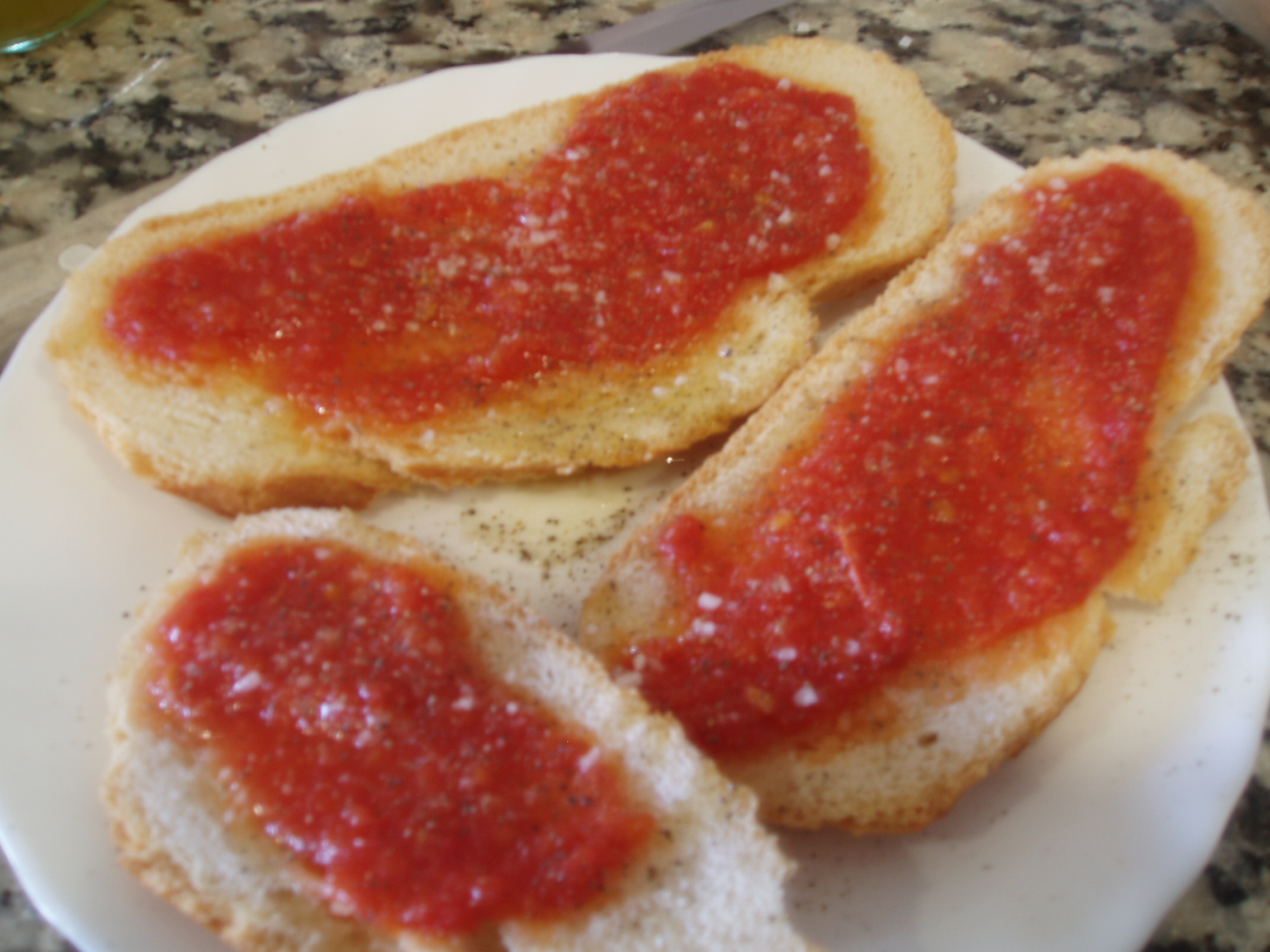
I do enjoy my breakfast.  I don´t go all faint and feeble if I miss out on it, but my favourite quick and easy breakfast here in Spain is fresh bread, drizzled with olive oil (from our olives if I´m lucky) with crushed fresh tomato and seasoned with sea salt and a good grind of pepper.  All you need to do with the tomato is blitz a ripe tomato with the hand blender – remove the skin or not, your choice and that´s it.  It´s usually tastier in summer when the tomatoes have more flavour, but if I come across a gorgeous specimen outside of the warmer months, it´s earmarked for my breakfast.  If the bread is a little stale, it´s toasted  lightly on my griddle pan.  If I fancy some spice, it´s sprinkled with little fresh or dried chili at the end (not so Spanish), and if I´m extra hungry a few slices of jamon are added.  But the truth is, the simpler the better.

That´s not to say I don´t enjoy a Full English, or a Bacon Buttie when the mood strikes.  Come to think of it, a bowl of porridge in winter always goes down well too.

January Seafood Stew

Warms Your Cockles

It´s a grey old Saturday in January here, with no particular plans for the day.  I hear a loud “toot, toot” outside and my heart lifts. Fish Man is here.  Although we live in an isolated part of the mountains, we´re not entirely cut off.  In fact, food-wise we could probably survive without ever going shopping.  We have our chickens and the vegetable garden of course.  We have goatherds who sell us a goat for the freezer, or a lamb too come to think of it.  Bread Man stops daily and leaves me a lovely crusty loaf, the grocery man comes at the weekend with all sorts of exciting things, even the man with gas cylinders stops at my door.  But two or three times a week we have the excitement of Fish Man.

The downside is that we´re pretty much the last stop on his route, so he often doesn´t get to us until about 1pm.  Sometimes he´s sold out of most things, but if I ask him for something specific, he saves it for me.  Usually that´s Pulpo (Octopus) or Raya (Skate) which we love.  The upside is that he´s usually keen to get back to Malaga, where he lives, for his own lunch, so prices come down so that he can shift the last few things, or he throws in a few goodies for free.  He gets up early and heads off to Malaga fish market then sets off up the mountains to the villages around where we live.

Weekends in Spain are not about the weekend roast but about Paella, which we all know and love.  In Andalucia, they just call it an Arroz, a “rice” which is just like Paella but often served with more stock.  A soupy Paella, if you like.  Otherwise it´s a Fideua, which is exactly the same but made with short, thick noodles, called Fideos.  This morning I bought half a kilo of small prawns and eight medium sized squid.  I grabbed a small packet of mussels (removed from the shell and frozen) from my freezer and a couple of small fillets of hake which were also in the freezer.  Because it´s a bit of a trek to the supermarket, and of course there are things that can´t be bought our of the back of a passing van, I tend to keep my freezer pretty well stocked with things I can grab in the morning and defrost quickly.

I asked Big Man what he fancied – Paella, Fideua, Seafood Soup, Stew?  A stew, it was decided, so I started to get things ready.  What you need for four people with “normal” appetites, or three “greedy guts”, or two “greedy guts” with enough leftover to turn into a soup that evening with a drop more stock, is:

  • About 2 cups of peeled prawns (keep those shells, we´re going to make stock)
  • About 500 grams of cleaned squid cut into chunks
  • A cup of mussel meat
  • A medium fillet of white fish, cut into chunks
  • Half a red pepper, finely diced
  • A stick of celery, finely diced
  • Half and medium onion, finely diced
  • A third of a courgette, finely diced (optional)
  • Three fat cloves of garlic, crushed
  • Half a tin of chopped tomatoes
  • About a litre of fish stock.  Either cover the prawn shells with water, add a few bat leaves, a chunk of onion and boil for about 8 minutes or use a cube

You can use any fish or shellfish you like really, and if you don´t have a lot of fish, you can thicken the stew up with a few noodles, or serve it as a soup with plenty of stock. Otherwise you could use rice and turn it into a paella – it´s up to you!

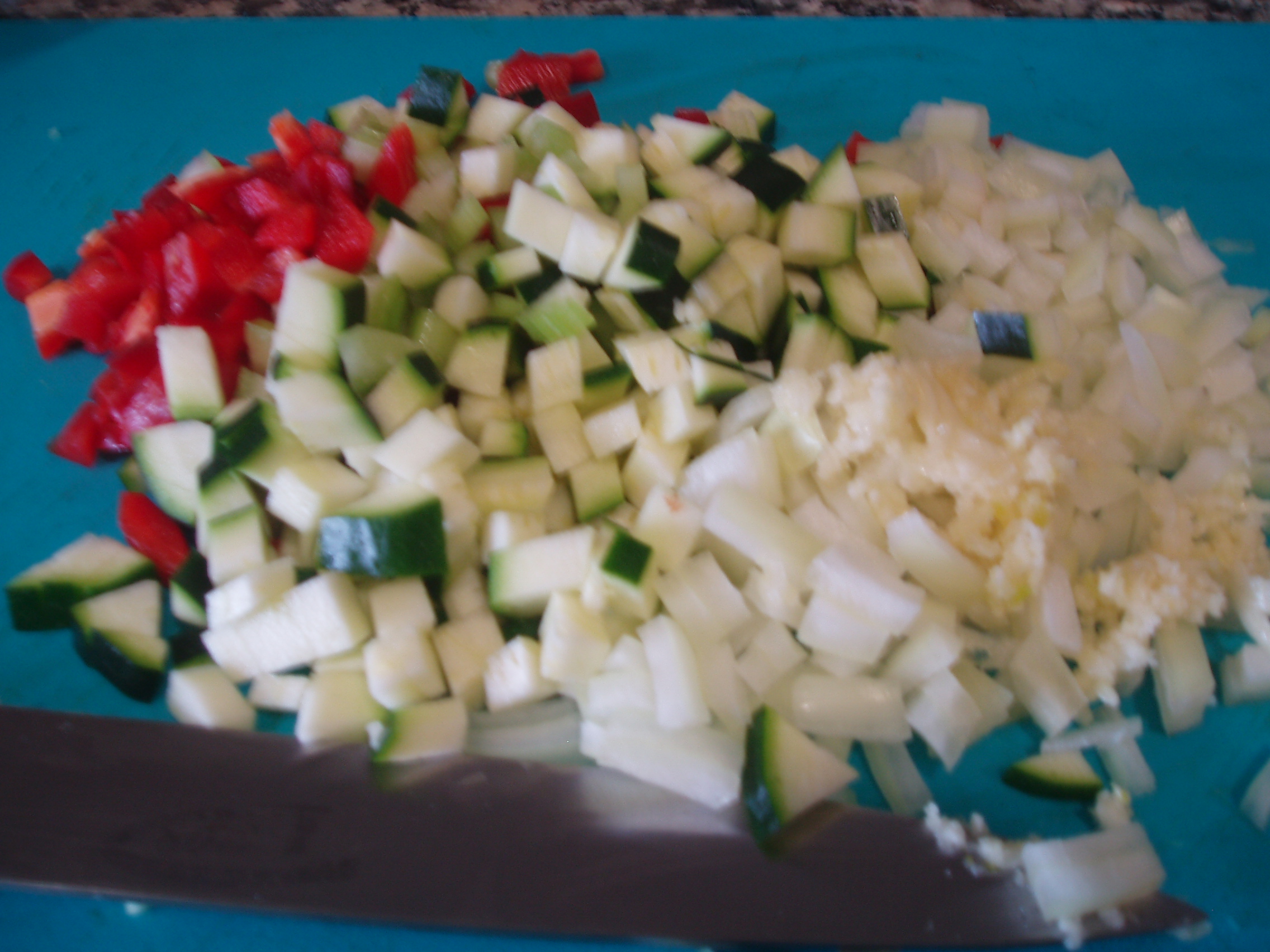
So, you start by sweating the peppers, onion, celery, garlic and courgette. Again, if you have other vegetables you want to use, feel free.  Peas or broad beans are good, but best thrown in at the end with the fish as they don´t need much cooking.

Beautifully Chopped!

Add your tomatoes and continue cooking gently for a few minutes.  I usually cook this in my favourite pan – a large, deep, non stick frying pan.

Now add your stock.  It will look rather dull and unappetizing at this point, rather like watery tomato soup.  Fear not.  Now you´re going to boil it, but not too fiercely, for about ten minutes and reduce it by about a third.  Pour yourself a glass of wine if you don´t already have one in your hand.  If not, why not?  If you want to serve this for guests, prepare it to this point, even the day before (but keep it in the fridge) and forget about it.

...with tomatoes
...with stock

When you´re ready to eat, heat the stock to a simmer and put all your fish in.  Start with the squid as it will take about 30 seconds longer than the rest.  Simmer gently for about 3-4 minutes and then serve.

If you think it´s not going to be enough to go round, or you fancy something a little more “robust” add your noodles before the fish and when it is almost cooked through, add the fish.  About a mug full would be good for this quantity leaving you with some soup and some thickness to the finished dish. The temperature has dropped here, and we´ve lit the fire, so we´re going with some Fideos today for a more filling meal.

If you want to make a paella (although the courgette is not very traditional, but hey, it´s your dish, you can do what you like with it), add the rice before the fish and cook for about 20 minutes.  A mug and half would be good – you want it drier than the soup, but keep an eye on it and add a little boiling water if it looks like it might dry out before the rice is cooked.  Add the seafood, stir, lower the heat and cover with a lid and leave to simmer for 3-4 minutes.  Turn the heat off and then leave to “rest” for about 5 minutes.

Action Photo!

Serve in large, deep bowls with plenty of fresh lemon to squeeze over and a sprinkle of chopped parsley.  Crusty bread and a salad are all that you need to go with this.  Delicious.  The Mediterranean in a bowl.