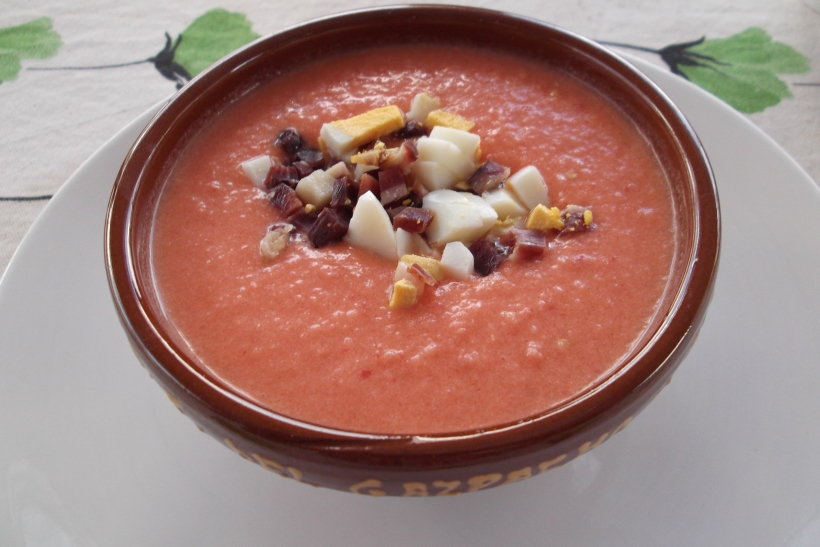
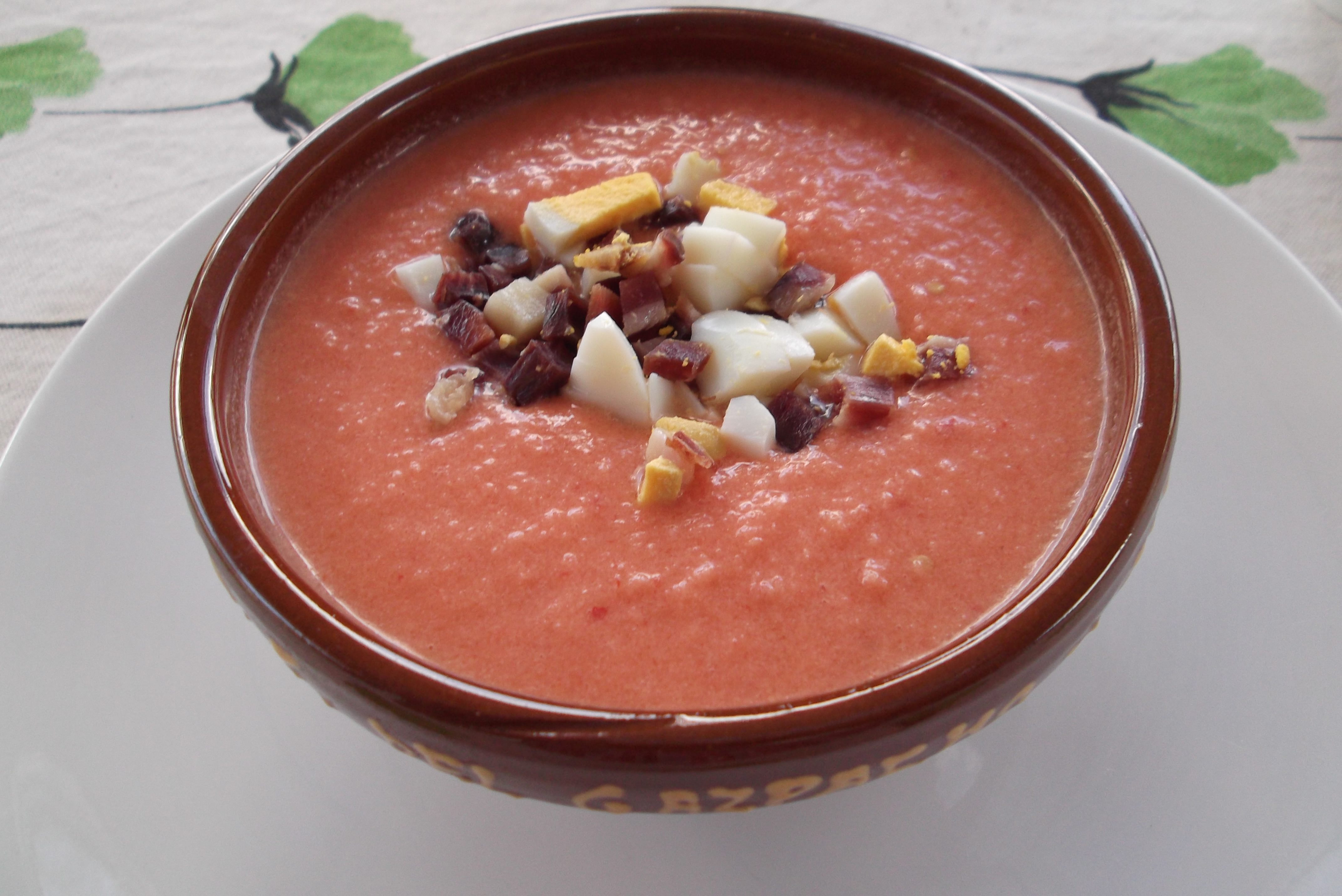
As promised, another version of the famed Andalucían gazpachos. This one originates from the beautiful city of Córdoba, and is my favourite version of all. It is different in that it uses very few ingredients but can be served three ways – very thick as a dip with small breadsticks (known as Picos), medium thick garnished with chopped hard boiled egg and jamon or tuna as a chilled soup starter, or diluted with water as a refreshing drink. So…three dishes in one!
Ingredients for this are few and it will serve from 6 (as tapas) to 2 (as a soup) approximately:
2-3 slices of stale bread without the crust (should be a fairly dense bread rather than sliced white from the supermarket)
About 500g of tomato, cored and peeled (I had one HUGE tomato as you can see in the photo) but usually the volume of the tomato once in the jug is a little more than the volume of the breadcrumbs
A chunk of red pepper (optional)
Half a clove of garlic (don´t recommend you use more or it will overpower the taste the taste of the salmorejo)
Vinegar
Water
Olive oil
Salt
Once again, the holy trinity of water, salt and vinegar appear but we´ll use very little water this time.
Dribble a very little amount of water onto the bread which you will have put into a mixing jug, and leave for a minute or two to absorb it.
Start with bread and water
Add the tomato and pepper if you are using it. The truly authentic recipe doesn´t use red pepper, but after wondering why my salmorejo never looked as red or tasted as sweet as anyone else´s, I was let into the secret of the locals round here – red pepper!
Tomato and Red Pepper
Add your garlic, a teaspoon of salt, a tablespoon of vinegar and at least two tablespoons of olive oil and start to blend with the hand blender.
Add Vinegar and Salt
You need to get this really smooth, almost like a purée. The more oil you add, the smoother the mixture will be, although I tend to go easy on it just for the sake of my waistline! Taste every so often and adjust the salt and vinegar to your liking. Again, it should be “alegre” or lively in flavour.
Start to blend
When you´re done, leave to chill in the fridge for about an hour.
Get it smooth and thick
Traditionally it´s served in a deep earthenware bowl (to maintain the freshness) with chopped hard-boiled egg and jamon on top. Some people substitute the jamon for tinned tuna but I guess chopped bacon would also be nice.
It´s also great as a dip or sauce served with little breadsticks (like very short grissini) or croutons.
Ok, so I say the word Gazpacho, and what do you think of? A bowl of a chilled tomato based soup, with chopped pepper, cucumber and possibly more tomato floating on top? I´m right, aren´t I?! Ok, so enough with the questions. You´d be right of course. But you´d also be wrong. Well, not wrong exactly, just probably not aware of the different versions of Gazpacho that exist in Andalucía. Gazpacho is Andaluz (i.e. from the Andalucían region of Spain) rather than Spanish. Just as Paella is Valencian and not Spanish.
It´s all getting complicated, so maybe I should start at the beginning. Andalucía has always traditionally been more reliant on agriculture (farming, olives, goats and pigs) than industry. Based on hard labour through grafting on the land, or the “campo”. So what did those hungry labourers do at midday, apart from take a well deserved rest in the shade of an olive tree, that is? Well, they took their lunch, or the makings of it, with them. Life was, and still is, fairly tough for a lot of people. Poverty reigned and many of the traditional dishes came about through necessity. Ask any older person here what the key ingredients of a gazpacho are and they´ll tell you “water, vinegar and salt”. And it´s true, they go into all the versions. The reason for this was to make you thirsty. And therefore drink more water, and thus feel full up. Your belly was full of liquid and stopped you craving more food.
So, we have our country men with a twist of salt, a bottle of vinegar and a knife. Water came courtesy of a nearby stream, and the vegetables that went into their gazpacho were those that could be found in the countryside around them. Sometimes tomatoes, peppers, onions. Other times wild leaves, oranges or a melon.
The gazpacho you see above looks, and actually tastes, like a very finely chopped salad in a bowl of iced water. I won´t lie to you, that´s pretty much what it is! When I first came here, I admit that I didn´t really “get” it. Now that time has passed and I´ve endured quite a few very hot summers, it all makes sense. A chilled bowl of iced salad/soup, with a little tickle of salt and vinegar, the tang of fresh mint and the crunch of all my favourite summer vegetables goes down a treat when you can´t face doing anything more energetic than swatting a fly away and adjusting your sombrero.
Our village prizes this version of Gazpacho so much that it has a three day Fiesta Del Gazpacho dedicated to it every first weekend in August! All good fun, although we tend to slake our thirst afterwards with a cold beer or a few glasses of wine. And then, when we´ve cooled down, we all take to the dance floor and Paso Doble until dawn. Happy days.
If you want to try it, you´ll need (roughly, as the quantities are really down to you) for four bowls:
Half a lettuce heart finely shredded and chopped (this is what you will do with all the vegetables)
Half a green pepper
A medium tomato, peeled
Half a sweet onion
About a third of a normal cucumber, peeled or one small Spanish cucumber
About 15 large mint leaves
A handful of broad beans if you have them (optional)
White wine vinegar
Salt
Iced Water
Some Ice cubes
Mix all the salad ingredients in a large bowl and pour over water so that the vegetables are just covered. Gradually start to add salt and vinegar to taste (they tend to use a lot of both here, but go steady until you get a flavour you like). The locals say it should taste “alegre” which is happy or lively! Add a few ice cubes and leave for at least half an hour so that the mint really infuses the water, then ladle into bowls, lower yourself onto a comfy chair in the shade of an olive tree, tilt your sombrero over your eyes and enjoy.
Go one, give it a go, you might like it! And it´s a wonderful way of getting your “five a day”…
I think I´m still about bit confused as to whether it´s Winter, Spring or Summer here in Andalucía. The calendar says May, so I´m thinking Spring. Last week we had torrential rain and had to light the fire again in the evening. Yesterday I was sunbathing and gardening and the temperatures reached the high 20´s. No wonder I´m feeling a little confused.
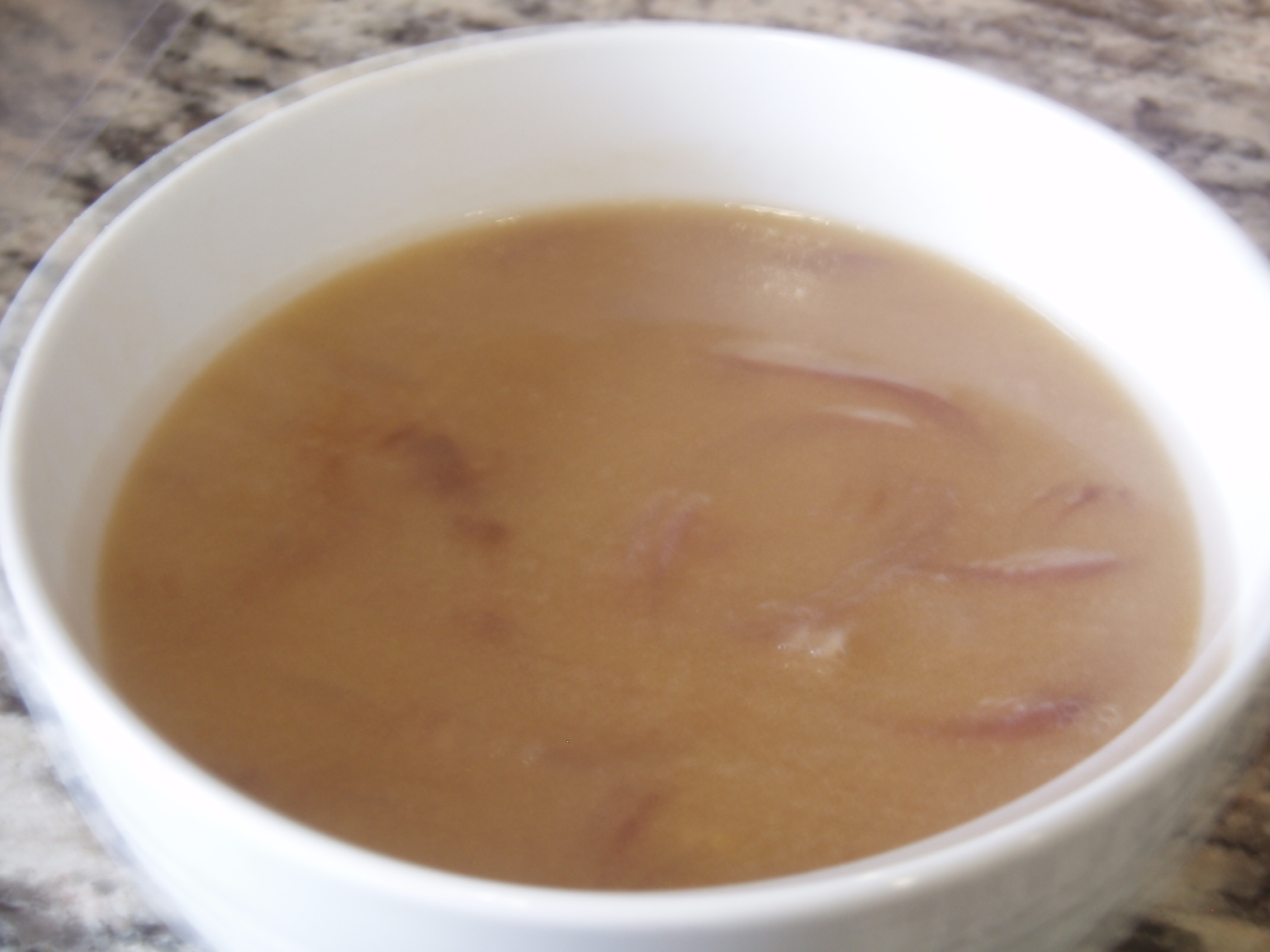
Soup always fits the bill, especially for a light supper. Warming when you want it to be, chilled when you need cooling down and always very comforting.
Saved...from the compost heap!
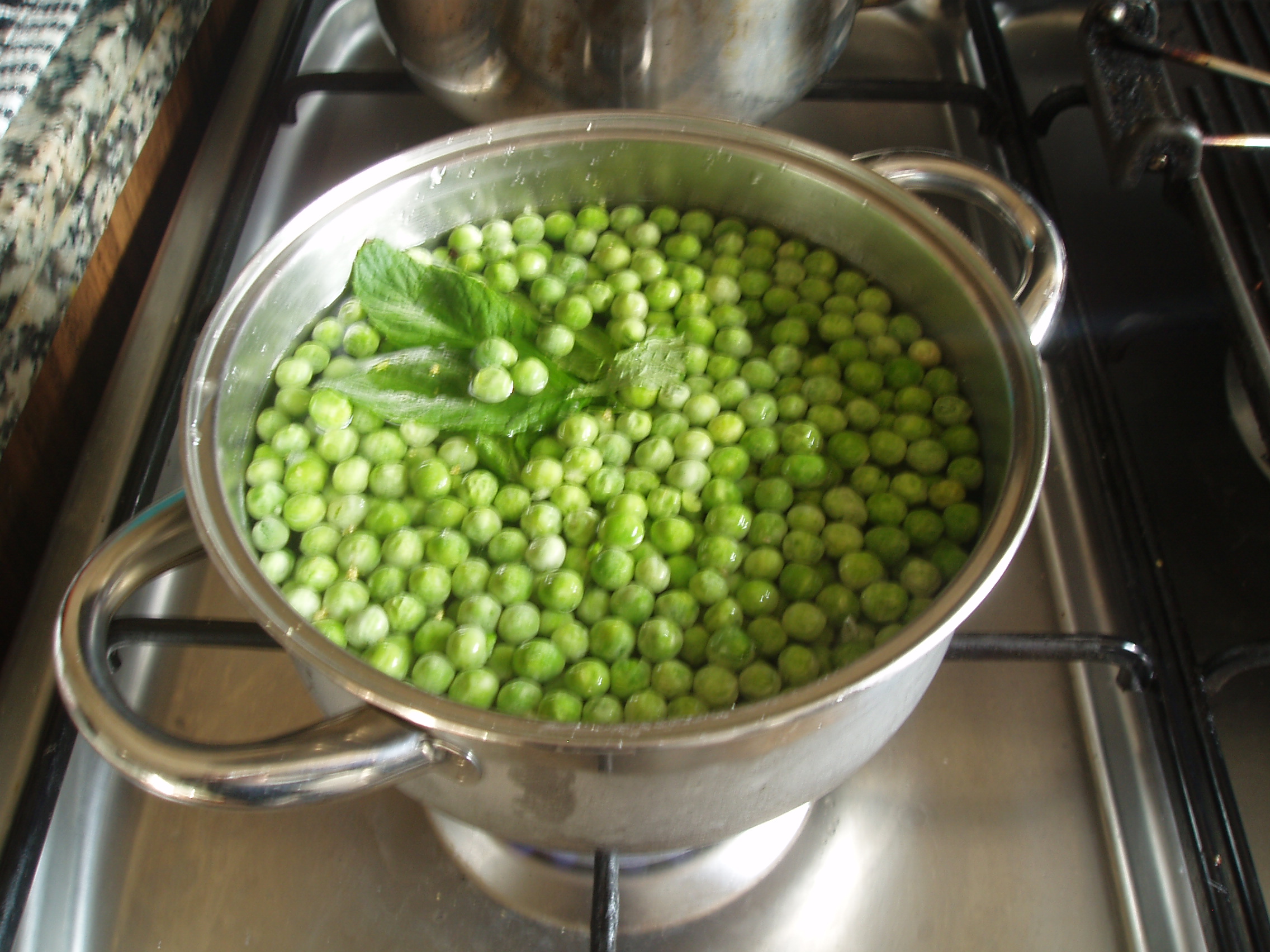
We still have the last of our Spring Onions in the garden which have grown to enormous proportions. Big Man is going to pull them up as the last few are pretty tough, but the centres are still incredibly tender, so I thought I´d save a few before they ended up on the compost heap and turn them into a soup. A quick nip outside the back door led me to my beautiful mint which has really taken off again after its winter rest and a trip to the freezer for some frozen peas and I was almost set.
Now, Big Man claims not to like peas, so when I first made this soup for him I told a porky and said that it was made with a mixture of broad beans and peas. Once he had declared it “delicious, you must make this again” I confessed and it´s become a bit of a favourite. Our broad beans are now ready to eat, so perhaps next time I´ll make the “true” version and see which one we prefer.
The serving I made fed two accompanied with plenty of crusty bread and is equally good served piping hot or icy cold.
I have a saucepan which I know makes a perfect serving for two, so measurements are a bit vague for this one I´m afraid. Will try to explain! Ingredients used were:
Just under half the pan full of frozen peas (a cup and a half approx)
A potato the size of my clenched fists (I don´t have big hands – if only the rest of me was in proportion!)
2 very large spring onions, including the green stems cleaned and chopped
About 10 large mint leaves
Water
Seasoning
This is quick and also very low fat (well, no fat actually), so also good if you´re watching the waistline. Which I really should be doing, but hey, back to the cooking.
I had a ready cooked potato left over from some potato salad – I cook them in their skins and then peel them and tend to keep these in the fridge as a staple. If you don´t have a ready cooked one, peel, cube, boil until tender and then drain.
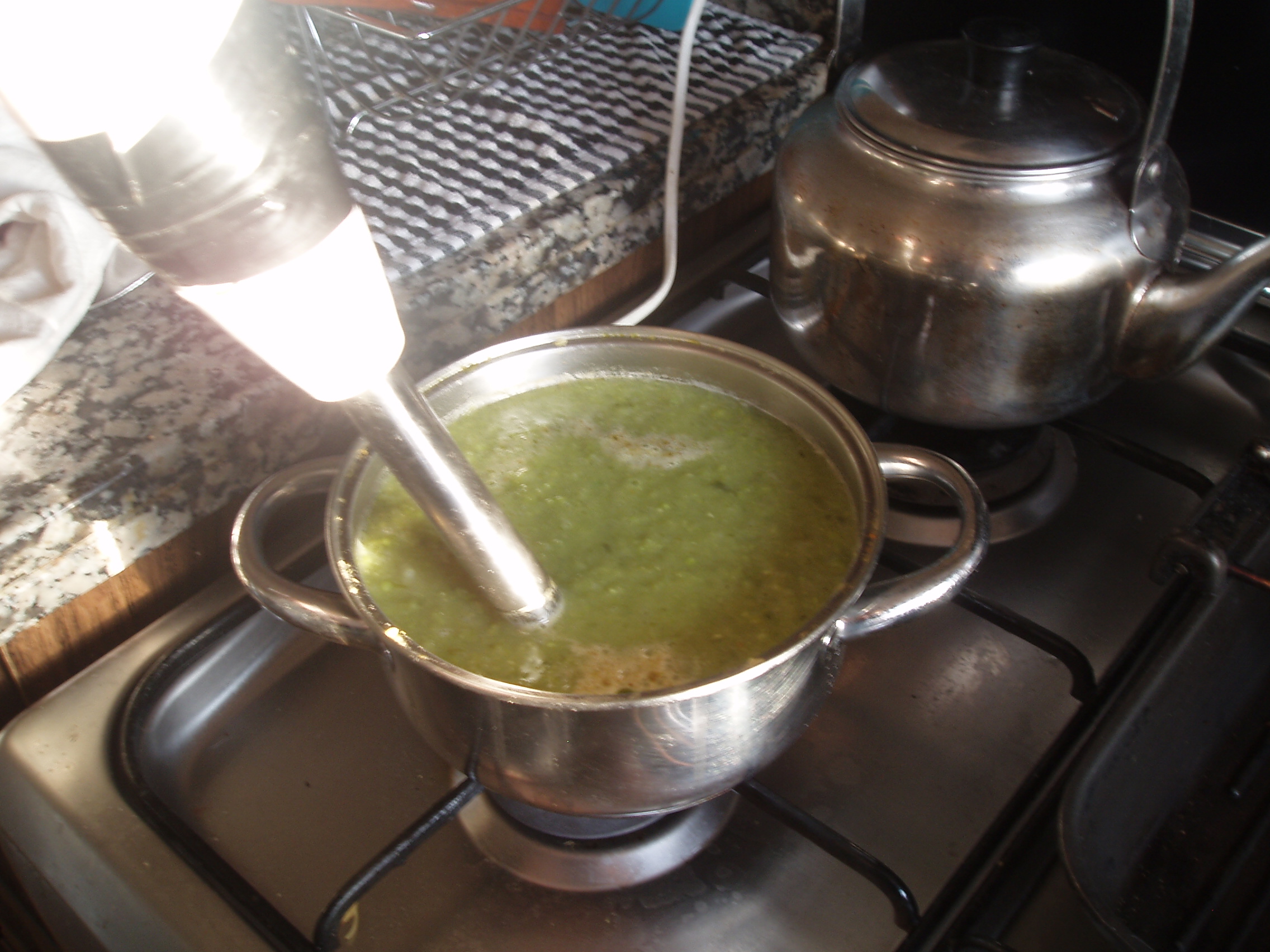
Put all your ingredients into a saucepan, season and cover with twice the volume of water (or vegetable stock) and bring to the boil. Cook for a few minutes until the peas are done and then leave for another few minutes to cool down slightly. Check and adjust your seasoning.
Then all you need to do is to blitz it with a hand blender and it´s ready to serve. Quick, delicious and easy!
Nearly ready
I´ve also served this with cubed jamon (or you could use lightly fried lardons or diced bacon). If you wanted a creamy version you could swirl in some cream or yogurt just before serving. A drizzle of extra virgin olive oil over the top just seems to finish it off perfectly. No photo of the finished dish I´m afraid as we were clearly too hungry and forgot to take one! Enjoy…
We´ve had some amazing mild, sunny February weather, but yesterday things changed and the rains came down. The temperature dropped and made me yearn for warming soups. I had bought a couple of kilos of red onions from a lady in the market a few days previously. They were probably home grown as she had a wheelbarrow full of them and nothing more. The onions were eye wateringly strong, as I had found out when I used some in a salad, so I thought that perhaps they would have a gentler flavour if cooked slowly in a chutney or soup.
Memories of a romantic week in Paris with Big Man reminded me of French Onion Soup. I went to the top of the Eiffel Tower for him, despite a severe dislike for heights. After returning to ground level, pale, shaking and cold, we found a little bistro where we warmed ourselves up with Onion Soup and a bottle of red wine shared on one of those tiny Parisian Bistro tables which lend themselves to knees and hands touching over a romantic meal.
If you fancy a bowl of cockle warming Onion Soup, with or without the Gallic Romance, open yourself a bottle of white wine, pour yourself a glass and get ready to chop and cry. For two, you´ll need:
Half a kilo (or more if you don´t mind chopping them) of onions, finely sliced. French if you have them, but otherwise any nationality of onion – it doesn´t even need a French accent
Two tablespoons of olive oil
A thick slice of butter
A level teaspoon of sugar
Two heaped teaspoons of plain flour
750mlof beef stock or chicken stock with a teaspoon of marmite or Bovril (or you can use stock made with a beef stock cube)
A glass of dry white wine
Salt and pepper
A slug of brandy (optional)
It´s not a difficult dish to make. It´s cheap too, but needs a bit of patience. No rushing this one I´m afraid!
Cry Me A River...
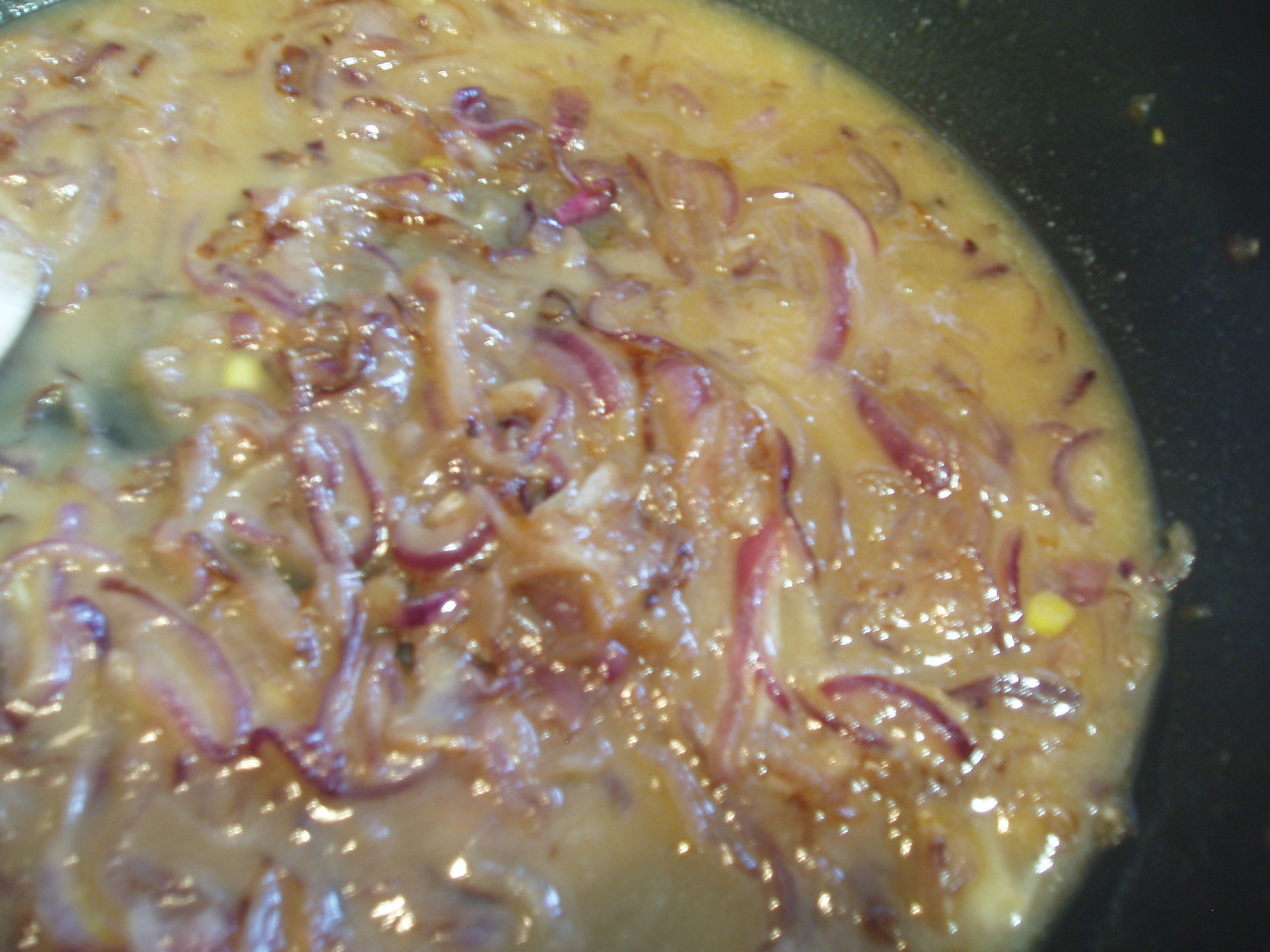
First you´ll thinly slice those onions, then you´ll blow your nose, wipe your eyes and melt the butter with the oil in a large frying pan. Add the onions, mix them around to coat them and turn the heat down to low. These will now cook very gently until they start to caramelize but still remain soft.
This can take at least half an hour, sometimes double that. It just depends on the time of year and how much water the onions have. Stir them with a wooden spoon from time to time and when they start to turn brown, sprinkle the sugar on top and keep cooking until they are dark brown. This can take another 10-20 minutes.
Starting to carameliseAdd flour and wine
Now sprinkle over the flour and cook gently while stirring for a minute.
At this point you can add your wine and then your beef stock (if you have it, but it´s very hard to buy good beef, let alone find beef bones to make stock in Southern Spain). I use chicken stock (if I have some made) otherwise water and a stock cube and I add a good teaspoon of marmite to give it a beefy taste. I know it´s salty, but you haven´t seasoned yet, and depending on how much salt you like to use, you can leave this part of the seasoning out at the end.
Add stock and simmer
Today I used homemade chicken stock, and because our chickens are corn fed, my stock is very golden in colour. This means that unless I add loads of marmite to darken it, it won´t be as dark as it usually turns out. Too much marmite makes it super salty, so I live with golden coloured soup sometimes!
Simmer gently for about 15 minutes and you´re almost ready to serve. Taste to check and add salt and pepper if you like. If it´s a touch sweet from the caramelized onions, I find a sprinkle of salt and a slug extra of white wine usually balances the taste out.
If you like you can serve with little rounds of melted cheese on toast at the bottom of the soup bowl, or floated on the top, but what really gives it that extra warming hit is a small hit of brandy poured in just as you serve. Bon Appétit!
Just as I finished making my soup, the sun broke through the clouds and rain, and I had a beautiful rainbow to look at and brighten my day. Lucky me, Onion Soup and a Rainbow – life can be full of the most unexpectedly lovely moments.
It´s a grey old Saturday in January here, with no particular plans for the day. I hear a loud “toot, toot” outside and my heart lifts. Fish Man is here. Although we live in an isolated part of the mountains, we´re not entirely cut off. In fact, food-wise we could probably survive without ever going shopping. We have our chickens and the vegetable garden of course. We have goatherds who sell us a goat for the freezer, or a lamb too come to think of it. Bread Man stops daily and leaves me a lovely crusty loaf, the grocery man comes at the weekend with all sorts of exciting things, even the man with gas cylinders stops at my door. But two or three times a week we have the excitement of Fish Man.
The downside is that we´re pretty much the last stop on his route, so he often doesn´t get to us until about 1pm. Sometimes he´s sold out of most things, but if I ask him for something specific, he saves it for me. Usually that´s Pulpo (Octopus) or Raya (Skate) which we love. The upside is that he´s usually keen to get back to Malaga, where he lives, for his own lunch, so prices come down so that he can shift the last few things, or he throws in a few goodies for free. He gets up early and heads off to Malaga fish market then sets off up the mountains to the villages around where we live.
Weekends in Spain are not about the weekend roast but about Paella, which we all know and love. In Andalucia, they just call it an Arroz, a “rice” which is just like Paella but often served with more stock. A soupy Paella, if you like. Otherwise it´s a Fideua, which is exactly the same but made with short, thick noodles, called Fideos. This morning I bought half a kilo of small prawns and eight medium sized squid. I grabbed a small packet of mussels (removed from the shell and frozen) from my freezer and a couple of small fillets of hake which were also in the freezer. Because it´s a bit of a trek to the supermarket, and of course there are things that can´t be bought our of the back of a passing van, I tend to keep my freezer pretty well stocked with things I can grab in the morning and defrost quickly.
I asked Big Man what he fancied – Paella, Fideua, Seafood Soup, Stew? A stew, it was decided, so I started to get things ready. What you need for four people with “normal” appetites, or three “greedy guts”, or two “greedy guts” with enough leftover to turn into a soup that evening with a drop more stock, is:
About 2 cups of peeled prawns (keep those shells, we´re going to make stock)
About 500 grams of cleaned squid cut into chunks
A cup of mussel meat
A medium fillet of white fish, cut into chunks
Half a red pepper, finely diced
A stick of celery, finely diced
Half and medium onion, finely diced
A third of a courgette, finely diced (optional)
Three fat cloves of garlic, crushed
Half a tin of chopped tomatoes
About a litre of fish stock. Either cover the prawn shells with water, add a few bat leaves, a chunk of onion and boil for about 8 minutes or use a cube
You can use any fish or shellfish you like really, and if you don´t have a lot of fish, you can thicken the stew up with a few noodles, or serve it as a soup with plenty of stock. Otherwise you could use rice and turn it into a paella – it´s up to you!
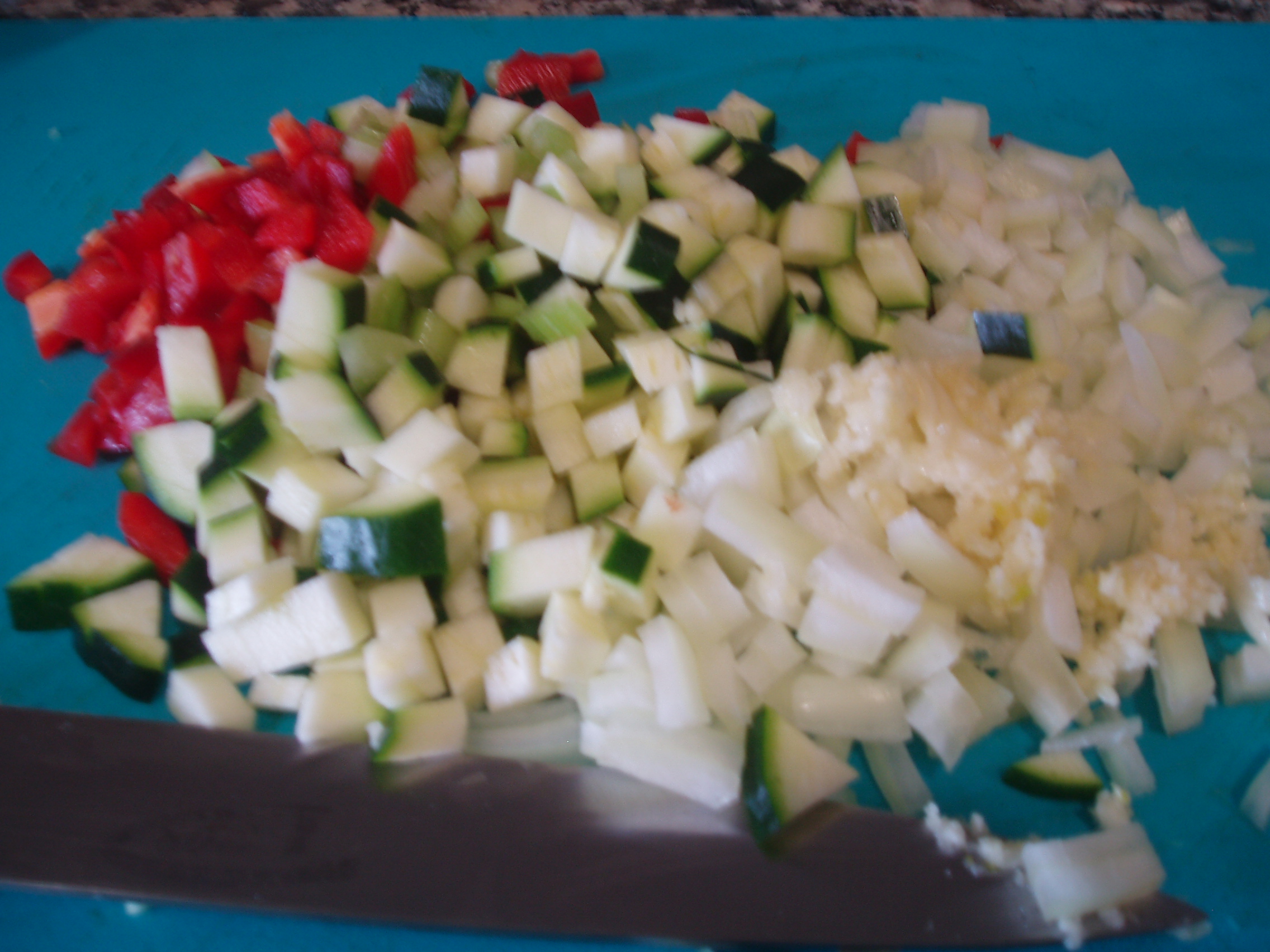
So, you start by sweating the peppers, onion, celery, garlic and courgette. Again, if you have other vegetables you want to use, feel free. Peas or broad beans are good, but best thrown in at the end with the fish as they don´t need much cooking.
Beautifully Chopped!
Add your tomatoes and continue cooking gently for a few minutes. I usually cook this in my favourite pan – a large, deep, non stick frying pan.
Now add your stock. It will look rather dull and unappetizing at this point, rather like watery tomato soup. Fear not. Now you´re going to boil it, but not too fiercely, for about ten minutes and reduce it by about a third. Pour yourself a glass of wine if you don´t already have one in your hand. If not, why not? If you want to serve this for guests, prepare it to this point, even the day before (but keep it in the fridge) and forget about it.
...with tomatoes...with stock
When you´re ready to eat, heat the stock to a simmer and put all your fish in. Start with the squid as it will take about 30 seconds longer than the rest. Simmer gently for about 3-4 minutes and then serve.
If you think it´s not going to be enough to go round, or you fancy something a little more “robust” add your noodles before the fish and when it is almost cooked through, add the fish. About a mug full would be good for this quantity leaving you with some soup and some thickness to the finished dish. The temperature has dropped here, and we´ve lit the fire, so we´re going with some Fideos today for a more filling meal.
If you want to make a paella (although the courgette is not very traditional, but hey, it´s your dish, you can do what you like with it), add the rice before the fish and cook for about 20 minutes. A mug and half would be good – you want it drier than the soup, but keep an eye on it and add a little boiling water if it looks like it might dry out before the rice is cooked. Add the seafood, stir, lower the heat and cover with a lid and leave to simmer for 3-4 minutes. Turn the heat off and then leave to “rest” for about 5 minutes.
Action Photo!
Serve in large, deep bowls with plenty of fresh lemon to squeeze over and a sprinkle of chopped parsley. Crusty bread and a salad are all that you need to go with this. Delicious. The Mediterranean in a bowl.
So in 2016 I turned 50. I was in Italy for my 21st, 30th and 40th. To keep this birthday tradition going I always knew I'd be in Italy for my 50! This blog starts with my 5 week adventure in Puglia but my love affair with Italy continues.....









 Chica Andaluza