Parpuchas – Salt Cod Fritters

Salt cod is a typical Lenten Food in Spain. Whilst the country is not considered as strictly Roman Catholic as it once was, some traditions still remain.

This week is Holy Week, most towns and villages as well as the major cities join in the commemoration with what some might consider quite excessive displays of idolatory. I admit it´s not for me, and I find the penitents who carry the statues around dressed in outfits many of us associate with the Klu Klux Klan  quite disturbing, but I respect the traditions and am happy to join in the with eating and drinking.


Holy Week Procession in Ubeda April 2011
Barefoot Penitent

Parpuchas are known more widely as Tortitas de Bacalao, but they are a very typical dish of Andalucía.  This name may well just be specific to this area.

They are easy to make and if you don´t have de-salted salt cod, fresh cod or any other firm fish would still give you some tasty fritters.  Here they are typically served with Miel de Caña, or Molasses, in the same way as Berenjenas Fritas (Fried Aubergines),but if you prefer lemon…well, I won´t tell anyone!

To make about 15 large fritters or 20 smaller ones

  • 200g salt cod, shredded into small flakes
  • 2 eggs, beaten
  • 1 cup of milk
  • 1 teaspoon of bicarbonate of soda
  • 1 cup of flour (approx)
  • 2 large tablespoons of finely chopped parsley
  • 1 finely chopped or crushed clove of garlic
  • Salt to taste if you are not using salt cod
  • Oil for deep frying

Add the milk, bicarbonate, parsley, garlic and fish to the beaten eggs and then gradually add the flour until you have a thick batter.  It needs to be about the texture of thick lumpy custard (not that any of you, I am sure, have ever made lumpy custard!).

Heat the oil until a cube of stale bread turns brown quickly when dropped in and then drop spoonfuls of batter into the oil. I used a tablespoon and it gave me rather large parpuchas – I´d recommend using about half a tablespoon full as they will puff up slightly. When they are brown on the bottom (and they will float to the top), flip them over and cook on the other side. They will not be in the oil for long.
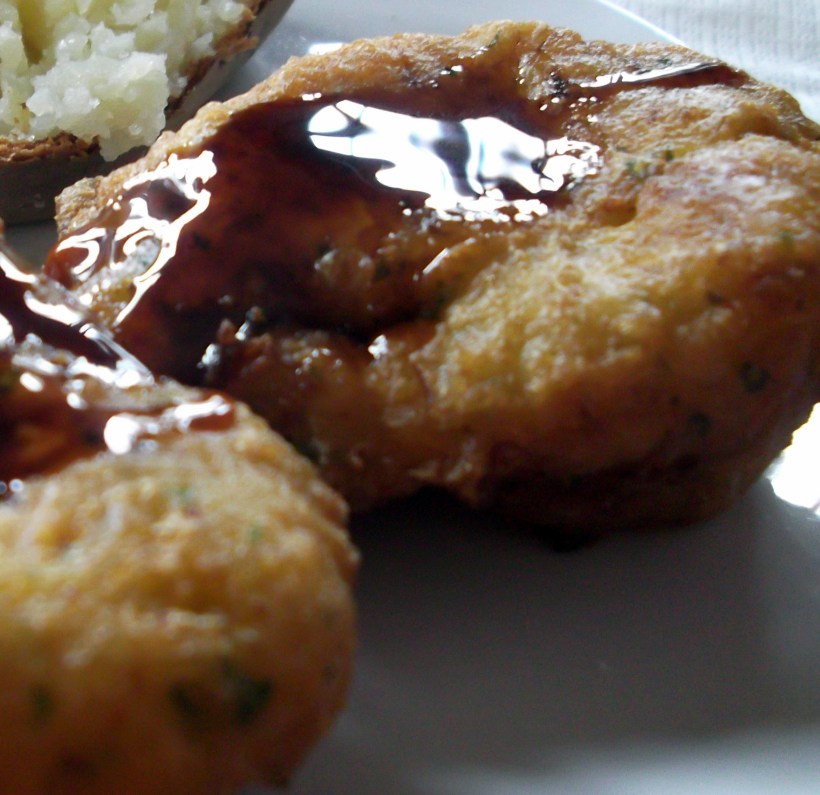
Remove with a slotted spoon, drain and sit them on kitchen paper for a few moments and serve hot, drizzled with Miel de Caña (to be typical) but also good with  lemon or tartare sauce. If you make too many, they are still very tasty cold as they retain their texture.

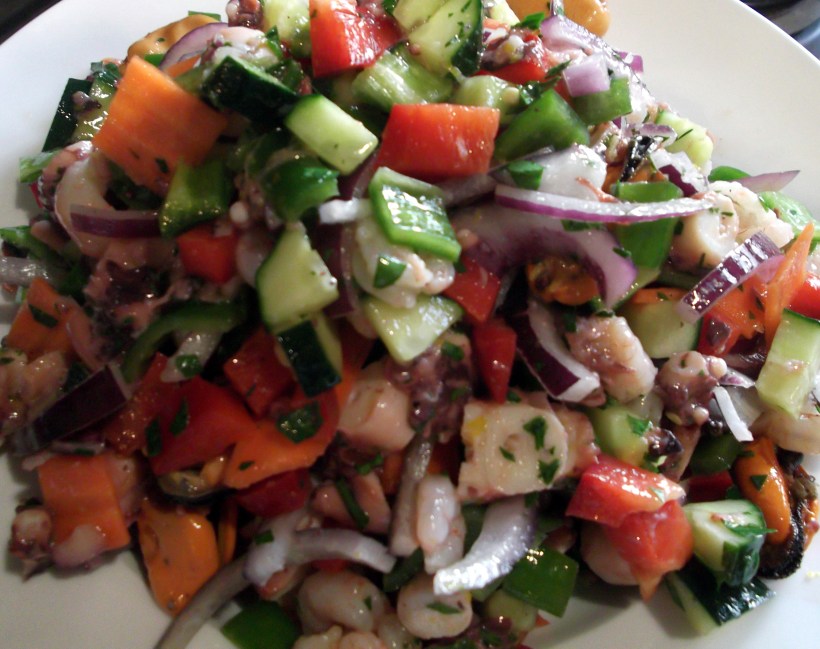
Salpicón De Mariscos – Seafood Salad

So many colours!

A typical tapas here which offers the best from the sea and the best from the salad garden is a Salpicón de Mariscos. We also enjoy it as a light lunch or supper dish or a starter.  Of course, there are many ways of making it, depending on what you have available.  Avocado? Yes, put some in. Don´t like cucumber? Leave it out.

Here´s my version which I also made a lemon vinaigrette for.  Typically though it would just be dressed with salt, white wine vinegar and olive oil.

Serves four as a starter or two as a main course.

Vegetables (all to be chopped into roughly 1cm squares)

  • Two long thin green peppers or one green bell pepper
  • Half a large red bell pepper
  • One medium red onion (or a sweet white onion). Tip…if you thinly slice and then leave in iced water for about 30 minutes and then drain before adding to your salad, it will remove any harshness of flavour
  • One small cucumber, partly peeled
  • Two carrots peeled and cut into thin strips with a peeler (this is not typical, but I enjoy the crunch and colour) and then cut into smaller pieces
  • One large salad tomato (add this just before serving)
  • Two heaped tablespoons of chopped flat leaf parsley

Seafood

  • A mixture of cooked prawns, octopus, mussels – I had about 2 cups in total

Dressing

  • One clove of crushed garlic, half the juice of a lemon, olive oil (you want 3 measures of oil to one of lemon), salt, pepper, half a teaspoon of sugar, a quarter teaspoon of English mustard powder (or use half a teaspoon of made up mustard)

Also – the grated zest of one lemon

Method

Mix together the salad and seafood.  If you are using tomato (and/or avocado) add just before serving.

Shake the dressing ingredients in a jar, taste and adjust seasoning to your preference.  Pour over the salad and mix gently.

This benefits from sitting somewhere cool  (but not cold) for at least an hour before eating. Otherwise you can make ahead, store in the fridge and then remove it an hour before serving.  Add the tomatoes and/or avocado if using, grate over the lemon zest and give it one final stir.

Have plenty of crusty bread to hand to mop up all those lovely lemony juices.

Back to the 70´s – Prawns in Lettuce Cups

Getting Groovy with the Prawns

Do you remember the 1970s? Well, I am sure some of you do, even if you were only babes in arms.  I was a young teenager at the end of the 1970s but it was a time in London when great changes were afoot in the world of food.  The height of sophistication at the time for a dinner party was probably something along the lines of prawn and avocado cocktail, steak with pepper sauce and Black Forest gâteau for dessert. And nothing wrong with any of that I say…but the 80s were soon going to herald the advent of Nouvelle Cuisine (or really tiny portions) and strange mixtures of ingredients such as Loin of some Obscure and Almost Extinct Creature Marinated in a Gooseberry and Guinness Jus. Well, you know what I mean.

Having watched a DVD of Abigail´s Party (I wish I knew how to insert video clips), I was clearly feeling nostalgic and decided to go a bit retro with my peeled prawns. Sometimes you just have to go with the flow and accept you´re getting old…

Ingredients for 4 people as a starter

  • Two lettuce hearts (use 8 of the bigger outside leaves and use the rest for salad)
  • 1 cup of peeled prawns, cooked and cut in half if large
  • 2 hard boiled eggs, chopped (not too finely)
  • 1 ripe avocado (chopped into small cubes)
  • 1 tablespoon of chopped parsley
  • Salt & pepper to taste
  • Half a cup of Marie Rose sauce (I made mine using 3 tablespoons of tomato ketchup, 3 tablespoons of mayonnaise, 1 heaped teaspoon of horseradish sauce, 1 teaspoon of Lea & Perrins Worcestershire Sauce and 1 tablespoon of sweet chili sauce)
  • Pimentón to taste

Simply mix all the ingredients together and spoon into the lettuce leaves.  Sprinkle with hot or sweet Pimentón.

Now, put some groovy 1970s dinner party music on the built in Hi-fi, slip into a glamorous kaftan and enjoy the evening….

Tortilla de Patatas – Potato Omelette

This was a two egg omelette made in a small, deep frying pan

I can´t believe that I haven´t posted my version of this Spanish classic.  Probably one of the most famous tapas dishes in Spain, simple, economical and delicious. Can be served hot or cold. There is always a great debate about how to cut the potatoes.  Ask 5 people and you´ll get five different answers – the choice is yours.

Ingredients per person

  • One large potato peeled, halved and cut into thin (but not wafer thin) slices or chunks
  • Half a medium onion, finely chopped (optional)
  • 2 eggs
  • 1 tablespoon of milk
  • ½ teaspoon of cornflour (optional)
  • Salt
  • Olive oil for frying

Put the potatoes (and onion if using) into a deep frying pan with straight sides if possible. This helps with turning the tortilla.  Choose the size of pan according to how many people you are cooking for – you want the tortilla to be deep, so a smaller diameter and a larger depth works well.  Cover with plenty of olive oil (this can be drained and reused) and use a low heat to braise the potatoes until they are tender, turning them over gently a few times during cooking.

Drain the potatoes and save the oil. In a large bowl beat the eggs and milk together and if you want a thicker, spongy texture to your tortilla, add the cornflour to a little of the milk then mix in with the eggs.  Season with salt then add the potatoes to the eggs and mix gently. The secret to a successful tortilla, I´ve found, is to have a high quantity of “filling” in relation to egg.  The egg binds the potatoes (or whatever vegetable you choose to use) together.

Pour a little oil into your frying pan and when it is hot, turn the heat down low, add the eggs and potatoes and cover with a lid.  This now needs to cook very, very slowly until it sets in the middle and the bottom starts to brown.

Turn the tortilla using a large plate and then slide the uncooked side into the pan. Timings will depend on how large your tortilla is.  If you are unsure about flipping the tortilla, pop the frying pan under a hot grill for a few moments to completely set the top, then flip it.  Once it is browned nicely on both sides, turn out onto a plate and enjoy it hot or cold.

For a less authentic but less calorific version of this dish, use potatoes cooked in their skins. Peel and slice or cut into chunks and then warm them through in a very little oil before adding to your egg.  I use this method more often than the “oil braising” method to help in the waistline war, and no one has noticed the difference!

For another version, take a look at my Potato and Brocolli Tortilla here.

Pinto Bean “Paté” or Dip

I make a lot of soup, especially vegetable soups using whatever I have available.  To make them more filling, I often add lentils, pearl barley or beans. Today I fancied making a mixed plate of tapas to eat before lunch and had paté cravings.

Instead of making a meat paté I took about a cup of dried beans that I had soaked overnight  (the other half of which were destined for the soup pot) and made them into a tasty, garlicky paté which we served with pickled courgettes, our home cured olives, pickled onions from Cook, Eat, Live Vegetarian´s lovely recipe, salami made by a neigbour and some dried oven baked rolls.

To make one bowl of paté cook about a cup of your favourite dried beans until tender and drain (or use a can of beans).  I cooked them with a few sticks of celery and a chopped carrot for extra flavour.

Put the cooked beans into a blender jug and add 2 tablespoons of olive oil, the juice of half a lemon, 2 cloves of garlic, salt and pepper and a small bunch of fresh parsley.  Blend using an immersion(stick)  blender or a food processor.  If the texture is too thick, taste and then add either extra oil, lemon juice or water depending on which flavours you want to dominate. Adjust seasoning if necessary.

Quick, easy, tasty and economical.  Pass the bread please!

Lomo en Manteca – Confit of Loin of Pork

So, I translated this dish as confit, as it sounds so much more appetizing than “slow cooked in lard”.  Let me tell you how I come to be posting about this delicious dish.  Do you find that you´ve struck up friendships through your blog? I bet the answer is yes.

Someone forgot to tell the ladies it was Singles Day at the local bar...

Well, a blogging pal of mine, Mad Dog, has a bit of a passion for many things Spanish, due to having worked in Barcelona.  We exchange e-mails and ideas from time to time and for some very strange reason recently, we were talking about lard and how it has fallen out of fashion.  He sent me info about it and I was amazed to learn that weight for weight, it has less cholesterol than butter.

Anyway, I´ll leave it to him to tell you more another day, I´ll move on to the fact that lard most definitely has not fallen out of fashion in Spanish cooking. Round here, if you´re not using olive oil, it´s lard.  Even in cakes.  Many of the more traditional dishes use lard and it was very common to preserve pork in lard for the winter months, after the matanza, or pig killing.  Back in those days the meat was stored in big earthenware pots and slabs of pork were dug out and used as needed.

Pork loin, slowly cooked in lard is a common dish still and is served cold and thinly sliced as a tapa, or warmed through or refried for a “plato de los montes” (a mountain dish) with egg, fried potatoes, fried peppers and chorizo and morcilla for an immensely filling meal.

To recreate this dish nowadays is very simple. Quantities are not that important as it will all depend on how much meat you are using.  Nowadays people tend to cook it frequently and store it in the fridge – so no need for mountains of lard to cover kilos of meat.

An optional but highly recommended stage is to take your piece of boneless pork and the night before cooking rub it with a large garlic clove, sprinkle some salt over, add a small amount of white wine and chopped thyme and forget about it until the next day.

You will need enough pure lard which, when melted, will cover the pork when it is in a container.  Cut the pork into thick slices (about 10cm wide), remove any garlic and thyme clinging to it and put in a pan with the lard on a very low hear.  Cook very slowly until the meat is cooked through but not browned. Some people mix a little olive oil in with the lard, that´s up to you.

Now either leave the meat in the cooking pot if you do happen to have a nice earthenware one or transfer it to a storage container and leave to cool. The lard will revert to solid form and cover the meat.  When you want to serve it, remove the meat from the fat, covering over any pieces that become exposed.  This will keep for several weeks at least, but if you plan on storing it for longer (which is probably unlikely), don´t salt it before cooking.

As a tapa, slice thinly and serve with a chilled glass of your favourite wine or beer, a little slice of bread and a few tangy olives.  Old men in flat caps are optional.

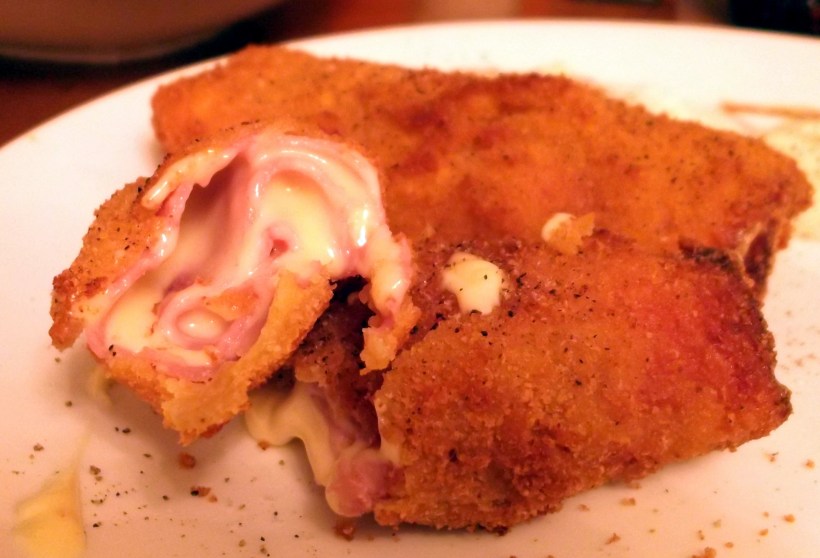
Saint Valentine…don´t you mean San Jacobo?

I have a work project on at the moment which is keeping me busy, so at home we´ve got a week or so of quicker to cook dishes coming up, or slow cooked dishes that I can put in the oven and then forget about for a few hours.

This speedy light lunch or supper is often served as a “child friendly” dish here in Spain. Sometimes you just don´t fancy “fancy” food. Something simple and speedy, and just a little naughty is required.  Deep fried ham and cheese coated in breadcrumbs hits the spot.  And if you serve it up with a dollop of ketchup and a fried egg with a runny yolk – well I won´t tell anyone that you´re not 9 years old!

Per person you´ll need

  • 2 large slices of your favourite ham
  • Enough thin slices of cheese to almost cover the ham (choose one that melts like cheddar, mozzarella etc)
  • A beaten egg plus 2 tablespoons of milk (this is enough for 4 slices of ham)
  • Dried breadcrumbs to coat the ham
  • Hot oil for frying

Place the cheese on the ham and either roll it up or fold it over to make a “sandwich”. Use a toothpick if necessary to keep your San Jacobo closed, but don´t forget to remove before eating…!

Dip the ham in the egg then the breadcrumbs and then repeat. This will give you a good seal so that the cheese doesn´t ooze out as it melts when it cooks, and a super crispy coating.

Get your oil very hot and fry (you can deep or shallow fry – your decision). Remove when browned and serve immediately.

I tried to find out why these little fried ham parcels are called “Saint Jacobs” but no one seems to know.  At least it makes the meal sound a little more gourmet than it actually is.  Make sure you have a cold beer to hand as a medical aid in case you burn your tongue on that lovely melted cheese.

PS. Happy Valentine´s Day to you all – young. old, single or happily with someone, it´s all about love…so go on, go out today and hug someone!

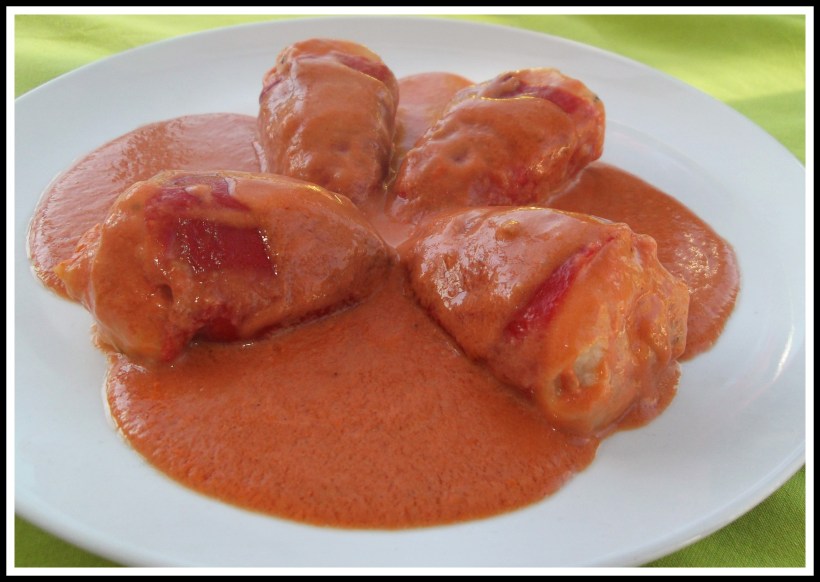
Pimientos del Piquillo Rellenos – Stuffed “Piquillo” Peppers

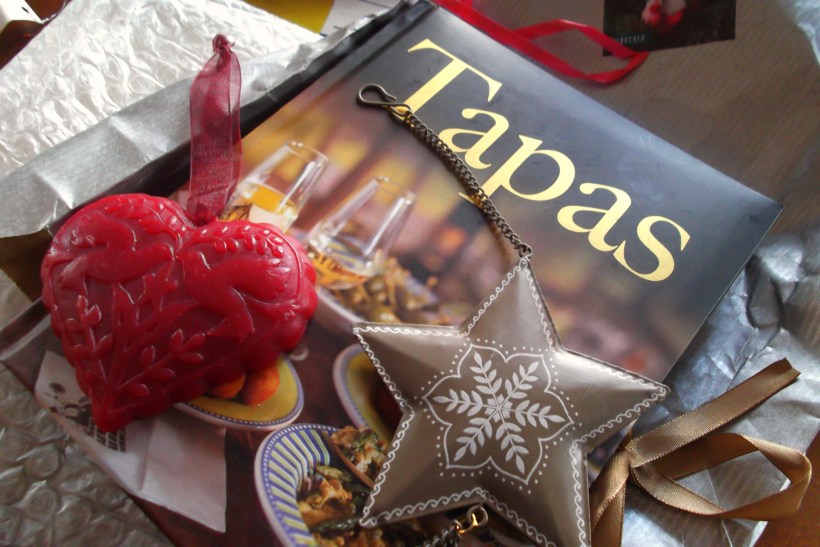
As I was mostly quite a good girl last year, Secret Santa gave me a beautiful cookery book packed full of delicous Tapas recipes. Thanks Giovanna at BlueJellyBeans!

After having a good old read of it, I decided that the first recipe I wanted to make from it was one that I often order in bars or restaurants but had never made at home.  The stuffed piquillo peppers (sweet, red and shaped like a little beak which gives them their name) are sold here in tins or jars. If you can´t get hold of them, I won´t tell anyone if you adapt with full sized peppers or perhaps the tips of some long sweet peppers.  You´ll need to roast and peel them first though.

I adapted the recipe a little to use up some salt cod (bacalao) that I had left, but the filling is up to you.  It could be cream cheese, mashed potato, tuna, vegetables, béchamel sauce….let your imagination go wild!

Ingredients to serve 2 as a starter

  • 4 pimientos del piquillo
  • Half a cup of mashed potato plus half a cup of cooked, flaked bacalao (or a cup of your preferred filling)
  • A tablespoon of chopped parsley
  • Black pepper (no salt with bacalao as it is already very salty)

For the sauce – half a cup of tomato conserva, 2 tablespoons of single cream, 1 tablespoon of tomato purée blended together with an immersion blender and seasoned to taste

Mix the potato, fish and herbs together and season with pepper.  Carefully fill the peppers using a small teaspoon.  Put them into a small frying pan and cover with a lid.  Warm through on a very low heat, turning them over after about 2 minutes.  I didn´t use oil but if your pan is not non stick, then use a very small amount. Now pour the sauce over and warm through very gently.

Place the peppers on your serving plate and cover with the creamy, tomatoey sauce.  Gorgeous, tasty and really rather cheffy looking!

Secret Santa and Stinky Baked Camembert

You know that Christmas really is upon you when you decide to Get Organised.  I put that in capital letters to help motivate me.  And then when you decide to Get Organised, Things Go Horribly Wrong. I think you get the idea.

With my parents arriving shortly I sorted out our spare room for them this morning with my best linen, plenty of coat hangers and a few little tasteful decorations.  The bedspread is a gorgeous mulberry colour and I have some lovely purple Christmas lights that I wanted to drape around. Do you think I could find them? Like heck I could.

Then I decided to remove all my nice table linen from the chest in the spare bedroom so that I don´t have to go disturbing my parents.  What did I find? Well, the linen was where it was meant to be but I also found the remains of an enormous red wine stain on my lovely tablecloth.  It´s not even in the middle where it could have been hidden by plates or candles…damn, that´s now doing its third round in the washing machine.

Finally, the dishwasher made a very rude noise and appeared to have given up on me mid cycle.  I foolishly opened the door to give it a good talking to, and out flooded a sea of dirty and very hot water.  One of those days, you see.

But all was not bad.  In the midst of all this mayhem, sorry…Festive Fun… Big Man came in bearing a beautiful poinsettia for me and a parcel from Secret Santa. I also saw that Nia awarded me the Versatile Blogger Award, so a huge thank you to the lovely Nia.  For my responses to this in a previous post, check this out.

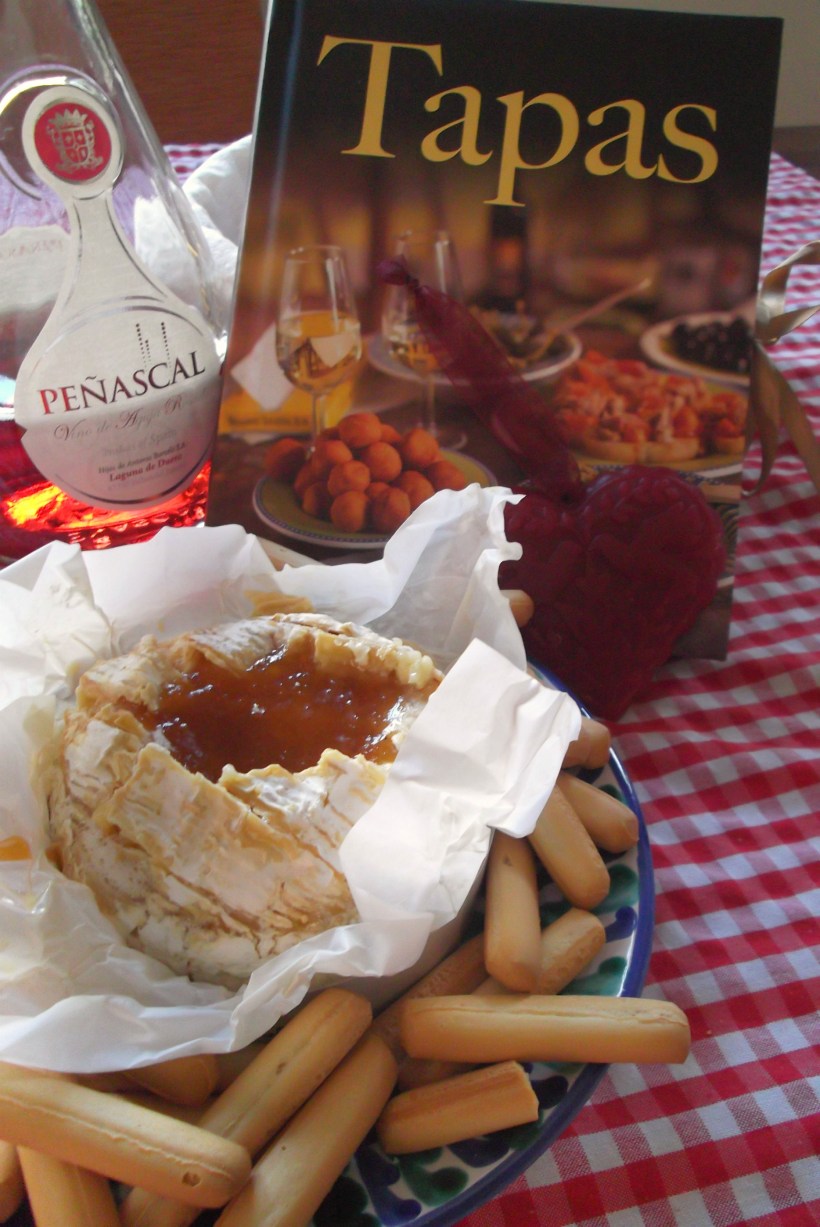
Tandy over at Lavender and Lime kindly organised this fun exchange of gifts, so thanks so much Tandy! My Secret Santa (you can´t hide your details from the Spanish Postal system!) is a lovely Blue Jellybean from Madrid – thanks Jellybean, I´m so pleased with my gifts!  Look at my gorgeous book of Tapas recipes – there are some old favourites in there plus a load of new and inspiring ideas for me to try out next year.  I´ve only managed to get a quick flick through it as I had to wrestle it off Big Man who was deciding what “we” (for “we”, read “me”) should try first.  I also received some gorgeous decorations…which are very special as I ask Christmas visitors to buy me a new decoration for us to keep and remember them by.  So perfect…my first gifts and I am a very, very lucky Chica indeed.

Of course, while things were exploding and flooding all around me, I did have time to make a little bite to eat.  Inspired by some Baked Brie recipes From the Bartolini Kitchens and Rufus´Food and Spirits Guide, I decided to do a simplified version with a Camembert which was so ripe it was about to take a walk all on its own!  I unwrapped the very stinky camembert from its box and separated the plastic paper from the waxed paper which I wrapped around the cheese again.  I put it back into the base of the box and baked for about 20mins in a hot oven.

We ate it with bread sticks, and I put a few spoons of my plum compote in the top of the cheese.  The strong taste of the cheese worked well with the cinnamon and vanilla notes in the plum and we quietly sipped a glass of vino Rosado whilst the dishwasher groaned and breathed its last breath.  Guess what Santa might be buying tomorrow?!

Quick Braised Wild and Oyster Mushrooms

Remember our beautiful walk recently?  We had such a wonderful morning and came home with about half a kilo of wild mushrooms.

Because they were so fresh, I knew they would keep for a day or two, so in the first dish I made, I used half of them and kept things very simple.

We grow oyster mushrooms in our garage. No, don´t worry – there´s no nasty fungus creeping up the walls or anything.  You can buy bales of straw which are impregnated with mushroom spores and then wrapped in black plastic.  You cut slits into the plastic and keep the “alpaca” as these bales are known in the dark and ensure that they are kept damp.  About a week after acquiring your little treasure your first mushrooms will appear.  Just cut and eat.  Then when you´ve harvested as many as you can, you flip the alpaca over and cut a few more slits.  If you keep it going you can be eating your own grown oyster mushrooms for several months.

I took about the same quantity of oyster mushrooms as wild, cut the wild mushrooms into thick slices and tore the oyster mushrooms into strips.

In a deep terracotta dish (or you could use a frying pan) I added three crushed cloves to garlic to the mushrroms together with about 3 good tablespoons of olive oil, some Maldon (or kosher) salt, several good grinds of black pepper and two red chillis (these are optional).  I turned the heat up to high and as soon as the mushrooms began to sizzle I reduced it and covered them to let them sweat and get tender for about 10 minutes.  I then removed the lid and added a small glass of dry white wine and let everything bubble away until the liquid had reduced by half.

We ate this as a starter with plenty of rosé wine and some crusty bread to mop up the delicious juices.


PS. On a totally different subject – since I changed the look of my blog (i.e I changed the theme) my photos don´t seem to appear properly.  They are cut off on the right hand side!  Has anyone come across this and do they know how to resolve it? Thanks for any advice anyone might be able to offer me.