Gazpacho as we know and love it

In Andalucia we don´t eat tomatoes...we drink them!

So, now we come to the Gazpacho most people are familiar with – the iced tomato and vegetable soup famed the world over (well, almost!).

It is served both as a soup here and as a drink.  In most homes it comes in a glass.  In fact there is a wonderful advert for my favourite Spanish beer, Cruzcampo, which celebrates all things Andalúz.  One line in the voice over says something along the lines of “In Andalucía we don´t eat tomatoes, we drink them!” (If you have time to watch it, it´s worth it, even if you don´t understand Spanish, just to see a few snippets of summer life in Andalucía).

Every housewife will give you a slightly different recipe, adding her own little tweaks (more of this, less of that). Some use stale bread, some don´t. I tend not to unless I want to serve it a little thicker as a soup which can then be garnished with little chopped cubes of the same vegetables that go into it.

So, without further ado, here´s how I make mine.

Peeled Tomatoes, Green Pepper, Red Pepper, Onion (optional) Peeled Cucumber, Salt, Water, Olive Oil, White Wine Vinegar.

It´s difficult to give quantities. If my tomatoes are lovely and red, I use less red pepper. Sometimes I don´t use onion.  But the green pepper and the cucumber do give it that distinctive fresh taste, so try not to leave them out.
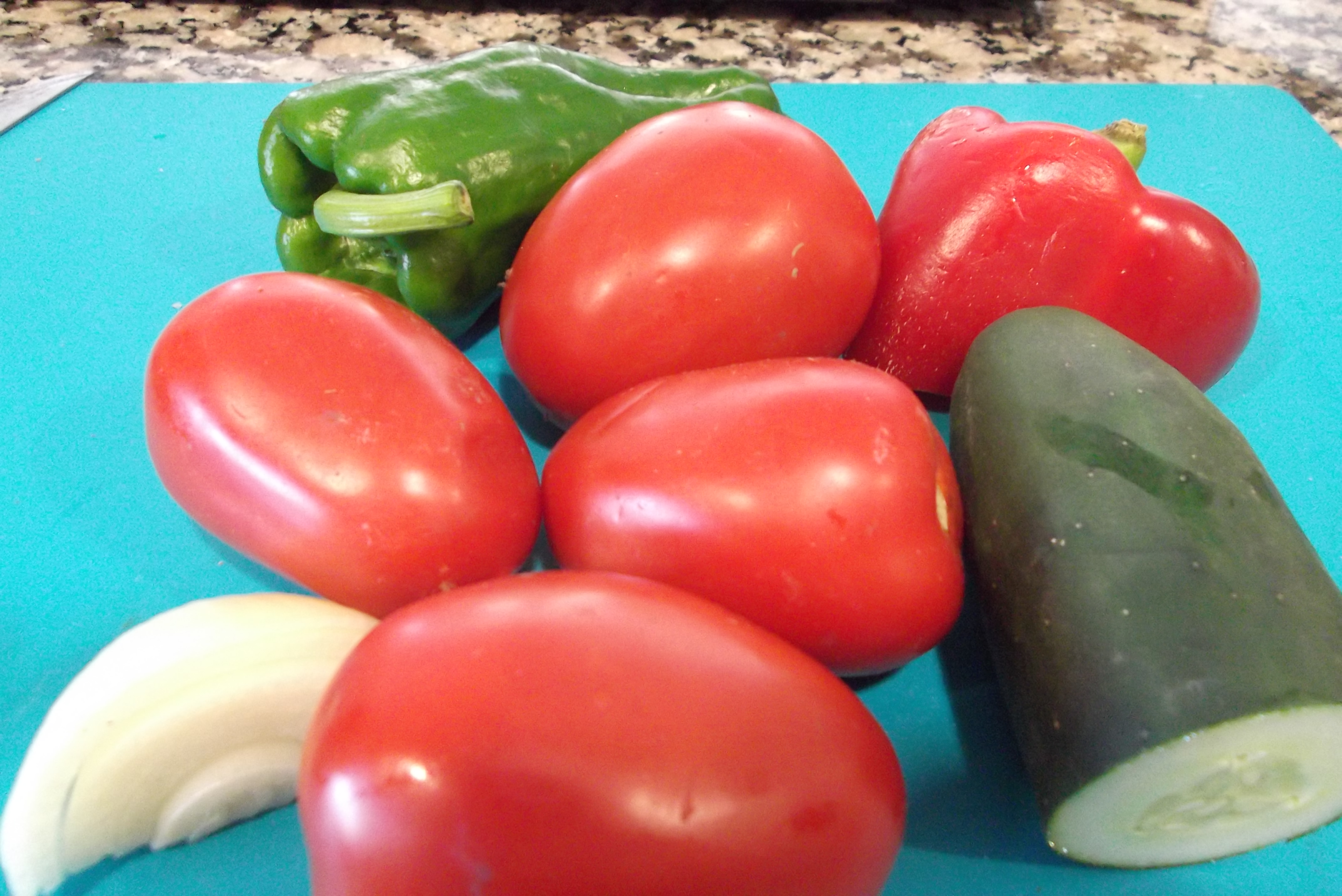
A few simple ingredients

Today I used 4 large plum tomatoes, one thin green pepper, a small amount of red pepper and a small chunk of onion and half a small peeled Spanish cucumber.

Put all the vegetables into a jug or the food processor.

Put into your jug or blender

Start with one level teaspoon of salt, 3 tablespoons of vinegar, 1 tablespoon of olive oil and about half a litre of water.

Add water, vingegar, oil and salt

Now it´s time to start blending.  Add more seasoning, vinegar and water as you go along if you want to.  Today I added another tablespoon of vinegar (you remember they like it “alegre” or lively here right?!) and about another 250ml of water to thin it a little.
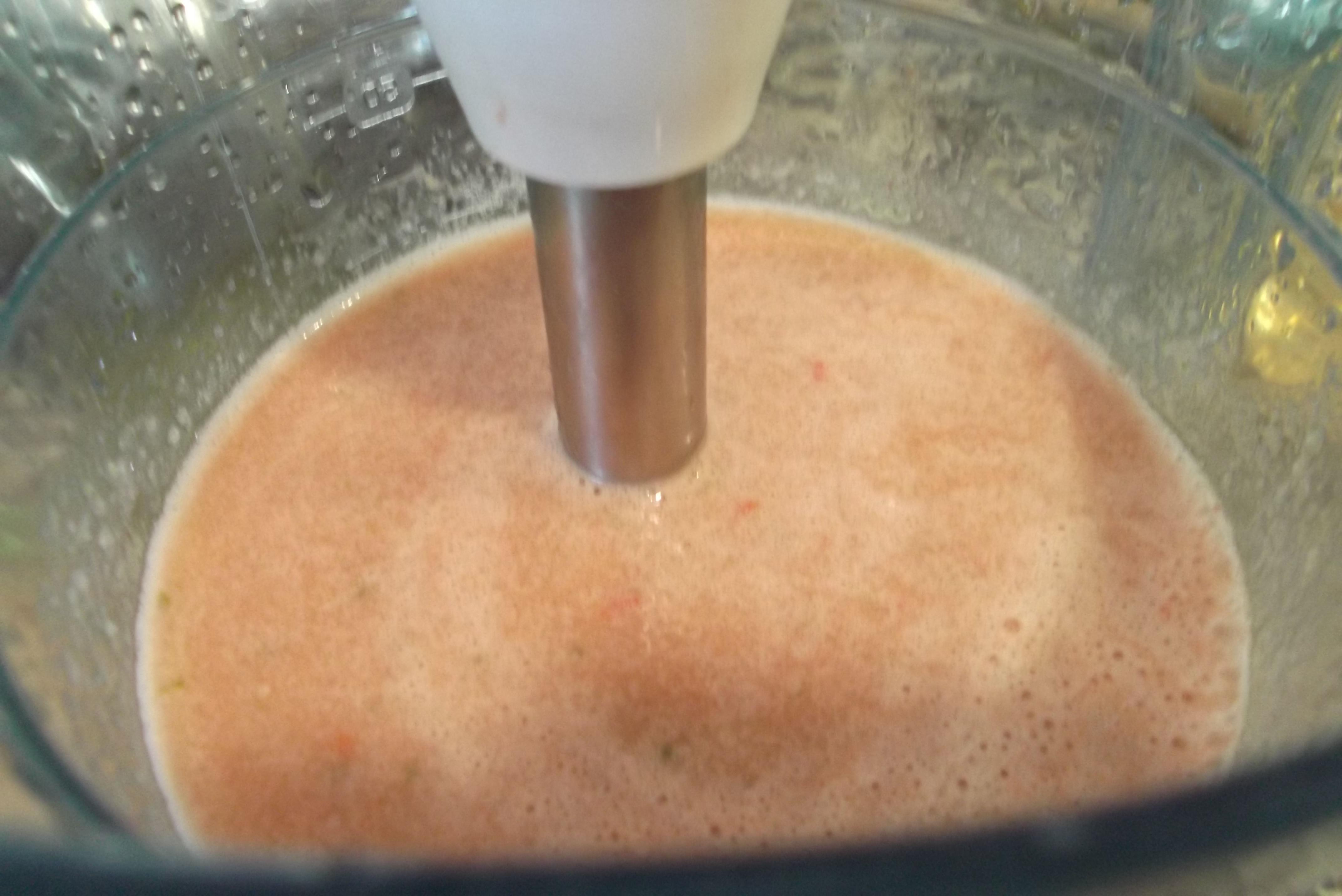
...and blend!

Then chill until you need it.  If you have put onion in it´s fine on the day you made it but I find it starts to “ferment” a little if you have any left over.  Also, while standing in the fridge it may start to separate a little with the water at the bottom and the vegetables on top – just give it a stir before serving and it will be fine.

Big Man gets arty with the vegetables

Now, go and put on a straw hat, a paso doble on the cd and lie back in a shady spot and sip on your ice cold Gazpacho.  Or ga-pacho, as they tend to say here! These Andaluces and their habit of dropping the “s” sound….most confusing!
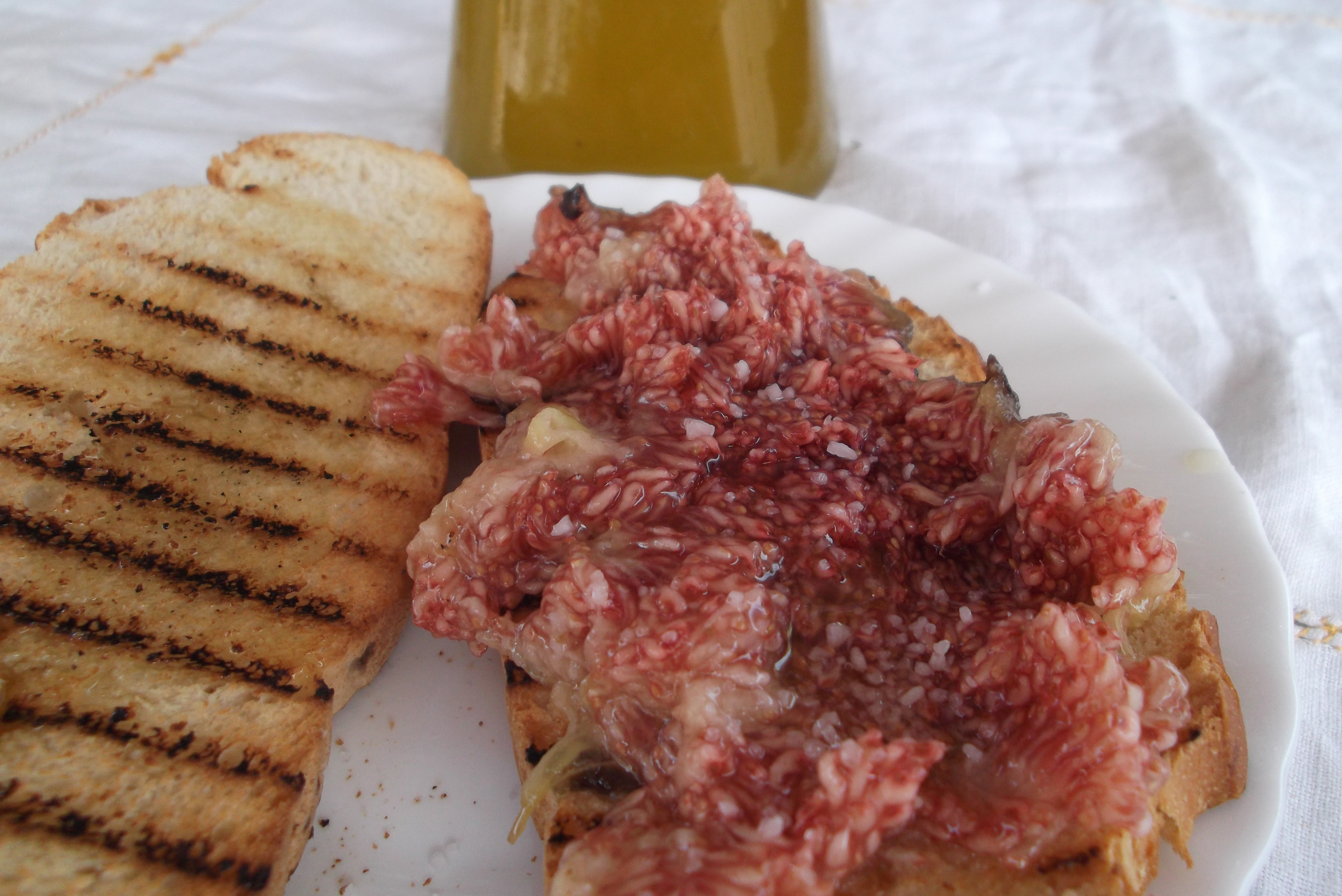
Figs for breakfast

A Kind of Roman Breakfast!

When I was a child, summer holidays were extra special.  We joined the great exodus of Italians “going home” for August.  My father, like many Italians, started his working life in London as a waiter.  Sometimes the restaurant he worked in, usually Italian, shut for the month to allow staff to be with their families.  Other times, it didn´t, which often meant a return from holiday at the start of September with no job for my father.  I´ve only recently thought about this and how difficult and precarious things must have been for the family financially at times and the sacrifices they made for us children.

My family, however, thought it was important for my brother and I to be in Italy with our many cousins and aunties and uncles, spending time being free on the beach, eating meals late at night, talking Italian and sharing that special love that comes from a huge extended family. I thank them for it, I´m sure much of what I experienced in those summer holidays helped make me the person I am today.

We often drove to Italy as putting the car on the overnight train from Calais to Milan was expensive.  Then we faced a further day or two of journey to the very south, the “toe of the boot”, to Calabria. It was an epic journey, but it was made fun with plenty of food, books to read, songs to sing in the car (no DVDs or Playstations then!) and stops along the way to visit more family and friends.

We always stopped in Roma, where my father had spent a portion of his youth and visited Zia Sara and Zio Angelo.  Roma has some wonderful food markets and I have strong memories of someone going out in the morning to buy focaccia for breakfast – that typical flat white bread drizzled with olive oil, coarse salt and sometimes rosemary.  I don´t know if it was a Roman thing, or a family thing, but if we were lucky we also got a bag of juicy figs to go with it.  An extra sprinkle of salt, a little drizzle of olive oil and it was heaven on a piece of bread.  Sweet, salty and peppery all at the same time.

Now I try to recreate it with griddled bread, a sprinkle of coarse sea salt and a drizzle of our very own olive oil.  It´s not quite the same, but the memories make it all the sweeter.

Salmorejo Cordobés – Another kind of gazpacho


Creamy Salmorejo

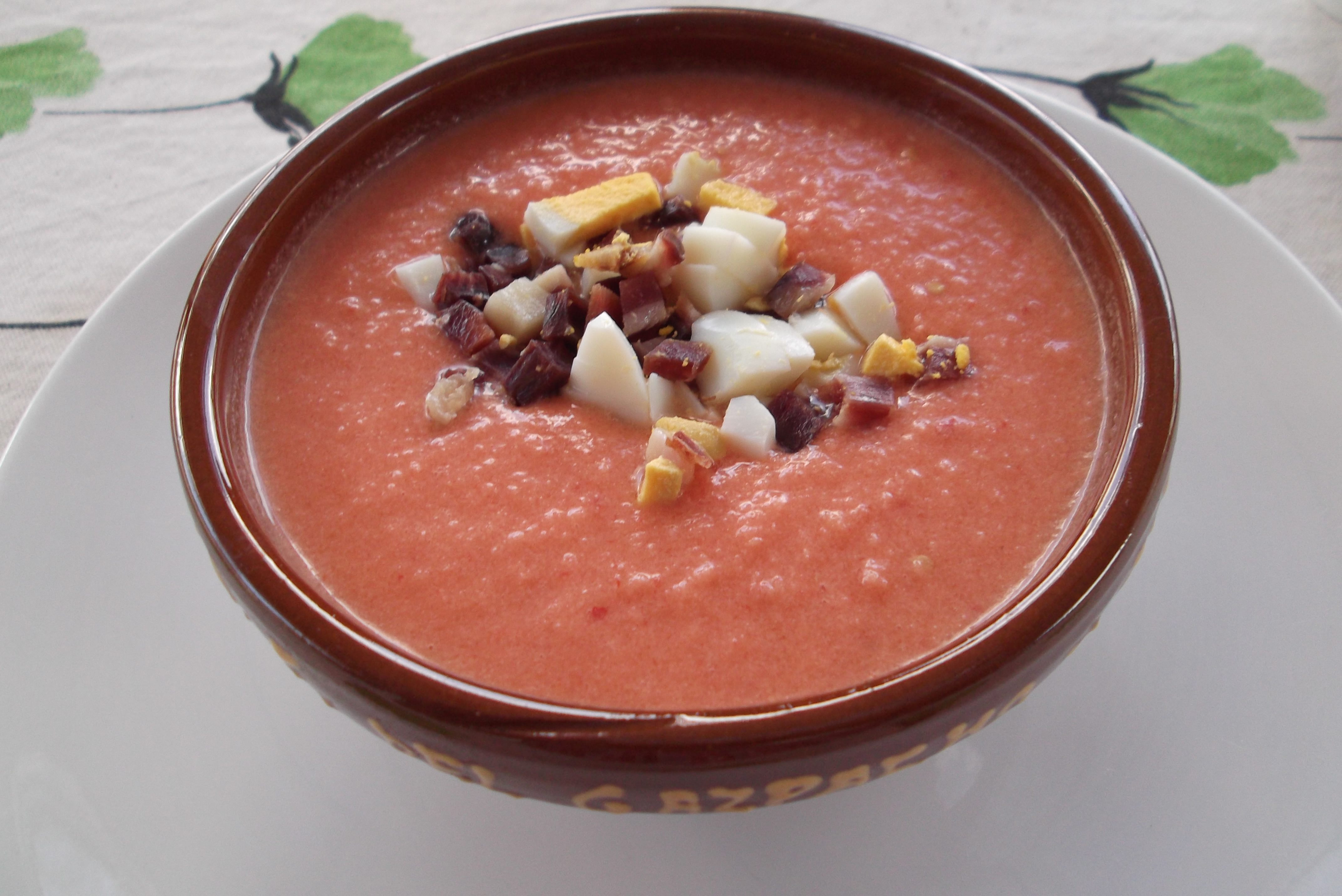
As promised, another version of the famed Andalucían gazpachos.  This one originates from the beautiful city of Córdoba, and is my favourite version of all.  It is different in that it uses very few ingredients but can be served three ways – very thick as a dip with small breadsticks (known as Picos), medium thick garnished with chopped hard boiled egg and jamon or tuna as a chilled soup starter, or diluted with water as a refreshing drink.  So…three dishes in one!

Ingredients for this are few and it will serve from 6 (as tapas) to 2 (as a soup) approximately:

  • 2-3 slices of stale bread without the crust (should be a fairly dense bread rather than sliced white from the supermarket)
  • About 500g of tomato, cored and peeled (I had one HUGE tomato as you can see in the photo) but usually the volume of the tomato once in the jug is a little more than the volume of the breadcrumbs
  • A chunk of red pepper (optional)
  • Half a clove of garlic (don´t recommend you use more or it will overpower the taste the taste of the salmorejo)
  • Vinegar
  • Water
  • Olive oil
  • Salt

Once again, the holy trinity of water, salt and vinegar appear but we´ll use very little water this time.

Dribble a very little amount of water onto the bread which you will have put into a mixing jug, and leave for a minute or two to absorb it.

Start with bread and water

Add the tomato and pepper if you are using it.  The truly authentic recipe doesn´t use red pepper, but after wondering why my salmorejo never looked as red or tasted as sweet as anyone else´s, I was let into the secret of the locals round here – red pepper!

Tomato and Red Pepper

Add your garlic, a teaspoon of salt, a tablespoon of vinegar and at least two tablespoons of olive oil and start to blend with the hand blender.

Add Vinegar and Salt

You need to get this really smooth, almost like a purée.  The more oil you add, the smoother the mixture will be, although I tend to go easy on it just for the sake of my waistline!  Taste every so often and adjust the salt and vinegar to your liking.  Again, it should be “alegre” or lively in flavour.

Start to blend

When you´re done, leave to chill in the fridge for about an hour.

Get it smooth and thick

Traditionally it´s served in a deep earthenware bowl (to maintain the freshness) with chopped hard-boiled egg and jamon on top.  Some people substitute the jamon for tinned tuna but I guess chopped bacon would also be nice.

It´s also great as a dip or sauce served with little breadsticks (like very short grissini) or croutons.

Easy Bread Recipe

Waiting for it to cool...!

Although we live in a fairly isolated hamlet, Bread Man stops by every day except Sunday and we also have another one that comes three times a week.  No problems getting hold of that staple carbohydrate for us.  However, I enjoy making bread, and don´t always fancy the same type every day, so we restrict our deliveries to three times a week and then I make whatever takes our fancy.

This recipe is one that I generally mix up in the bread maker, but cook in the oven.  I do this because I prefer the more rustic shaped loaves I get when I finish them off myself, and because I can cook them with a pan of boiling water at the bottom of the oven to give them a great crust.

Ingredients go into the bread maker in this order

  • 350 ml of water
  • 1 tablespoon of olive oil
  • 4 cups of strong bread flour
  • Half a cup of whole meal flour
  • 1 ½ teaspoons of salt
  • 1 sachet of easy blend yeast

This dough can also be made without a bread maker as I used to use this recipe before I bought one.  I made the bread using the all in one method i.e. put all the ingredients into a bowl and mix by hand until they come together, then knead for at least 15 minutes until the dough starts to become silky, leave to rise in a lightly oiled bowl and covered with a floured tea towel.  Leave to double in size, knock back, knead again, leave to rise and then a final knock back and shape into your loaf then leave to rise a final time.

Whichever method you use, put your loaf onto a floured surface which you will be able to use to slide the bread into the oven and onto a heated baking sheet.  I have some flexible chopping boards which work fantastically for this.

When you have shaped your loaf, cut a few slashes in the top and sprinkle the surface with flour. Heat the oven to 180 degrees Celsius and put your baking tray inside.  Heat a kettle or saucepan of water and when you are ready to cook, place a deep tin at the bottom of the oven and fill with hot water.  Slide your loaf onto the baking tray and cook for about 45 minutes.  Exact timings will depend on your oven, but it should sound hollow when tapped on the bottom.

Remove from the oven and allow to cool – try to resist cutting into it while it´s still hot, or you´ll end up with lots of crumbs and slices of bread with holes in them!

En joy with your favourite toppings – butter, cheese, jam or with a drizzle of olive oil and a sprinkle of salt “al estilo Español”. Or try this http://wp.me/p1hSAl-12 which is My Favourite Spanish Breakfast! (Sorry. am having huge problems inserting links, so it probably doesn´t look pretty, but it links to another recipe)

Braised Salt Cod with Potatoes and Broad Beans/Bacalao con Papas y Habas

"Poor Man´s" Bacalao

Many years ago, in most Mediterranean countries, salt cod (or Bacalao as it´s called here) was poor man´s food.  Whole cod was salted, then dried in the sun to be stored and used when fresh fish was scarce.  Nowadays, it´s become rather a luxury item, in the same way that offal and bizarre cuts of meat have become trendy around the world.

Fortunately for us, Portugal is only about 4 hours´ drive away, so we get to have a few breaks there every so often throughout the year.  Also fortunate for us is the fact that the Portuguese consume huge amounts of Bacalao and sell it at greatly reduced prices.  The supermarkets there will sell you anything from small flakes of cod to flavour soups and stews, to entire cod which they can chop up into portions with special electric saws.  Before it´s rehydrated, the salt cod is tough but bendy, and it would be virtually impossible to cut it up at home. 

On our last visit we stocked up, as it can be frozen, and have enjoyed many meals with our “Souvenir of Portugal”.  Sadly we´re coming to the end of the supply, but on the plus side, this means we´ll have to plan another little break over there.

When you´re anticipating eating salt cod, you have to plan ahead.  De salting it can take anything from 2 to 5 days, depending on the thickness of the fillets you have.  Of course, you can also use fresh cod, in which case you can just go straight ahead and cook.

Put your fillets in a container which will allow them to be completely covered in water.  If it´s hot, put the container in the fridge, but it´s not necessary if the weather is cooler.  Try to change the water at least 3 times a day and test the cod by holding it up to your lips.  Then lick your lips!  You´ll know when it´s ready when it has lost that strong salty taste, although it will always retain a small trace of it. Just be warned, dried salt cod doesn´t smell too great.  Overcome any revulsion you may feel, the finished dish won´t taste anything like it smells right now!

There are many, many ways of preparing salt cod – deep friend in batter, roasted, grilled, poached in sauce.  This is a simple recipe which, once the cod has been desalted, is relatively quick and easy to prepare.

For 2 people you´ll need

  • 2 large salt cod fillets, desalted
  • 2 large potatoes roughly chopped and boiled for 5 minutes
  • A cup of broad beans (use the pods too if they´re  tender) chopped and blanched for a minute or two
  • An onion finely sliced
  • 2 cloves of garlic finely sliced
  • About 3 tablespoons of olive oil
  • Black pepper
  • A lemon

If you´re lucky enough to have a terracotta cooking pot, do use this as it seems to add something to the flavour.  If not, don´t worry, a deep frying pan will work just as well.

Put the oil, garlic, onions, potatoes and beans into the frying pan on a very low heat.  You will now slowly braise these in the olive oil until all the vegetables are tender.  You don´t want to brown them, so keep the heat low and half cover with a lid or some foil.  Stir occasionally to get them all covered in your lovely olive oil. Incidentally, this style of cooking potatoes is known in Spain as “a lo pobre” or poor man´s style. Usually they´re done with strips of green peppers though, and not broad beans.

Once the vegetables are ready, lay your cod fillets on top, skin side up.  Cook them gently for about 3 or 4 minutes (without moving or prodding them) or until the underside is no longer opaque.

Flip the fillets over, they´ll now only need a minute or two to finish cooking.

Remove from the heat and serve with plenty of lemon to squeeze over.  I also like an extra drizzle of “raw” olive oil, but if you´re watching the waistline (as I really should be doing) then leave this out.  You probably won´t need to add any salt, but taste it first and decide for yourself. ¡Buen Provecho!