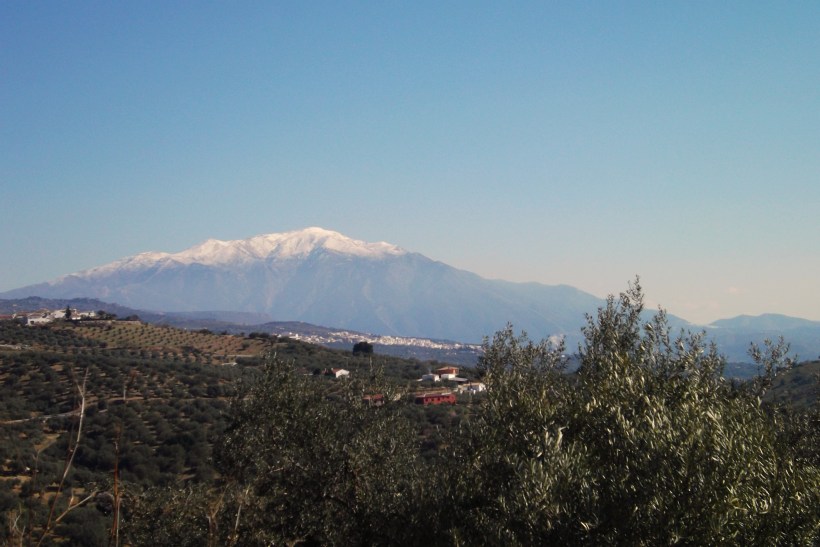
Olive Crushing Time

Yes, after what seems to be a very long wait, we crushed our olives this weekend. It was actually 14 months since we last crushed as we had very little rain in the autumn of 2011  (as opposed to lots in the autumn of 2010) so we left the olives on the trees for as long as possible to let them fatten up.  Of course, you lose some, but we like that it acts as fertiliser for the soil in our little olive grove.  We´d rather have a few litres less oil but of a higher quality.

So, first you pick by knocking the olives to the ground into the waiting nets.  I was excused this backbreaking duty but Big Man asked me to tell you all that it´s hard, hard work on the arms and your back.  I do feel sorry for him, his poor muscles are still aching.

Load the olives into trailers and marvel at the variety of beautiful colours.

Now head off to a small local mill where they still stone crush (as opposed to using stainless steel crushers) and cold press (not heating to remove impurities) and don´t filter.  We want the pure stuff in our house, and our olives have only been “treated” with rainwater and chicken poo (ok, we won´t  dwell too much on that).

Tip them into the hopper.
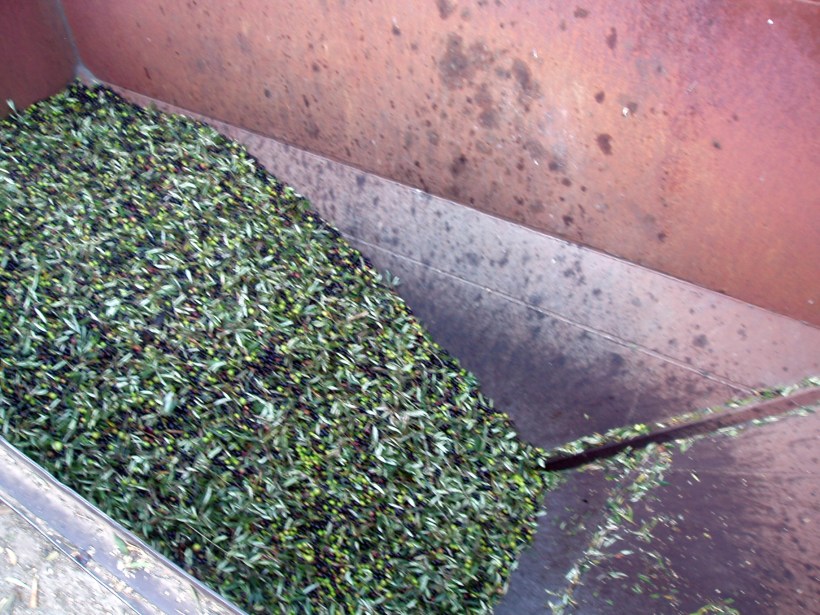
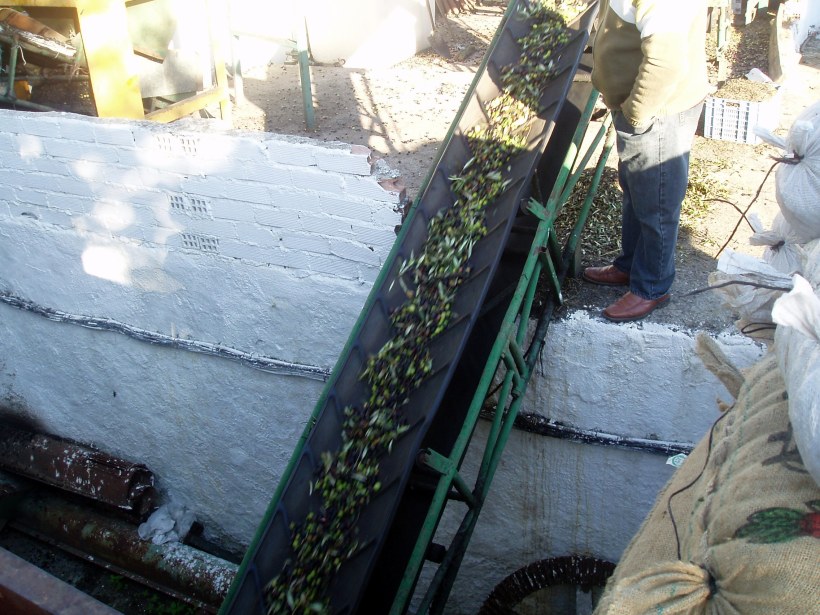
Then up the ramp they travel and into the blower which removes leaves and twigs. They are weighed after this when “clean”.  We had 964kg this year, about 20kg more than last year which surprised us.
Now the fun bit – into the press where they are squashed between the enormous old stones. The smell at this point inside the mill is heady and intoxicating – freshly crushed olives coming at you from all directions.  It´s enough to make you sneeze.

Then into a tank for a little rest and finally out and into your waiting containers.  This year we got an amazing 235 litres of liquid gold which we split with the couple who help us pick them – 55 litres more than last year and an amazingly high ratio of oil to olives (a yield of about 24% when most people round here are currently getting 18 or 19%). So, it was worth the wait, and a good year for our olives.

Much of it will be consumed at home – we use it for everything in the kitchen.  Some will be given away, and some will be carried over for another year when the yield is lower.

Of course, the most important thing, what did it taste like? Amazing!  It´s still cloudy and green and tastes peppery and fresh with no acidity.  This is how I like it best.  Over the next few months the oil will gradually settle and turn a golden colour and take on a softer taste.  I´d love to send you all a little sample to dip some fresh crusty bread into, but if you´re ever round these parts, we´ll make sure to give you a taste.

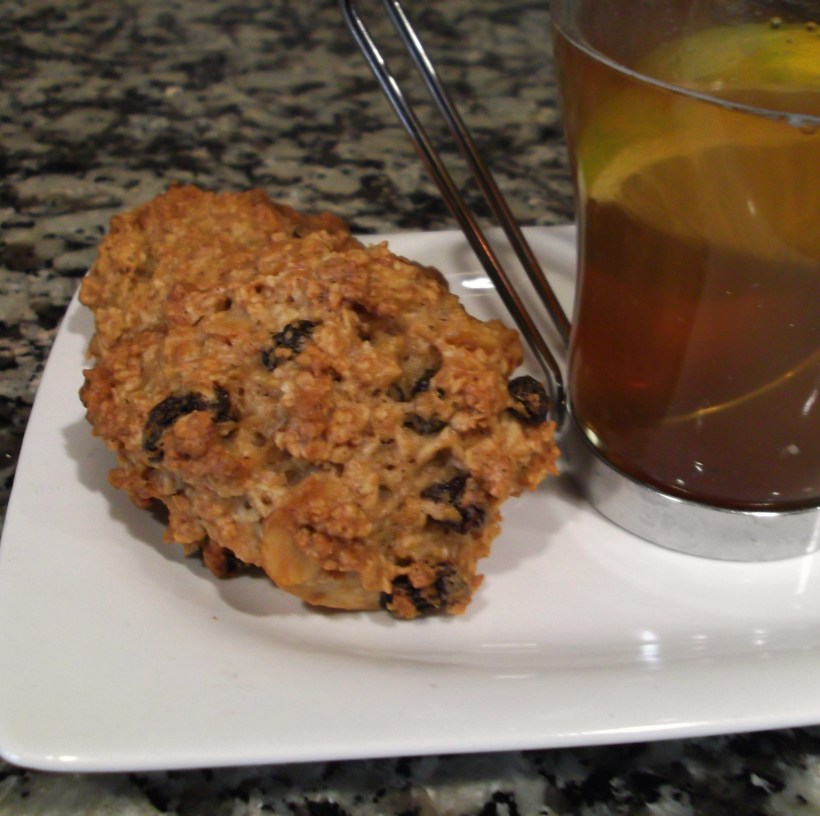
Orange, Almond and Raisin Cookies

I´m not a very sweet toothed person, but as soon as I decide to try and eat sensibly for a while to shift a couple of kilos, I find myself craving things I wouldn´t normally eat. Like cookies.

I came across a lovely recipe over at IamSimplyTia which I thought we be a perfect, not so naughty treat.  Of course, as soon as I set about making the cookies, I needed to adapt as I was short of some of the ingredients.

Here´s my adapted version for a guilt free but flavour packed snack.

Ingredients (makes 18 large cookies)

  • 2 mashed ripe bananas
  • ¼ cup of natural yogurt
  • ½ teaspoon of almond essence
  • ¾ cup of white sugar
  • 2 tablespoons of maple syrup
  • ½ teaspoon of salt
  • ½ teaspoon of ground cinnamon

Put all of the above ingredients into a large bowl and beat until well blended.

Now add

  • ¾ cup of self raising flour
  • 1 ½ cups of oats
  • ½ cup of raisins
  • ¼ cup of almond slices
  • the grated rind of half a large orange

Mix well with a wooden spoon and place the mixture in the fridge for 30 minutes. Meanwhile heat the oven to 180ºC and line 2 baking trays with ovenproof or silicon paper.

Place heaped tablespoons of the mixture on the baking trays and bake for about 25 minutes until lightly browned on top.  Leave to cool for fruity, nutty, crispy on the outside, chewy on the inside cookies.  Thanks for the inspiration Tia!

Becuase of the changes I made these are best eaten within 48 hours – but I don´t think that will be a problem, will it?!

Up the Mountain Bouillabaisse with Orange and Fennel

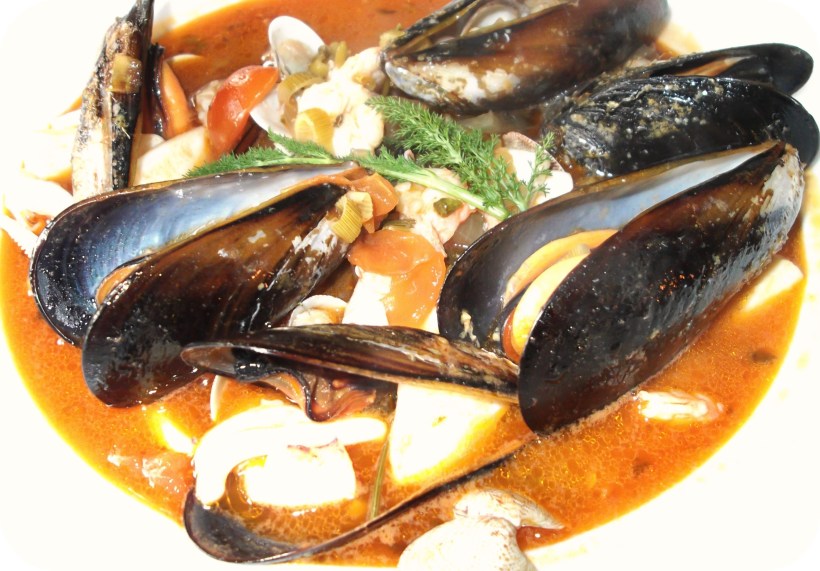
One of my very dearest friends, Donna came to stay in the summer, and she´s a chick who enjoys cooking and eating, even though she´s a tiny little thing who looks like she eats like a sparrow! On her first night I wanted to prepare something special for us all and one of the first questions she asked as I picked her up at the airport was “What are we eating tonight?”. When I told her I was making a fish soup I could see her little face fall, she looked so disappointed. I don´t know what she was expecting, but when I served a similar version to this recipe, she brightened up  considerably and then gave me a good telling off for giving such a delicious meal such a dull name.

So that´s why it now has a “proper” name, and I have to agree, it does sound so much nicer than “Fish Soup”.  Mind you, a lot of things sound so much more exciting when you say them in French.

For two hungry people as a main course I used a mixture of mussels (500g), prawns (250g), clams (250g) and a large squid cleaned and chopped into bite sized chunks.

You´ll also need an orange, half a bulb of fennel (however I used wild fennel), a pinch of saffron stamens or turmeric, a cup of chopped tomato, four fat cloves of garlic peeled and thinly sliced, a medium onion peeled, halved and thinly sliced, the juice and zest of a medium orange, a bay leaf, a dried chili (optional), a glass of white wine (also optional but if you prefer to cook without it you may need a little extra liquid) and some olive oil for frying.

Of course, this is not an authentic version of the Provençal fish stew which is served with a rouille, but my adaptation.

Start by peeling the prawns and covering the shells with about 600 ml of water.  Then add the bay leaf and bringing to a boil. Turn down to a simmer for about 10 minutes and then strain, reserving the stock.

Clean your mussels well and rinse the clams two or three times to remove any grit.

Now lightly fry the onion and garlic in some olive oil until soft and transparent, and add the finely sliced fennel and cook for a few minutes more.  Add the tomato and allow it to cook down for a few minutes. Now add the chili if using, season with a little salt and and few good grinds of fresh black pepper and the juice of the orange plus the grated orange zest, the fish stock and finally the wine.  Simmer for a further 5 minutes then begin to add the seafood and shellfish.  Start with the thickest first (in my case it was the squid) then after about 2 minutes when the squid had turned white I added the clams and mussels and covered with a lid.  When they had opened I added the peeled prawns which were quick to cook, just a minute or two.

Finally, remove from the heat, taste and adjust seasoning and serve garnished with fennel tops, some grated orange zest and with plenty of crusty bread for those lovely juices.

For another, slightly different version with vegetables and fideo, take a look at this recipe.

Braised Goat (or Lamb) with Squash and Red Wine

Finally we have had a small drop in temperatures and it looks as though rain may well be a real possibility in the next few days.  Me, a Chica who hates the cold and damp, breathing a sigh of relief at the thought of rain which is so badly needed for the olives, the fruit trees, the rivers.  What a long way I have come on my Andalucían journey!

Winter weather means warming winter food.  After having friends over recently, I was left with half a kilo of chopped goat which had not been cooked so I froze it for a rainy day. That rainy day came round and to make a change from the simple local way of cooking it with garlic, chilli, bay leaves, peppercorns and white wine I decided to make a stove top casserole.

We are still being supplied with squash by Big Man´s cousin and I wanted to use some of this too.  I also felt that if I “disguised” the squash slightly with lots of warming flavours, I might be able to persuade Big Man to enjoy it as much as me.  I think it worked, he ate it with gusto and even had seconds.  No leftovers for the dogs or to serve as tapas the next day with this dish!

Ingredients (to serve 2 if the meat has bones, 4 if it is boneless)

  • 500g chopped lamb or goat (use a cheap cut like neck which is full of flavour)
  • 500 squash or pumpkin, peeled and cut into 2cm cubes
  • About 5 fat cloves of garlic, peeled and thinly sliced
  • 1 medium onion thinly sliced
  • ½ litre of lamb stock or use chicken stock plus a teaspoon of marmite or a beef stock cube
  • 2 glasses of red wine (or replace with stock if you prefer not to cook with alcohol)
  • 2 tsp of tomato purée
  • Salt and pepper
  • A sprig of rosemary, leaves removed and finely chopped
  • Olive oil for frying
  • About half a cup of flour
  • 1 teaspoon of mustard powder
  • 1 dried red chili crumbled (optional)

Mix the mustard powder with the flour and season and toss the cubs of meat in it. Fry the meat until slightly browned and remove from pan.

Add more oil if necessary and gently fry the onions, garlic and squash until the onion is soft and transparent.

Add the meat to the pan, pour over the stock and wine, and add the tomato purée, rosemary and chili (if using). Let it bubble for about 5 minutes then reduce the heat and cover.  Cook gently for about an hour and half until the meat is tender and the sauce thickened. Taste and adjust seasoning.

We ate this with some fried polenta, but it would also be great with rice or mashed potato and a glass of that lovely red wine you opened to put into the cooking sauce.

Boiled Gammon and Parsley Sauce

Some dishes, to me, are so typically English and bring back memories of food from my past.  Gammon is cured (usually wet cured in a salt brine) pork, from the leg.  It can be bought smoked, as an entire joint or as steaks.  It just can´t be bought in Spain, so I will have to work on a way to make my own.

Meanwhile, I picked up a few small joints of gammon on a pre Christmas shopping trip to the strange place that is Gibraltar.  A couple of hours´ drive from Malaga, it is a British Overseas Territory on the southern Iberian Peninsula.  I have to confess it´s not my favourite place as it seems to contain all that is bad about Britain packed into a very small area…but I don´t wish to offend and I am sure there is much more to it than I have ever seen on two brief shopping trips.

A trip to Gib, as it´s known to the Brits, allows us ex pats to stock up on things (particularly food) that we miss and either can´t get hold of or can´t be transported over easily by our visitors.  So, amongst many other food goodies, gammon it was.  I thought that Big Man would enjoy it as he loves pork and ham, but I knew it would be a new and interesting taste for him.

Gammon can be roasted or boiled and served hot or cold.  I decided to do a hot dish, boiled gammon with parsley sauce, which is a typical dish of comfort food from my homeland.

Ingredients (serves 4)

  • One small brined gammon (about 750g)
  • About 6 carrots peeled and chopped into large pieces
  • 2 medium onions peeled and halved
  • 2 bay leaves
  • 4 cloves
  • Water to cover
  • 6-8 medium potatoes boiled in their skins and peeled and halved to serve

For the parsely sauce you will need half a litre of home made béchamel sauce (infuse the parsley stalks in your milk before making it) and two tablespoons of parsley stirred in at the end. For extra flavour, use half milk and half stock (from boiling your gammon).

Simply put the gammon, onion, carrots, bay leaves and cloves into a deep saucepan and cover with water.  Don´t use salt – it will be fairly salty from the brine. Bring to the boil, skim off any scum that rises to the surface, cover and simmer gently for about an hour until the gammon is tender.

When the gammon is cooked, leave it to sit in the hot stock while you cook your potatoes and make the parsley sauce.  I used one cup each of milk and stock (which should both be cooled) , 2 tablespoons of plain flour, 1 tablespoon of oil and whisked everything together over a low heat until it started to boil and thicken.  This is my cheat´s way of making white sauce.  Finally I stirred in my chopped parsley and let it sit for a few minutes.

Remove the gammon from the stock and slice or chop (it will not slice easily when it´s warm, but I don´t mind chunks!).  I put some runner beans into the stock with the carrots and onions, bought them up to the boil and then strained the vegetables, reserving the stock for soup. Serve with the boiled, peeled potatoes and vegetables and enjoy the lovely steamy smells of gammon and parsley that will float up and fill you with a sense of comfort.

Red Shoes and Ruins

The best things in life are free, so they say.  On the whole I´m inclined to agree.  Love, friendship, laughter…oh, and blog awards.  They are all marvellous aren´t they?  Linda from Savoring Every Bite very kindly passed The (Red) Educational Shoe award onto me.

I can fully understand why she was awarded it in the first place, do pop on over to learn so much about Italian family, culture, food and generally about making every little moment in life into a special memory. When Linda passed the award on, she mentioned some of the “travels” she had been on via my blog, so today we´re going travelling. To just outside the beautiful City of Cordoba to be precise.  But before you pack your toothbrush I want to do the time honoured thing and pass this award on to a new blogging find.

JPWaldron has a fantastic blog which he calls “A free guide to foraging for all”.  See, I told you the best things in life are free.  If you live in the country, or aspire to or even just dream about it, I promise you´ll love what you find over there. And you´ll certainly learn a lot.  I´m sure he won´t mind being sent a red high heeled shoe…I think it´s a metaphorical shoe after all!

So, Cordoba.  I have a very soft spot for this beautiful city as Big Man and I had our first “date” there way back in September 2005.  Can you date when you´re a grown up? I like to think so.  Anyway, we go back there as often as we can and spent a fantastic weekend there at the end of January to celebrate my birthday.  I´ll show you some photos of this amazing city another day.

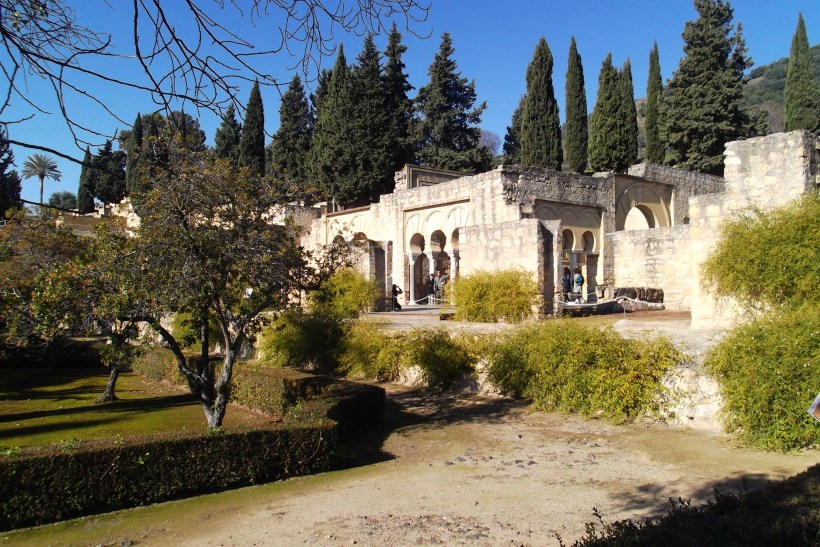
Today we´re heading about 10km out of town to an amazing archaeological site, The Medina Azahara or Madinat al-Zahra.  We´ve visited before, some 5 years ago and since our first visit an amazing vistor´s centre has been built and much more of this amazing abandoned city uncovered and restored.  Unbelievably, it´s free to go in, if you are ever lucky enough to be in the area, make it a priority.  It´s an incredible experience that you´ll always remember.

The city is considered to be one of the most important mediaeval archaeological sites in Spain. It covers 112 hectares and was the political and administrative capital of Al-Andalus (Muslim Spain) for a large part of the 10th Century.

There is something very special about this place, it never feels crowded and it´s easy to imagine the Caliph and his city doing business, receiving guests from around the world, and the thousands of servants keeping the city running.

There were several mosques, one of which can be seen clearly.

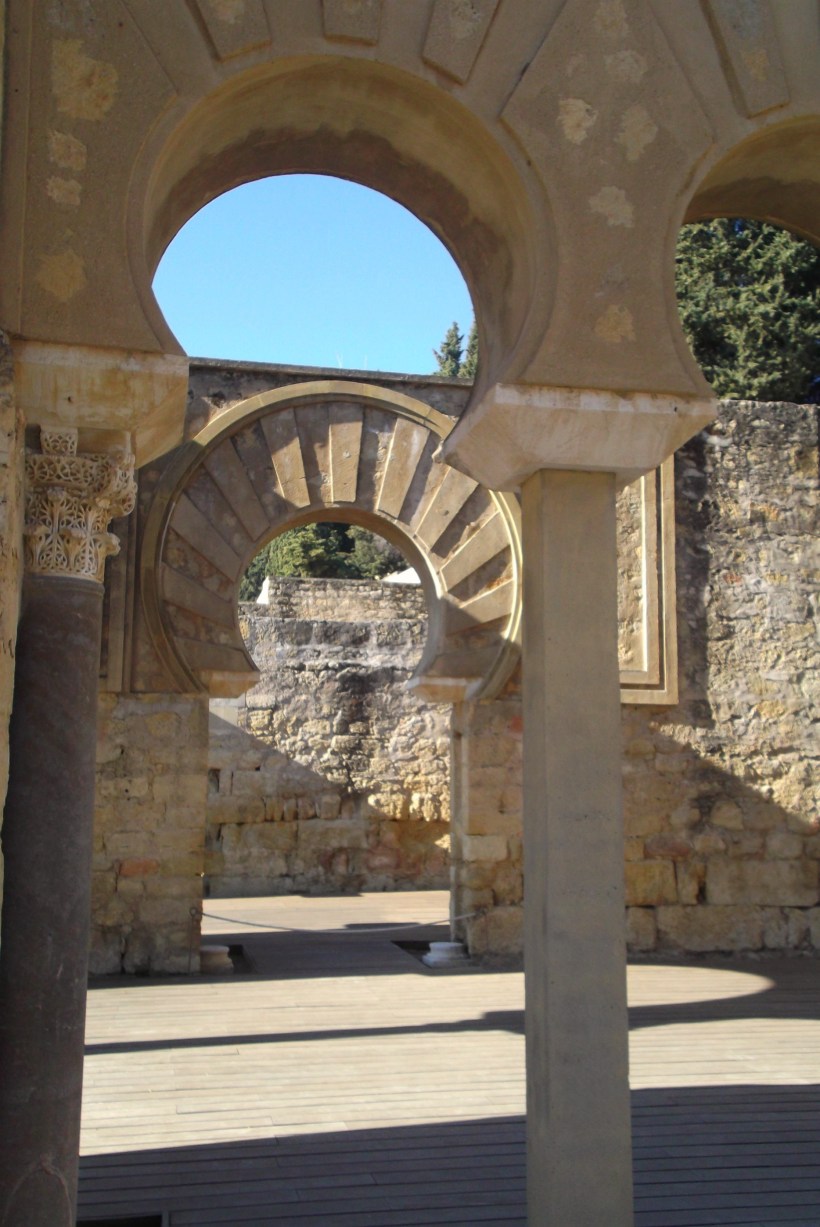
Stunning archways, this one they believe was the Prime Minister´s house.

Beautiful gardens…you can almost hear the trickle of water which flowed around the city.

So, do linger a while and soak up the peaceful atmosphere, and before you leave, take a final look back over the site and the city of Cordoba in the distance.

Hasta luego, come back soon…

Ginger Spiced Carrot and Split Pea Soup

Winter and soups go together. As do winter and colds and I´ve got one right now. Fortunately it´s not too bad, as I´m still cooking and enjoying my food. Shame really, as a day or two of fasting is probably no bad thing for me.

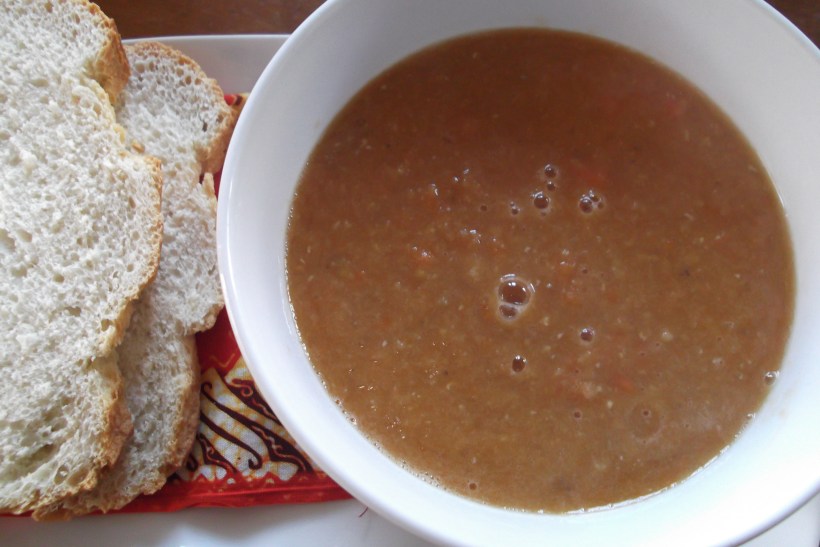
I fancied soup this morning but didn´t want to wait for hours for stock to simmer. Now that I´ve realised I can buy split yellow peas in our supermarket, I don´t even have to wait overnight for other legumes to soak before cooking.  They´re also super healthy, packed with protein and fibre and low in fat.  This means they fill you up without filling you out.

As my sense of taste and smell is a little dulled at the moment due to my cold, I decided to make a warming spicy soup to try and wake those senses up a little.

To serve 4 as a main course

  • 1 cup of split yellow peas (or you could use lentils) rinsed
  • 5 cups of water
  • 3 medium carrots, peeled and finely diced
  • 1 cup of minced tomatoes or conserva
  • 1 heaped tablespoon of tomato purée
  • 1 teaspoon of ground cumin
  • ½ teaspoon of chili powder
  • 1 piece of fresh ginger (about the size of your thumb) peeled and grated or use a teaspoon of dried ginger
  • 3 cloves of crushed garlic
  • Salt to taste (but do not add until the soup is cooked)

Put all the ingredients into a large saucepan, bring to the boil then cover and reduce to a simmer for about 30 minutes until the split peas and carrots are cooked.  Season to taste and either eat as is or purée with an immersion stick blender or in your regular blender.  It´s good with a dollop of creamy natural yogurt but I prefer a drizzle of olive oil, a squeeze of lemon juice and a sprinkle of extra cumin.  Serve piping hot, sitting by the fire.

Snow and Almonds

Driving home from an appointment yesterday, everything looked so beautiful  We had some amazing views of La Maroma, the highest peak in the province of Malaga. No skiing there, you have to go to the Sierra Nevada for that, but it certainly looks beautiful when it is dusted with snow.

The day was bright and sunny, and luckily I had my camera with me to take a few snaps.

Where we had stopped to take the photos, we had the mountain to our right, and to our left beautiful almond tress in blossom. It´s a funny old winter here.