A Cake To Take Visiting – Orange, Almond and Raisin Cake

Wrapped Up and Ready to Travel!

Customs vary immensely the world over, but some are the same regardless of where you are. When visiting friends for a meal, a little gift is customary. If it´s home made, so much the better, especially if it´s edible.

My mum passed a recipe on to me when I was last in London. She thought it would appeal because the finished cake is not too sweet (she knows I don´t have a hugely sweet tooth), uses oil instead of butter (so much easier here where butter is rarely used) and contains ingredients which are local to Andalucía – oranges, almonds and raisins. Perfect, all I needed was a chance to make it.

Easter weekend was a mix of quiet and hectic for us. Saturday found us heading across the “frontier” from Málaga province to Granada, to a remote area to join some friends in their Cortijo for lunch and a walk.  More of the walk another day as I got rather carried away taking photos.

The cake was made the night before and was a huge hit. It´s very moist and is a cross between a cake and a dessert and would also be perfect served with whipped cream, crème fraîche or ice cream.

Ingredients

  • 150g raisins soaked in 50ml of amaretto (warm the amaretto and leave the raisins in soak for at least an hour) If you don´t want to use alchohol, a delicate tea would also be perfect for soaking.
  • 2 oranges (as bitter as you can find)
  • 4 eggs
  • 180g caster sugar
  • 150g ground almonds (I left mine quite coarse, it´s up to you how fine you grind them, this cake the cake a nutty texture and a rougher look on the top)
  • 150g self raising flour (or plain flour with 2 tsp baking powder)
  • 50ml olive oil
  • 2 tsp icing sugar

Preheat oven to 180ºC/350ºF/Gas 4 and line a 24cm springform tin.

Place the whole oranges in a saucepan of water and ensure they are covered. Bring to the boil and simmer for about 15 minutes or until tender. Blitz 1½ oranges until finely chopped, reserve.  Squeeze the juice from the remaining half orange then set the juice aside.

Whisk the eggs until light and fluffy then whisk in the sugar.  Fold in the almonds and olive oil then sieve in the flour then fold in.  Gently stir in the pulped oranges and half the raisins and pour the mixture into the tin, spooning the remaining raisins over the top of the cake.

Bake for about 60 minutes until a skewer inserted in the middle of the cake comes out clean.

Remove the cake from the oven but keep in the tin. Place the juice of half the orange and the icing sugar in a pan and dissolve the sugar.  Pierce the cake all over with a skewer and pour the orange syrup over.  Leave in the tin to cool then remove and enjoy.

PS. I think this would also be great made with polenta!

Baked Cherry Cheesecake

A slightly sad looking final slice of cheesecake....

I am sure we all have “go to” recipes for times when we are in a hurry, or just want to return to an old favourite.  I adore baked cheesecake and have been using an adapted version of a BBC Good Food one for several years now.
When I found out that I had been asked to make a dessert for lunch with friends, I got out my cream cheese and eggs and quickly got to work. Apologies for the photo, I forgot to snap it in all its glory before we attacked it!

Ingredients

  • 12 crushed digestive biscuits (graham crackers)
  • 50g melted butter
  • 600g cream cheese
  • 2 level tablespoons of flour
  • 175g sugar
  • 3 eggs
  • 150ml whipping cream (or heavy cream)
  • 1 teaspoon vanilla essence
  • 1 jar of cherry jam plus I used some of my cherries in brandy (drained)
  • 1 sachet of flavourless gelatine or vegetarian substitute

Heat the oven to 180º C or gas mark 4.  Mix the crushed biscuits with the butter and press into a springform tin. Bake for 10 minutes and leave to cool.

Beat the cream cheese, flour, sugar and eggs together then add the cream and vanilla essence and then any fruit filling (not the jam).  Blend gently, pour into the tin and bake for 45 minutes.  It will still be slightly wobbly in the centre but leave to cool out of the oven.  It will continue to cook slightly.  I have to confess mine always cracks, I don´t know if there is a way around this – I´d be happy to learn!

For the topping you can either just cover with fruit or make a jelly fruit topping.  I did this by adding a sachet of powdered gelatine to about 4 tablespoons of cold water.  In a small pan warm the jam until it starts to bubble then pour it over the gelatine and mix well until all the granules have dissolved.  Leave it to cool down until almost cold and starting to set then pour over the cheesecake (still in the tin).  Refrigerate for at least 2 hours and remove from the fridge an hour before serving to reach room temperature.

Orange Marmalade

February is traditionally marmalade making month.  I´m a little behind this year, and hope this recipe doesn´t reach those of you, who want to give it a try, too late.

First of all though, I´d like to say a big thank you to two fellow bloggers who very kindly nominated me for awards.  Waterfalls and Caribous chronicles the adventures of a young couple travelling the world.  They´re currently in South Korea, and if, like me, you have never been to a Love Motel (it´s not rude, I promise!), click here. Thanks guys for the Versatile Blogger Award, and here´s my previous post on that if you want to check it out.

The lovely Alli over at Pease Pudding very kindly awarded me the Liebster Blog Award. If you haven´t visited this great blog yet, do pop over, it´s written by a lass from Northern England now living in beautiful New Zealand. Thanks Alli, and if you missed it, here´s where I share the love.

Last year I posted a more traditional way of making it, this year I´m using a slightly quicker method (no hand chopping and a quicker set), although marmalade making from scratch is a fairly lengthy, but rewarding process.

For the other method, click here.

Ingredients

  • For every kilo (or just over) of oranges, two kilos of sugar and 1.25 litres of water and one lemon
  • The biggest, heavy based, saucepan you have
  • A wooden spoon
  • A couple of large jugs or bowls and a fine sieve
  • About 6 regular sized jams jars and lids per kilo of oranges

Start by washing and drying the oranges, and lemons and putting them in the biggest saucepan you have and covering them with water.  You will now bring to the boil and cook gently until softened.  Unless they are tightly packed they will probably float, so just turn them around in the water every so often. This will take about an hour and they are ready when you can easily pierce them with a skewer.

Remove the oranges from the liquid (don´t discard it) and when they are cool enough to handle, cut them in half and scoop out the flesh, pips and pith and place into the reserved liquid.  You will also probably need to cuts the skins into quarters and with a knife or spoon, scrape off as much of the white pith which still clings to it.  This is important as it will give you that precious pectin which will make your jam set. Put the two halves of each lemon in with the pulp.

Now bring the liquid with all the pulp and pith to a boil and using a potato masher, press down on the pulp as it boils. Leave it boiling gently for about 10 minutes and press the pulp a couple of times during this period.

As this is boiling you can process the skin – either by hand into fine shreds, or in a food processor into tiny chunks.

Now strain the liquid from the pulp and keep pressing as you pass it through the sieve to get any last drops of pectin out.

Put the liquid back into the pot, add the sugar and the chopped orange skin and cook gently until the sugar has dissolved.  Now bring up to a quicker boil until it reaches setting point.  You´ll find this happens quite quickly with this method, and if you like a thicker set marmalade, cook for a few minutes longer.  Personally I like a softer texture – the choice is yours.

Once it is ready, leave to cool slightly for about 10-15 minutes and to allow the shreds to settle, then pour into sterilised jars, seal and wait for them to cool before labeling (if you do this). Now enjoy the wonderful smells of oranges which will still fill your house and cut yourself a lovely slice of bread to enjoy the fruits of your labours.

Spree has also made the most of the lovely oranges around at this time of year. Check out her beautiful rhubarb and orange jam.

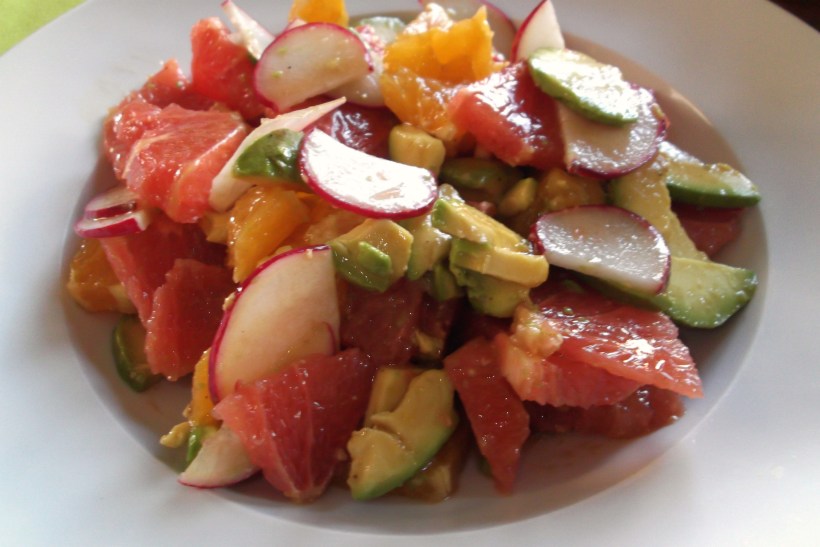
Citrus, Avocado and Radish Salad

We love our citrus fruit here in Andalucía.  Our lemon tree, after 3 years, now keeps us well provided in lemons all year round.  We have planted 3 orange trees too, so in a year or two, we´ll be enjoying our own oranges.

In the meantime, we rely on the kindness of friends and neighbours who keep us well supplied in oranges from about November to March, which is when Andalucía is lit up in the colour orange.  Fields of orange trees are a delight to the eye, and so too are the city streets lined with the trees of bitter oranges which are destined for England and its world famous Orange Marmalade.  But more of marmalade another day.

I was inspired by a stunning recipe from Sawsan over at Chef in Disguise for a beautiful orange and avocado salad. Grilled fish was on the menu for lunch, but sadly I have no idea what it is called in English.  As it´s a fairly oily fish, I thought that the tangy flavours of a citrus salad would complement the fish perfectly.  I was right!

Ingredients for 2 people

  • 1 large pink grapefruit and 1 large orange peeled and cut into bite sized chunks
  • 1 ripe avocado peeled and cubed
  • Radish – our radishes here are HUGE so I only used one finely sliced, but use however much you like (or not)
  • Dressing:  any juices that run off the fruit as you peel them plus a teaspoon of lemon juice, the juice of an orange and twice the volume (of the citrus juices) of olive oil, a pinch of sugar if your orange is sour, half a teaspoon of mustard powder, a grind of pepper and a pinch of salt.

Mix up the salad ingredients gently or layer onto a plate.  Mix the dressing ingredients in a jar, taste and adjust seasoning if necessary and pour over the salad.  Any remaining dressing can be stored in the fridge for use another time.

So pretty, so tasty, and so good for you.

Chocolate Refrigerator Cake

The Spanish love sweet things.  I don´t think I´m making too much of a generalization with that statement.  Not that they´re greedy, but a little cake or biscuit is always most welcomed with a strong cup of coffee at the end of a meal, or a big bowl of milky coffee if it´s the start of the day.

Dealing with preparations for our unexpected lunch for 12, I was lucky that I had already made some of Spree´s gorgeous Mexican Wedding Cookies for an earlier family meal. The recipe makes plenty, and they were hugely popular. The only change I made to these, as I was in a rush, was to grind all the nuts (I used almonds and walnuts) and not chop half of them.  Lovely, lovely little biscuits and I´ll definitely be making them again.

Another quick recipe which came to mind was for Chocolate Refrigerator cake.  I made this the night before our lunch party and cut the cake into small squares the next morning.  These went down well too, and it´s a good recipe to make with little children as you only need a (supervised) heat source for melting.

Here´s the way I made it, although you can chop and change (or even omit) the fruit/nut filling.

250g crushed digestive biscuits (graham crackers)
100g butter
2 tablespoons of golden syrup or honey
3 level tablespoons of cocoa powder
About half a cup of “filling” – I used the last of my drained boozy fruits and added the grated zest of one lemon and one orange

Melt the butter with the golden syrup and cocoa then add to the crushed biscuits and filling.  Mix well until everything is well coated. If you leave some large chunks of biscuit/cracker, you will have some pretty speckles in the finished “cake”.

Pour into a tin lined with cling film, flatten and press it with your finger tips then cover and refrigerate for a few hours or overnight until firm.

Cut into squares – it´s very rich so I tend to do “bite sized”. And that´s it. Doesn´t get much quicker or easier does it?!

Roscón de Reyes – The Cake of Kings

A final post on Festive Food from me here.  The Twelve Days of Christmas come to an end on Twelfth Night, the evening of 5th January.  Traditionally in Spain this was the night to bake your Roscón de Reyes to be eaten the next day, Epiphany, which celebrates the arrival of The Three Kings.

For the children of Spain this means polishing their shoes to be put outside, awaiting the arrival of the Kings to fill them with gifts.  I guess little gifts were the norm way back, although that has changed over time.  Naughty children were left Carbón, or coal….so get polishing and I hope you´ve all been good.

The Roscón is a light, brioche like sweet bread which is filled and covered with candied fruits and often split and filled with whipped cream or sweet custard.  Additionally it is traditional to bake or put into the cake a small trinket (it used to be a figure of the Christ child) and a dried bean.  The finder of the trinket in their slice was King for the day, and the finder of the bean had to pay for the cake!

This is the first year I´ve attempted to make a Roscón, but I was pretty pleased with the results.  I hope my neighbour is too as I am taking this over to her this afternoon as a little thank you in return for a huge basket of Persimmons she gave me.  Happy Epiphany to you all on 6th January!

Ingredients

  • 200g approx of sultanas, glacé cherries and candied peel, soaked in alcohol if desired (see my Boozy Fruits recipe)
  • 500g plain flour
  • 1 sachet of quick/easy blend yeast
  • 1 tsp salt
  • 150 ml milk
  • 100g softened butter
  • 100g caster sugar
  • Grated zest of one orange and one lemon
  • 1 tsp vanilla essence
  • 3 large eggs, beaten
  • To decorate – about 6 roughly crushed sugar cubes or 6 heaped teaspoons of sugar dampened with a few drops of water and thick slices of candied peel (see this excellent post on how to make your own over at Rufus´ Food and Spirits Guide) and some glacé cherries.  You will also need one beaten egg and 2 tablespoons of apricot jam diluted with a little water to glaze when the cake is baked.

Mix the flour, yeast and salt together. In a separate bowl beat the sugar, zests and butter until fluffy then gradually add the beaten egg, vanilla essence and milk.  It doesn´t matter if it curdles.  Now add the flour and knead to form a dough – if it is too dry, add a splash of milk.

Now add the fruits and knead for 5 minutes on a well floured surface with plenty of flour for your hands – things could get messy!  Put the dough into a bowl, cover and leave to double in size (about 2 hours).

Now knead again briefly and push a hole into the centre of the dough so that you can start to form a ring.  Imagine you are making a pizza doughnut with a hole in the middle.  When it is about the size of a large dinner plate, put it onto a lined baking sheet.  You can tuck the trinket/bean wrapped in foil under the cake now or put it into the cooled cake later if you are using. Note, next time I make one, I´ll make the hole in the middle larger as the dough rises quite a lot during baking.

Leave for about an hour until it has doubled in size and brush with beaten egg before pressing the candied fruit in around the top and sprinkling the sugar over.

Bake at 180º for about 45 minutes (check after 30 mins) and brush with the jam when it has cooled a little.  Leave to cool completely.  You can now serve it as it is or split it though the middle and fill with whipped cream or confectioner´s custard. Warning – this is a HUGE Roscón and will serve about 10-12 people.  It does keep for a few days, and if unfilled is also good sliced and toasted.

Adapted from a BBC Good Food Recipe.

Clara´s Pastry and Up the Mountain Mince Pies

Don´t recommend cooking these during a power cut!

Last Christmas Eve, which is the Big Night here as far as Christmas dining goes, we were a “small” group of only about 20 over at Big Man´s mother´s home. He comes from 10 siblings, all apart from one have at least two children.  Most of the neices are nephews are also married and have children of their own, so you can imagine what family weddings are like.

Because I have the biggest oven, I was put in charge of cooking 2 whole lambs.  Even though they weren´t enormous by some standards, it was a whole lot of lamb and a whole lot of cooking.  In true Up the Mountain style, we had a power cut on the evening of 23rd December which lasted 24 hours.  Luckily my oven is gas, so cooking the meat was not a problem but I was doing it by torch and candlelight.  As they tend to eat their meat cooked through here, and I had to ensure it wasn´t remotely pink, keep it warm and transport it 25km whilst ensuring no one went down with food poisoning, it was challenging to say the least.

Yesterday, we ran out of gas.  Not through negligence on my part but because the man who delivers the gas cylinders (no mains gas Up the Mountain) seems to have disappeared and we haven´t been able to swap the empty “bombonas” for full  ones for a few weeks.  Not to worry I thought, planning my baking today, I can use my little electric oven and Big Man can load the empty bombonas onto the truck and drive to the nearest village which stocks them and change them over.

Meanwhile last night, the lights went out, then came back on, but it looked as though they were being run by a generator fired up by an old lady pedaling slowly on a rickety old bicycle.  As I type this I am working on battery power, fingers crossed things resolve themselves soon and I can cook, bake and post.

Today I will make mince pies.  I don´t come from a family of great pastry chefs, but my best friend Ria, luckily does.  Her mum, Clara, makes the best pastry ever, and like many people of her generation, does it without a list of ingredients or measuring.  When I moved to Spain I remember calling her one Christmas in desperation and she yelled the ingredients down the phone to me which I then managed to transfer into measurements I can use.  She always uses margarine in hers with lard, I use butter and lard.  You can use all butter, the choice is yours, but don´t blame me if the pastry is not as good as Clara´s.

Ingredients

  • 200g plain flour
  • Pinch of Salt
  • 50g each of cold butter and lard
  • One egg, beaten
  • Milk

Rub the fat into the flour and salt until it resembles fine breadcrumbs (I won´t tell Clara if you do this in a food processor….not an option for me today with the electric situation), Then using a broad knife, work the egg into the flour.  Now gently start to bring the pastry together with your hands.  You will probably need to add a very little milk so add drops rather than slugs.  This morning I used about a tablespoon.

Now wrap in plastic and leave to rest in the fridge until you are ready to use it, but bring it up to room temperature first.

Bake at about 200ºC when you have filled with mincemeat, jam, whatever.  Obviously I had another power cut mid way through baking today, hopefully you won´t and yours will be perfect!

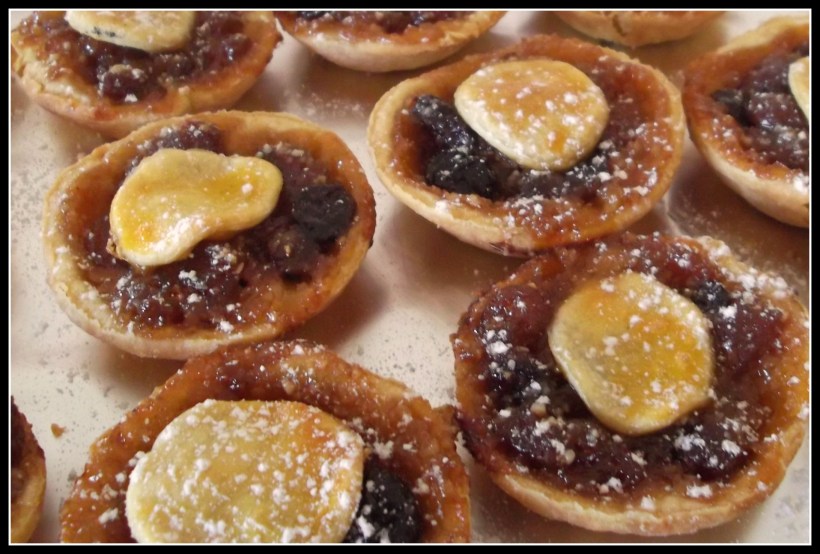
I made my  mince pies using my mincemeat, but even a humble jam tart is elevated to perfection with this biscuity pastry.  Clara doesn´t bake anymore, but I hope she´s proud that her recipe is being shared for so many others to enjoy.

Merry Christmas Clara – wish we could have a sherry and a mince pie together this year!

Christmas “Pudding” Jewelled Ice Cream

If you don´t like cake, or stodgy puddings, a great alternative at Christmas is ice cream.  To me there is something very decadent, almost naughty, about eating ice cream in the depths of winter. Of course, if you live somewhere that Christmas falls in the middle of summer, then it´s even more perfect.

We´ll be eating this not as an alternative to pudding, but as well as!  I´ll serve it with my Light Christmas Pudding and Boozy Fruits….and who knows, a few mince pies may sneak onto the table too.

It´s very easy to prepare, and can obviously made ahead of the Big Day. It´s another Delia Smith´s Christmas recipe, which I have tweaked a little over the years.

The night before you want to make the ice cream, soak about 100g of your favourite mixed candied peel (chopped) and raisins, plus some glace cherries in about 6 tablespoons of rum or your favourite liqueur and stir in 3 tablespoons of honey. I also used dried apricots and cranberries – it´s up to you!

For the ice cream, using an electric whisk, beat 4 egg yolks with 100g of caster sugar until pale.  Grate about 75g of creamed coconut into 400ml of double or whipping cream and heat it gently until the coconut has melted.  Stir over the egg mixture while whisking (it should thicken a little, but don´t worry if it doesn´t) then when it has cooled a little stir in 200ml of thick, creamy, Greek yogurt and add about a teaspoon of vanilla essence (optional).  Finally stir in the fruit and alcohol with honey and pour into a 1litre pudding basin.  Cover with a lid or a few layers of foil and freeze.

When it is about half frozen (it took about 8 hours in my very packed freezer) spoon the mixture out into a bowl and mix it gently to distribute the fruit which will have sunk to the bottom, then pack it back into the pudding basin.  Cover, freeze and forget about it until you are ready to serve.

This ice cream stays fairly soft, so you can turn it out and serve it immediately.  I usually hold a hot wet tea towel around the bowl for a few seconds before turning it out. It doesn´t look quite as pretty in the photo today as it will on the Big Day on a beautiful plate and drizzled with boozy fruit.

Light Christmas Pudding

It will look prettier on the Big Day on a Christmas Plate!

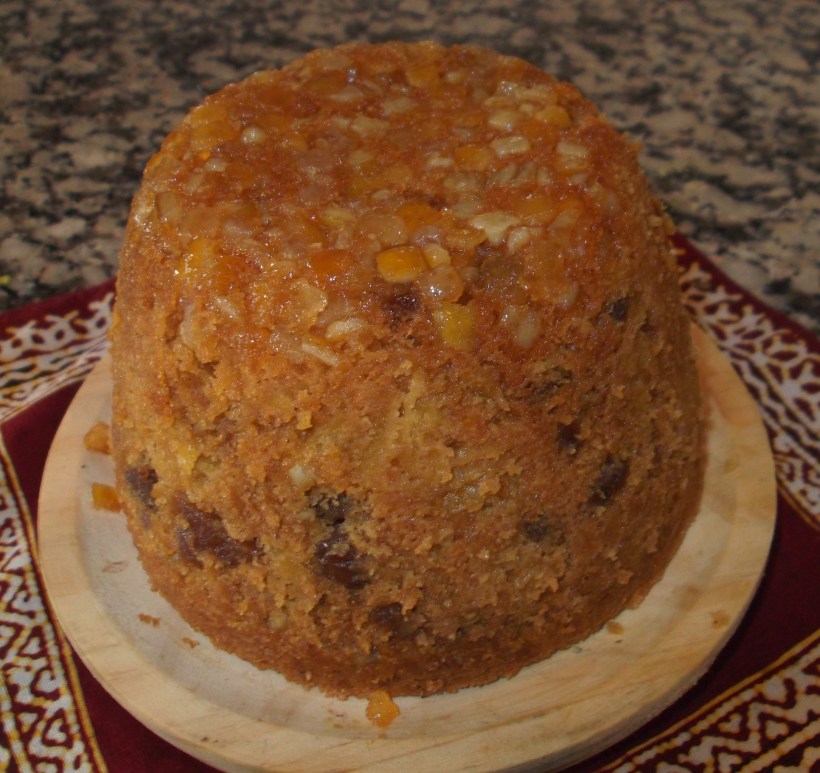
With the forthcoming arrival of my parents, I´m getting into the swing of Christmas food preparations.  Traditional Christmas cakes and puddings in the UK can be made ages ahead of time (even a year) to allow them to mature.  Of course, I am nowhere near as organised as all that, and none of us is mad keen on the heavier traditional pudding.

For many years I have made a lighter version based on a recipe from my trusty Delia Smith´s Christmas Cookbook.  In fact, looking back, I made it the first year I was in sole charge of Christmas lunch for 10 people.  My beloved grandfather had died in the November, and this was 21 years ago.  Of course, we were all still in a state of shock and sadness, especially my darling grandmother, but we still wanted to celebrate.  I lived up the road from my parents in a little flat, and it was decided that we would change things a little so that memories of sitting in my parents´ dining room with Grandad at the head of the table would be a little less vivid.

My parents cooked the turkey in their oven as I just didn´t have room, but everything else was done in my little kitchen.  All my wobbly hand me down tables and chairs were pressed into service, and the family walked up the road carrying girft and fold up chairs.  Plates were borrowed – I was a 25 year old in her first flat as a non sharer, so I was still building my collection.  Tears were shed, but much there was fun and laughter too.  It was emotional but happy and we all ate and drank far too much.  The meal ended with this pudding – made initially as my grandfather would probably have grumbled about there not being “proper” pudding and this made us all chuckle.  Since then it´s become a new kind of family tradition whenever I am the Christmas lunch fairy, and my parents requested it this year.

I haven´t changed the recipe much at all, so I hope Saint Delia won´t mind.  It can be frozen once made, and then warmed through in a steamer or Bain Marie on Christmas Day while you are eating lunch.

Ingredients

  • 175g sifted self raising flour
  • Pinch of salt
  • 110g softened butter
  • 110g brown sugar
  • 1 medium apple chopped or grated
  • 2 large eggs beaten gently
  • 3 rounded tablespoons of mincemeat
  • 2 pinches ground nutmeg
  • 1 tsp lemon juice
  • Grated zest of one lemon and one orange
  • 2 large tbsp of candied peel

Put half the peel in the base of a 1.2 litre buttered pudding basin. Beat the butter and sugar until creamy and then add 1tbsp of egg and flour and mix in, continuing until both egg and flour have all been incorporated.  Add the rest of the ingredients and stir in, then spoon the mixture into the basin.

Cover with a double layer of pleated foil and tie a string around to keep the foil tight and give yourself a handle to lift it out.

Mucky Cooker – oops, don´t let it boil over!

Place it in a steamer or saucepan half filled with boiling water and steam gently covered with a lid for 2 ½ hours.  Keep a kettle of boiling water to hand to top up the water when needed.

When the time is up, let it cool completely and you can then turn it out and wrap well in cling film to freeze until needed.  If making ahead and reheating on Christmas Day, slide it back into the pudding basin and cover again with foil to do this.

Delicious with custard or brandy sauce, boozy fruits, ice cream….whatever takes your fancy!

PS. Stir Up Sunday (the last Sunday before Advent) is when Christmas Puddings were traditionally made to allow them to mature.  Of course, I missed that date, but never mind!  I was also always told that every member of the family needed to give the cake or pudding a stir and make a wish – so we did this too…

Suet Free Mincemeat

For anyone not familiar with mincemeat, let me explain.  It has nothing to do with minced or ground beef, it´s made with fruit. Well…initially it was made of meat, flavoured with sugar, fruit and spices.  This, historically, was probably to mask the strong flavours of meat which needed to be preserved without the benefit of refrigeration.

Over time the mixture became sweeter and all that now remains of its meaty ancestor, is an ingredient called suet, which is usually beef or mutton fat. This melts down into the mix to preserve it.  Vegetarian suet it now also available.

When I spent my first Christmas in Spain 6 years ago, it was impossible for me to track down ready made mincemeat for my Christmas Mince Pies, let alone suet to make my own.  Things have changed now over the years, but I still use a recipe I came across (and I don´t know where, so apologies to whoever it “belongs” to) which is a suet free version of mincemeat.

The flavours develop and improve over time, although it´s excellent even freshly made.  If you make a large batch, it will be wonderful next Christmas!

Ingredients

  • 250g brown sugar
  • 250ml cider (sweet or dry) or apple juice
  • 1kg of peeled and chopped cooking apples
  • ½ teaspoon ground mixed spice
  • ½ teaspoon ground cinnamon
  • 250g each of currants, raisins, cranberries
  • 75g glace cherries
  • 75g blanched almonds
  • Rind & juice of ½ lemon plus rind of 1 orange
  • 6 tablespoons of brandy or rum (optional)

(Feel free to vary the ingredients according to your taste)

Dissolve the sugar in the cider over a gentle heat, add all the other ingredients except the alcohol and cook until soft and pulpy.  Cool slightly, stir in alcohol and put into sterilised jars.