Beef Pot Roast with Ale

I’m a great fan of cooking with alcohol. A glass of wine in my hand, another for the pot is good. Usually I use wine, but on this occasion I used beer, a dark beer called Hobgoblin (don’t you just love the names of some of the Ales produced in England!).

The recipe was another of my beloved slow cooked dishes, a pot roast this time, and it’s a perfect all in one dish that just needs some boiled potatoes or creamy mash to soak up all those delicious juices. Any leftovers make a perfect topping for pasta.

Dark Beer, Beef & Vegetable Pot Roast (1)

The steam in the photos must be the Hobgoblin escaping from the finished dish….

Ingredients (to serve 6 people)

  • 2 onions peeled and cut into quarters
  • 8 small carrots peeled and cut into large wedges
  • 3 celery sticks cut into pieces about the same size as the carrots
  • 2 leeks, cut into large chunks (or substitute any of your favourite root vegetables)
  • A piece of brisket, about 1.5kg
  • About 300ml of dark beer (don’t use Guinness though, it will be too bitter in the final dish)
  • About 100ml of beef stock
  • A little olive oil and flour

Dust the joint of meat with flour and in a deep frying pan with a little oil, brown the meat all over. Season the joint, remove and put into the cooking pot or slow cooker. Add the vegetables to the frying pan and cook until the onion starts to turn brown at the edges, then put them into the slow cooker (or oven dish if you are cooking in a conventional oven).

Pour the beer and stock into the frying pan and scrape up the juices from the beef. Sprinkle in a level tablespoon of flour and stir as you heat the liquid. It will start to thicken slightly. Bring the liquid to a boil and pour over the meat.

Dark Beer, Beef & Vegetable Pot Roast (4)

Cook in the slow cooker for an hour on high and then for about a further 7 hours on low until the meat is really tender. In a conventional oven it will need about 4 hours on low. You will need to turn the meat over 2 or 3 times during the cooking period as it will not be covered entirely by the liquid in the pot.

When it is cooked, remove the meat and vegetables from the sauce. If the sauce looks too thin, put it into a pan and either fast boil it to reduce or make a beurre manié .  It’s made with equal parts of butter and flour mixed together and stirred into the hot liquid – about a tablespoon of each for this dish. Add it to the liquid and cook until thickened. Check for seasoning and adjust if necessary, pour over the meat and vegetables and enjoy.
Beautiful Bavette from Boulogne

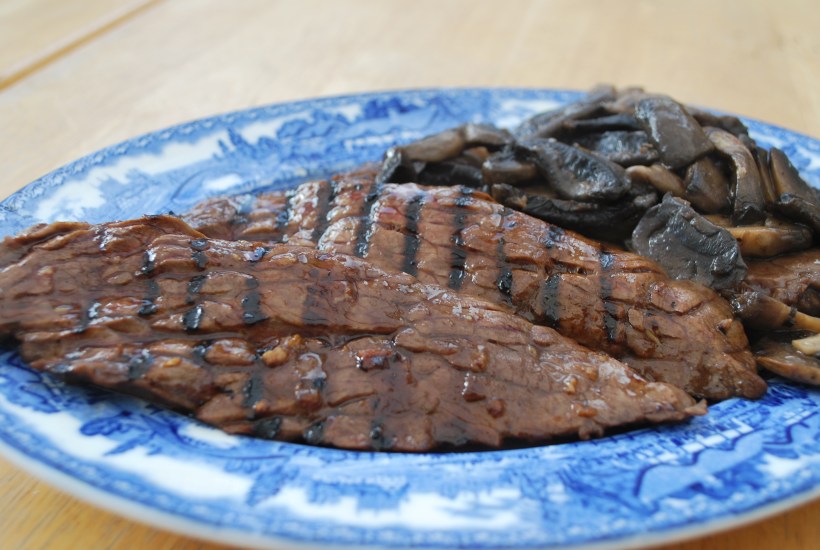
Our recent whistle stop trip to France to stock up on wine and food goodies gave me the chance to buy a cut of meat which is not widely used in England. I think it’s also known as Flank or Skirt steak but is more typically used for slow cooking, usually being cut into larger chunks. It’s not an expensive cut of meat and can be simply flash fried. Adding a marinade helps to tenderise it (it’s very flavoursome but not a meltingly tender cut like sirloin or fillet). It also reminded me of the Spanish Secreto Iberico.

Bavette (3)

This is a delicious treat which I served with pan fried mushrooms and a glass of red wine. Well, maybe it was two glasses!

Taken from a BBC Good Food Recipe

Ingredients

  • Two bavette Steaks
  • Olive oil for cooking
  • 2 tbsp soy sauce
  • 2 tbsp olive oil
  • 2-3 crushed garlic cloves
  • thumb-sized piece ginger, grated
  • juice ½ lemon
  • 1 tbsp balsamic vinegar
  • 1 tbsp honey
  • 1 rosemary sprig, bruised

Mix all the marinade ingredients together, pour over the meat and cover. Leave for a couple of hours at least, overnight if possible.

When you are ready to eat, get your griddle pan searingly hot and scrape the marinade off the meat. And rub a little olive oil onto both sides of each steak. Cook to your liking (although this meat is not so good well done) about 2 minutes on each side for rare, 3-4 minutes for medium rare.

Enjoy!

Syrian Style Roast Leg of Lamb

I was very lucky to have been given some fabulous cookbooks by my best buddy Ria. Ah she knows me so well! One is titled Almond Bar, written by Sharon Salloum, co-owner and chef of Almond Bar restaurant in Sydney, who was bought up in a traditional Syrian household. Ooh I’d love to go and eat there! Her recipes are based on family traditions, but adapted for the modern kitchen.

Syrian Lamb

As soon as I saw her recipe for roast leg of lamb, I knew I would make it for New Year’s Eve. We had family visiting from Spain and were going to have a fairly typical Spanish Family Celebration meal – masses of seafood and shellfish to start, lamb for main course, flan (or crème caramel to us!), fruit, Spanish biscuits, turrón and 12 grapes at midnight. The lamb was not typically Spanish because of the spices, but it was a big hit with everyone. The meat is cooked on high to start with then slowly cooked to tender perfection. Don’t wait until next New Year’s Eve to try this, I know I won’t be waiting that long!

(Apologies for the photo, it’s a cropped section of a family snap which also featured the lamb…)

Serves 8-10 (but you can scale it down for a smaller leg of lamb)

  • 2.5kg leg of lamb, bone in
  • 60ml olive oil
  • ¼ teaspoon ground cinnamon
  • ¼ teaspoon freshly grated nutmeg
  • ¼ teaspoon ground cumin
  • ¼ teaspoon sweet paprika
  • ¼ teaspoon freshly ground black pepper
  • ¼ teaspoon ground cardamom
  • 8 cloves crushed with a pestle and mortar
  • 3 teaspoons salt flakes
  • 6 cloves of sliced garlic
  • About 10 small sprigs of rosemary
  • 1 glass of white wine (not in the original recipe)

Preheat the oven to 200C (fan)/425F/Gas 7

Mix the oil with the spices, salt and pepper in a bowl. Rub the mix all over the leg of lamb then cut small incisions all over the lamb with a sharp pointed knife. Push the garlic and rosemary sprigs into the incisions.

Place the lamb in a deep oven dish and bake on high for an hour, turning after 30 minutes to brown on both sides. Pour the wine over the meat, cover the dish with foil to make a tent and reduce the oven temperature to 170C (fan)/375F/Gas 5 and return to the oven. Cook for another 2 ½ – 3 hours, basting every 20 minutes (but don’t stress if you do it a little less).

When the lamb is cooked, remove from the oven, keep it warm (I wrap it in foil and a couple of towels) and leave to rest for 15-30 minutes and serve with all the beautiful juices you will have left in the pan.

Solomillo Asado con Champiñones y Beicon – Roast Pork Fillet with Mushrooms and Bacon

Finally, back to the cooking. An easy recipe which looks like you´ve put lots of effort in and hours of work! This would also work well with pork loin or chicken breast.

You´ll need for 2 people (with leftovers which is always a good thing)

  • 1 pork fillet
  • A sprig of rosemary (discard after cooking)
  • About 10 mushrooms thinly sliced
  • 2 rashers of bacon finely chopped
  • ½ a medium onion finely chopped
  • 2 cloves of crushed garlic
  • Small glass of dry white wine or sherry
  • Seasoning
  • Olive Oil
  • Set the oven to about 180ºC (medium)

Put the pork fillet on a sheet of aluminium and rub in about 2 tablespoons of olive oil, and season all over with pepper and salt.  Tuck the rosemary spring under the meat and bring the aluminium up to create a basket for the meat, but don´t cover it completely.  This basket will save the cooking juices.

Put the meat onto a baking tray and into the oven and cook for about 30-40 minutes until the juices run clear when you put a skewer into the thickest part.  Remove from the oven, remove the rosemary, wrap the foil tightly round it and keep it warm for about 5 minutes to let it rest a little.

While the meat is cooking, put a few tablespoons of oil into a deep frying pan and cook the onion, garlic and bacon together gently until the onions are soft.  Add the mushrooms and a grind of pepper, stir over the heat until the mushrooms have all absorbed a little oil then add the wine and a few grinds of black pepper (no salt usually needed because of the saltiness of the bacon).  Put a lid on the pan and simmer gently for about 10 minutes or until the mushrooms are cooked and the liquid has reduced by about half.

Now pour in the meat juices and stir in.  At this point you could add a dash of cream if you fancy a creamy sauce.  Slice the meat and either pour the bacon and mushroom sauce over or serve separately.

Any leftovers of meat can be finely chopped, mixed with the mushrooms and bacon with a little cream and are delicious on pasta!

Apologies to my veggie pals and readers (you know who you are 🙂 ) this is an unashamedly porky plate with little room for adaptation but I hope you will understand and forgive….

Mixed Bean, Pork and Sausage Hot Pot

When in England we get to enjoy a wide variety of different foods that we wouldn’t normally have access to in Spain. Sometimes though, we long for the taste of our other home. If we lived in London, it would be easier to get hold of some of the more authentic ingredients to recreate certain dishes, outside of London it’s a bit trickier. Sometimes, London or not, you can’t get hold of them at all.

Our beloved Fabada, from the north of Spain, is one dish that it’s particularly tricky to replicate exactly without the traditional beans and smoked meats. No matter, we make do and end up with a delicious variation of the original. Fusion cooking? No….we’re not that trendy! Make do and mend? You bet!3 bean & sausage potaje (1)


This is a dish you need to plan in advance (especially if you are going to use dried beans which will need soaking overnight). It tastes even better the day after you’ve made it, so is a great one to prepare ahead, or use the slow cooker.

In Spain, this style of dish using dried beans is called a Potaje (pronounced po-tah-heh) which is similar to the French word Potage and the old English word Pottage. All three dishes seem to have much in common with each other as well as the name – do check out the links if you have time.

Ingredients (to serve 6 as a main course)

  • 500g mixed dried beans, soaked overnight
  • 6 fresh chorizo sausages
  • 4-6 slices of pork belly
  • A length of black pudding (or morcilla or boudin noir) about 25cm in length
  • 2 bay leaves
  • ½ teaspoon of saffron (or turmeric)
  • 1 teaspoon of smoked pimentón
  • Salt (smoked if you can get it)
  • Water

Cover the soaked beans with plenty of cold water and bring to a fast boil. Boil hard for 10 minutes, skimming off any froth that appears on the surface.

Now add the rest of the ingredients except the salt, and bring back to the boil. You can now either put the whole thing into a slow cooker and cook on low for about 8-10 hours, simmer on the stove top for about 2 hours or cook on low in the oven for 4 hours. Make sure you use a dish which has a lid.

When the cooking time is up, test the beans. They should be soft and creamy, even a little mushy. Season to taste. When you are about to serve, put the pot back onto the stove top (transfer to another pot if you used the slow cooker) and return to a fast boil for about 5 minutes. The liquid will turn from a clearer state to cloudy, and thicken at the same time.

Slice the pork belly and black pudding into smaller pieces and serve each person with beans, a chorizo and some pork belly and black pudding. A final drizzle of fresh, fruity olive oil over each dish will really lift the flavour. A perfect dish for a hearty lunch on a cold day.

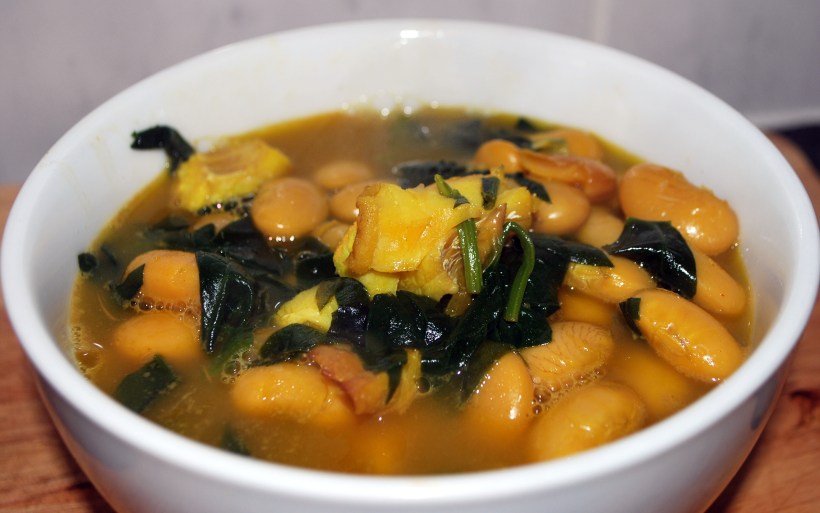
If you like this kind of dish, why not check out this dish of Pork Shanks with Giant Beans

We need more wine, the bottle is almost empty!

or Cod with Butterbeans?

Smoked  Cod & Butterbean Stew (1)

Very Slow Cooked Lamb Breast with Onions, Anchovies and Potatoes

Big Man and I are addicted to Car Boot Sales. They are (I think) a curiously English phenomenon, like caravanning and Morris dancing. Neither of which are our thing, but each to his own I say.

Basically it’s a good chance for a clear out of all your old rubbish/unwanted gifts/unwise purchases and fashion horrors. You then load these into your car, rock up to a local leisure centre or field (weather depending and also it helps to have the farmer’s permission and the participation of other car booters or you might get whisked away by the local police for fly tipping or bonkers behaviour) and sell your stuff out of the car boot. If, like me, you love to recycle and reuse and you think someone else’s unwanted stuff could possibly be your treasure and live in hope of coming across a Lalique Vase or Fabergé Egg for pennies which you will then sell for an enormous fortune, then car booting is for you. If the thought of rummaging through someone else’s rubbish turns your stomach….perhaps not.

Recently I bought the world’s most enormous slow cooker for a few pounds at a Car Boot Sale. Result! I’ve wanted one for ages but as nouvelle cuisine sized portions are not my thing (I’m more an Army Catering sort of Chica) I’ve struggled to find one that will let me cook up a good sized pot of food with plenty for dinner then leftovers.

Food Ago 2014 005

My first experiment was a chick pea dish, even though it was a hot, hot day. Delicious, the chick peas were melt in your mouth tender, although it was more a dish for a cold winter’s night.

Flushed with the success of my chick peas I thought I’d try cooking a piece of meat and a rolled lamb breast in the freezer beckoned to me. To be honest, it wasn’t that huge, but made plenty for two good meals for both of us.

Probably not the most photogenic meal in the world, but so tasty, the anchovies melt and just give a depth of flavour to the vegetables (not fishy at all) and can be easily cooked in a regular oven on low/medium for about 3-4 hours.

Ingredients (to serve 4)

  • 1 boned rolled lamb breast (about 800g)
  • 8 medium potatoes, peeled and cut into large chunks
  • 4 medium onions, peeled, halved and thinly sliced (I used both red and white)
  • 1 head of garlic, the cloves separated but not peeled
  • 1/2 teaspoon of turmeric
  • 1 tin of anchovies in oil
  • 2 tablespoons of olive oil
  • Salt and pepper
  • A glass of white wine

Mix all the ingredients (except the lamb, salt & pepper and wine), together and put into the bottom of the slow cooker or a deep ovenproof dish. Place the lamb on top, season well and pour the wine over. Cover with a lid and cook in the slow cooker for about 10 hours on low or in the oven (as explained above).

When cooked, slice the meat and serve over the potatoes which will be cooked but still holding their shape, and the onions which will be melted and tender. Pour over the juices and congratulate yourself on how fabulous you are at making something so tasty with so little effort. Or is it just me that does that?!

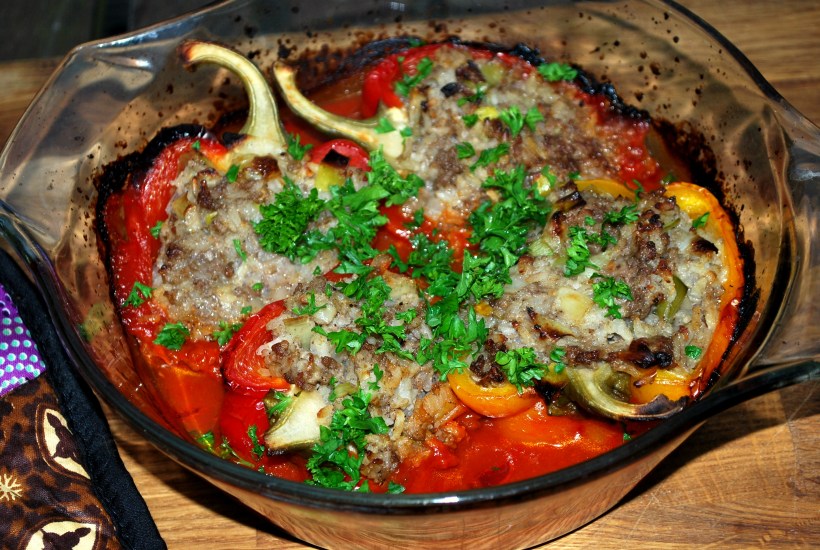
Ottolenghi Inspired Stuffed Peppers

Yes, the love affair with Mr O continues. Today the recipe is inspired by one from his book Jerusalem, and is, in turn, one of his own mother’s recipes. Momma knows best, we all know that.

As ever, I used what I had to hand, the original ingredients are in brackets following my version. It makes a stunning main course accompanied by a salad packed full of all your favourite leaves, or an excellent starter if you use smaller peppers and restrain yourself to eating only a half. Tough choice.

Stuffed Peppers (4)

Ingredients (to serve 4 as a main course or 8 as a starter – easily halved, or even doubled for a party)

  • 4 red bell peppers (which I halved and blanched in boiling water for about 3 minutes) (8 romano peppers, no need to blanch)
  • 2 cups of homemade tomato sauce or (1 large tomato roughly chopped, 2 medium onions roughly chopped, about 500ml vegetable stock)

Stuffing

  • 140g basmati rice
  • 1 tbsp Allspice (1 ½ tbsp baharat)
  • ½ tsp ground cardamom
  • 2 tbsp olive oil
  • 1 large onion finely chopped
  • 400g minced pork (400g minced lamb)
  • 2 ½ tbsp chopped flat leaf parsley
  • 2 tbsp chopped fresh mint (2 tbsp chopped dill, 1 ½ tbs chopped dried mint)
  • 1 ½ tsp sugar
  • Salt and black pepper

Put the rice in a saucepan and cover with lightly salted water. Boil for 4 minutes, drain, rinse and set aside.

Dry fry the spices, add the olive oil and onion and fry until the onion is soft. Pour this and the stuffing ingredients into a large bowl and mix). Season.

Stuff either the half peppers or if using the romanos cut a slit lengthways without cutting in half completely and stuff each pepper.

If not using previously made tomato sauce, place the chopped tomato and onion into a large pan with a tight fitting lid (or pour your sauce in). Sit the peppers on top, cover with a lid and either simmer on the stove top on a low heat for about an hour or cook in a medium oven until the peppers are tender. If using the stove top, make sure the sauce does not dry out by adding a little water if necessary.

Serve warm or at room temperature.

Pork Ribs with A Sauce of Pomegranate Molasses

Back in Andalucía, the pig is King, and all things porky  were very much back on the menu when we were there recently.

Ribs looked particularly good at the butcher’s and they sell half racks – a length of ribs but cut in half lengthwise, so they become short ribs.

Confession time – our favourite way to eat ribs is rubbed with some coarse sea salt and simply cooked on the barbecue. However, despite being sunny, there was a Big Wind Up the Mountain so a barbecue was out. Time to switch on the oven and cook them another way.

Ribs with Pomegranate Molasses (2)

Amongst the ingredients that came back with us from England was a bottle of Pomegranate Molasses, used a lot in Ottolenghi’s recipes and a big feature in many Mediterranean and Middle Eastern dishes. This dish is both boiled then oven cooked, but if you’re in a hurry you could skip the first step and simply oven cook the ribs. Boiling them first does make them very tender and juicy and you also end up with a wonderful stock which you can use later for soup…the choice is yours.

For 2 people

  • About 800g ribs

For the first stage (optional)

  • The juice of an orange, 2 cloves of peeled garlic, 2 bay leaves, a pinch of salt and a grind of pepper and enough water to cover the ribs in a saucepan

For the Sauce

  • 8 tablespoons of tomato ketchup
  • 2 heaped tablespoons of tomato purée
  • 3 cloves of crushed garlic
  • a tablespoon of grated fresh ginger
  • 8 tablespoons of pomegranate molasses
  • 4 tablespoons of white wine vinegar
  • half a teaspoon of hot pimentón or chilli powder
  • 4 tablespoons of molasses (or honey)
  • 1 teaspoon of Worcestershire Sauce

If you are going to boil the ribs first, put all the ingredients in a pot, bring to the boil and then simmer for about an hour. Remove the ribs from the stock and when they are cool enough to handle (or you can prepare them ahead to this stage) move on to the next stage.

Mix all the marinade ingredients together and pour over the ribs. I put them into an ovenproof dish lined with plenty of foil. Make sure the ribs are well coated in the sauce, wrap them in the foil to form a tent and bake in a medium oven for about an hour and a half.

Serve with plenty of napkins to clean those sticky fingers and faces and enjoy!

Beef Massaman Curry

When I was in England last time I was able to stock up on some ingredients which are harder for me to find in Spain.  I took them back to make sure I was able to cook up a curry when the urge struck. It tends to strike quite often but sometimes I just can’t do anything about satisfying it if I don’t have the ingredients to hand.  This means that curry pastes are the best way for me to sort out the curry craving as the spices often linger unloved in the cupboard. Yes, I admit it.

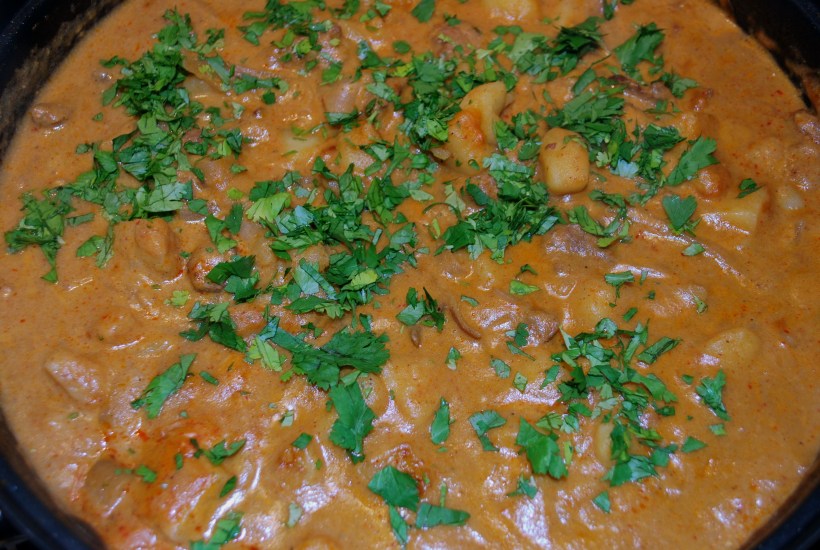
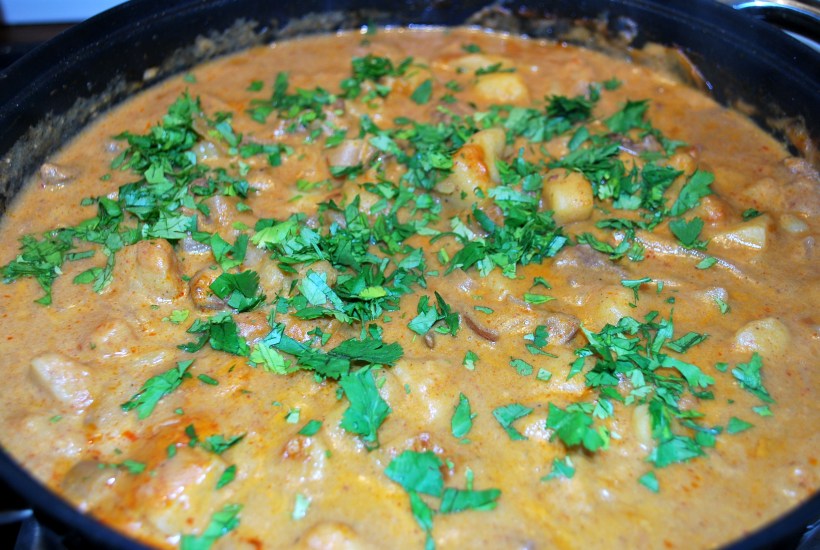
Beef Curry (4)

The Caribbean Food store in Bexhill is run by a jolly character who sells a range of curry pastes (and I really should have taken note of the brand name) which contain no artificial nasties – perfect for someone who loves to cook but feels a little guilty that she is not blending her own spice mixes. I was not familiar with Massaman Curry – a Thai curry which gives a gentle heat, sweet, sour, spicy and is utterly delicious.

Beef Curry (1)

The recipe comes from the BBC Good Food site with just a few little tweaks, but I have given details here too. I omitted the peanuts because I didn’t have any, but I expect they add a delicious crunch to the finished dish.

Ingredients to serve 4

  • 85g unsalted peanuts
  • 400ml can coconut cream
  • 4 tbsp massaman curry paste
  • 600g stewing beef steak, cut into bite sized chunks
  • 450g waxy potatoes, cut into 2½ cm chunks
  • 1 onion, cut into thin wedges
  • 4 kaffir lime leaves
  • 1 cinnamon stick
  • 1 tbsp tamarind paste
  • 1 tbsp palm or soft light brown sugar
  • 1 tbsp fish sauce
  • 1 red chilli, deseeded and finely sliced, and chopped fresh coriander to serve

Heat oven to 200C/180C fan/gas 6, then roast the peanuts on a baking tray for 5 mins until golden brown. When cool enough to handle, roughly chop. Reduce oven to 180C/160C fan/gas 4.

Heat 2 tbsp coconut cream in a large casserole dish with a lid. Add the curry paste and fry for 1 min, then stir in the beef and fry until well coated and sealed. Stir in the rest of the coconut with half a can of water, the potatoes, onion, lime leaves, cinnamon, tamarind, sugar, fish sauce and most of the peanuts. Bring to a simmer, then cover and cook for 2 hours in the oven until the beef is tender.

Sprinkle with sliced chilli and the remaining peanuts, then serve straight from the dish with rice.

If you are a curry fan too, how about this one? Or this vegetarian curry? Or nip on over to Soup Guru’s great blog and check out this gorgeous Indian Minced Beef Curry….

Pasta with Smoked Pork Belly and Black Olives and Breakfast in Biarritz

Driving through France on our little road trip we bought a few foodie souvenirs to remind us of Bordeaux. Some delicious wines, a piece of deliciously pungent cheese which we ate as part of a picnic and some wonderful cured pork belly. It was sold in a market from a butcher’s stall and was in the section with the salamis and cured meats. My French is a little rusty now but I think the lady who ran the stall was telling me that they cured it themselves and sold two versions – one smoked and one salted and peppered. Of course, we bought both!

I was too busy chatting to the butcher to take a snap, so here's one of the fish stall!
I was too busy chatting to the butcher to take a snap, so here’s one of the fish stall!

After leaving Bordeaux we stopped off for breakfast in Biarritz – it’s somewhere I had often hoped to visit and imagined the glamour of bygone days. It really was a quick pit stop but enough time to enjoy the beautiful coastal views and breakfast!

Le Petit Dejeuner
Le Petit Dejeuner

Back to the Pork Belly….It’s delicious cut into tiny pieces and enjoyed as a nibble with a glass of ice cold rosé wine. It’s equally wonderful when heated, in the same way you would use lardons. I made a quick, fresh tasting  pasta sauce to bring out the smokey flavour of this wonderful cut of meat and if you ever come across it…do buy some!

Pasta with Smoked Pork Belly (2)

Pasta Sauce to serve 2 people

  • 2 cloves of garlic, crushed
  • 4 ripe tomatoes cut into small pieces (save the juices too)
  • 2 heaped teaspoons of tomato purée
  • About half a cup of chopped smoked pork belly (or use bacon or lardons)
  • Half a cup of chopped black olives
  • A good splash of white wine
  • Salt and pepper
  • Olive oil

Put the water for your pasta on to boil and then start your sauce. Gently fry the garlic for a minute or two, until it starts to soften then add the tomatoes with their juices and cook for a couple of minutes until they start to break down. By now it’s probably time to put your pasta into the water, so go ahead, the rest of the sauce doesn’t take long.

Add the rest of the ingredients  and continue to simmer while the pasta cooks. Check and adjust the seasoning, drain the pasta and add the pasta to the sauce. Pour yourself a glass of wine and enjoy your speedy and delicious meal.