For anyone not familiar with mincemeat, let me explain. It has nothing to do with minced or ground beef, it´s made with fruit. Well…initially it was made of meat, flavoured with sugar, fruit and spices. This, historically, was probably to mask the strong flavours of meat which needed to be preserved without the benefit of refrigeration.
Over time the mixture became sweeter and all that now remains of its meaty ancestor, is an ingredient called suet, which is usually beef or mutton fat. This melts down into the mix to preserve it. Vegetarian suet it now also available.
When I spent my first Christmas in Spain 6 years ago, it was impossible for me to track down ready made mincemeat for my Christmas Mince Pies, let alone suet to make my own. Things have changed now over the years, but I still use a recipe I came across (and I don´t know where, so apologies to whoever it “belongs” to) which is a suet free version of mincemeat.
The flavours develop and improve over time, although it´s excellent even freshly made. If you make a large batch, it will be wonderful next Christmas!
Ingredients
250g brown sugar
250ml cider (sweet or dry) or apple juice
1kg of peeled and chopped cooking apples
½ teaspoon ground mixed spice
½ teaspoon ground cinnamon
250g each of currants, raisins, cranberries
75g glace cherries
75g blanched almonds
Rind & juice of ½ lemon plus rind of 1 orange
6 tablespoons of brandy or rum (optional)
(Feel free to vary the ingredients according to your taste)
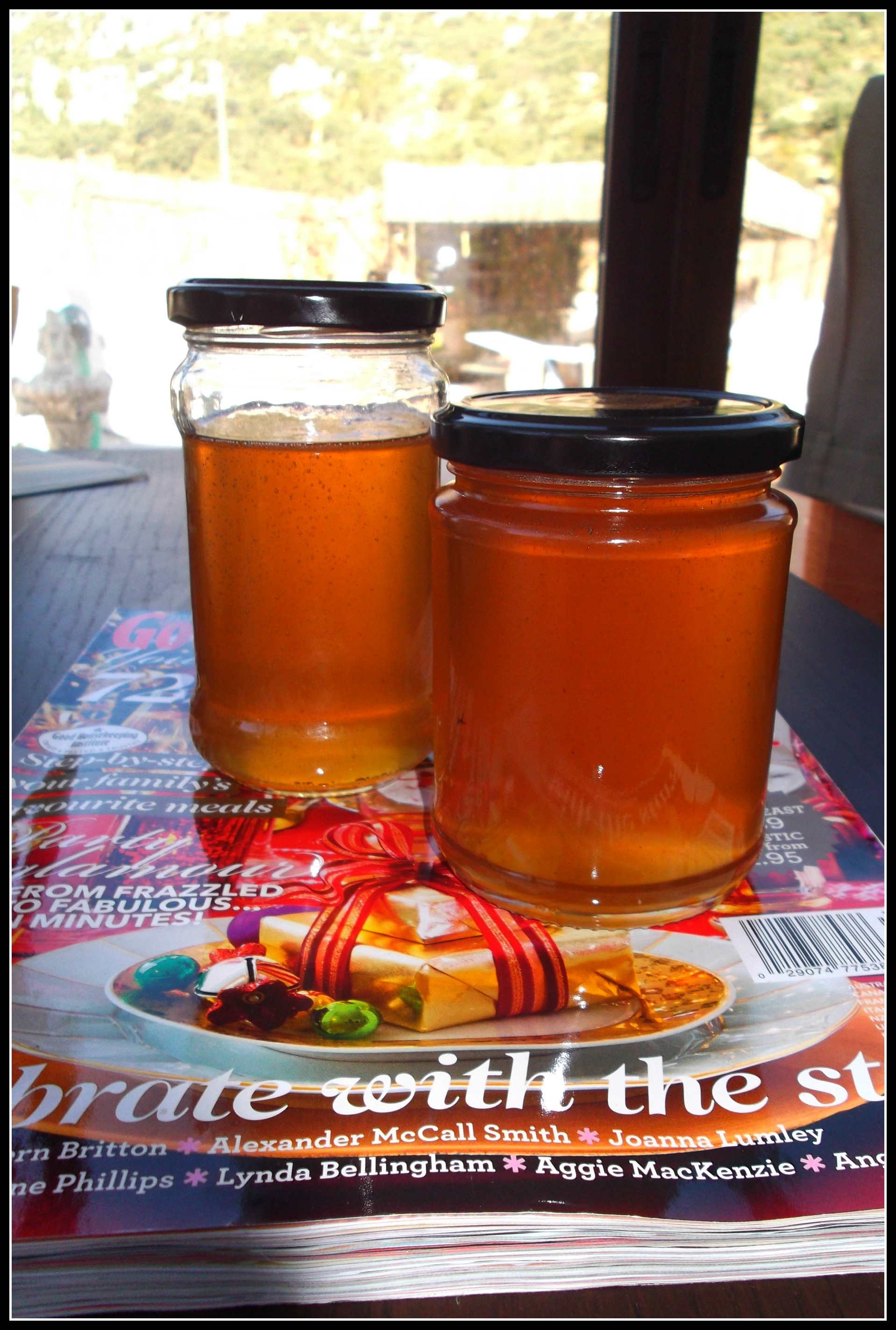
Dissolve the sugar in the cider over a gentle heat, add all the other ingredients except the alcohol and cook until soft and pulpy. Cool slightly, stir in alcohol and put into sterilised jars.
Remember our beautiful walk recently? We had such a wonderful morning and came home with about half a kilo of wild mushrooms.
Because they were so fresh, I knew they would keep for a day or two, so in the first dish I made, I used half of them and kept things very simple.
We grow oyster mushrooms in our garage. No, don´t worry – there´s no nasty fungus creeping up the walls or anything. You can buy bales of straw which are impregnated with mushroom spores and then wrapped in black plastic. You cut slits into the plastic and keep the “alpaca” as these bales are known in the dark and ensure that they are kept damp. About a week after acquiring your little treasure your first mushrooms will appear. Just cut and eat. Then when you´ve harvested as many as you can, you flip the alpaca over and cut a few more slits. If you keep it going you can be eating your own grown oyster mushrooms for several months.
I took about the same quantity of oyster mushrooms as wild, cut the wild mushrooms into thick slices and tore the oyster mushrooms into strips.
In a deep terracotta dish (or you could use a frying pan) I added three crushed cloves to garlic to the mushrroms together with about 3 good tablespoons of olive oil, some Maldon (or kosher) salt, several good grinds of black pepper and two red chillis (these are optional). I turned the heat up to high and as soon as the mushrooms began to sizzle I reduced it and covered them to let them sweat and get tender for about 10 minutes. I then removed the lid and added a small glass of dry white wine and let everything bubble away until the liquid had reduced by half.
We ate this as a starter with plenty of rosé wine and some crusty bread to mop up the delicious juices.
PS. On a totally different subject – since I changed the look of my blog (i.e I changed the theme) my photos don´t seem to appear properly. They are cut off on the right hand side! Has anyone come across this and do they know how to resolve it? Thanks for any advice anyone might be able to offer me.
Ms Chica Andaluza, Somewhere Up a Mountain in Andalucia
Dear Ms Andaluza
We understand that you have recently made Quince Jelly, something which the readers of Mediaevel Medlar Monthly would be most interested in reading about in more detail. A reporter will contact you shortly to arrange details of the interview.
Yours most sincerely
Ye Olde Editore, Mediaeval Medlar Monthly
Reporter: So Ms Andaluza
Chica Andaluza: Oh please, do call me Chica
R: OK, Chica it is. The Medlar is not a widely known fruit, what do you know about it?
CA: Well, I suggest your readers check out this excellent post by Mad Dog, which gives some fantastic information about this fruit which was traditionally used to make fruit jellies and cheeses.
R: How did you manage to get hold of your medlars then?
CA: I have a lovely friend, Florence, who let me pick a whopping 8kgs of fruit from her tree for my first journey into medlar jelly making.
R: Tell us a little more about it then
CA: Well, the fruit has to be “bletted” or almost left to rot before it´s edible. This is the fruit when we picked it.
And this is the fruit about 2 weeks later.
R: Talk me through the process of making the jelly then
CA: I used about 5kgs of the fruit which was “rotten” enough, and washed it to remove dust and leaves. It tastes, as a fruit, of something like prunes and plums…a sweet, pleasant, earthy taste.
Then I added just enough water to cover the fruit and cooked it until it was mushy.
R: How did you know how much water to add?
CA: I searched the internet for recipes, which were all a little vague. In retrospect, I should probably have used more water.
The reporter notes at this point that the subject of the interview is beginning to tremble slightly and mutter under her breath.
R: Once they were “mushy”, what did you do?
CA: The fruit has to be strained through jelly bags to extract the liquid which is then boiled with about two thirds of its weight in sugar until it reaches setting point.
The interviewee is beginning now to behave like Chief Inspector Dreyfus in the Pink Panther films – shaking and twitching uncontrollably when the word Medlar (rather than Clouseau) is used. A glass of wine calms the situation down a little.
R: Is there any special kitchen equipment needed for making this jelly?
CA: I´d recommend a step ladder
R: How so?
CA: Well, you need a large jug to put the jelly strainer over. I went to get one out of my “despensa” and could not be bothered to get the step ladder, and tried to hook it down with a metal skewer. This resulted in a large wooden tray crashing onto my face and giving me a black eye.
Almost a week later and it still hurts!
R: Oh dear, any other experience you´d like to share with our readers…
CA: Well, it took me almost 48 hours to strain the juice from the pulp.
R: That must have been a lot of juice
CA: Not really, about half a litre
R: Oh…
CA: And then I had to boil the syrup to hell and back to get it anywhere near setting point, so most of it evaporated
R: Oh…how many jars did you make in the end
CA: Not quite 2. I had envisioned inviting Roger over to take photos of my extensive stock of Amber hued jelly, but I don´t think I´ll bother now.
R: Will you be doing this again then?
At this point the interview was terminated as the interviewee collapsed into a hysterical heap clutching her eye and a large bottle of wine muttering “never again, never again”.
Ms Chica Andaluza, Somewhere Up a Mountain in Andalucia
Dear Ms Andaluza
Thank you very much for giving so generously of your time recently, particularly in your most delicate state of health. Whilst we wish you a speedy recovery, we do not feel that the tone of the interview will convey the message of the true beauty, flavour and versatility of the Medlar fruit and will not be publishing your interview.
Yours most sincerely
Ye Olde Editore, Mediaeval Medlar Monthly
Advertisement recently seen in Mediaeval Medlar Monthly
FOR SALE: Almost two jars of unset medlar jelly, offers over £500 per jar or will exchange for a small house or sports car. Serious buyers only please.
On my recent trip to London I spent plenty of time talking to my mum. As a fellow cook and foodie herself, we talked quite a lot about food. As you do. She mentioned that she really enjoys making and eating pies, but that my dad is not so keen on them. When she asked me what Big Man´s view was (you can tell can´t you that this was a deep and meaningful conversation) I realised that I had never made him a savoury pie.
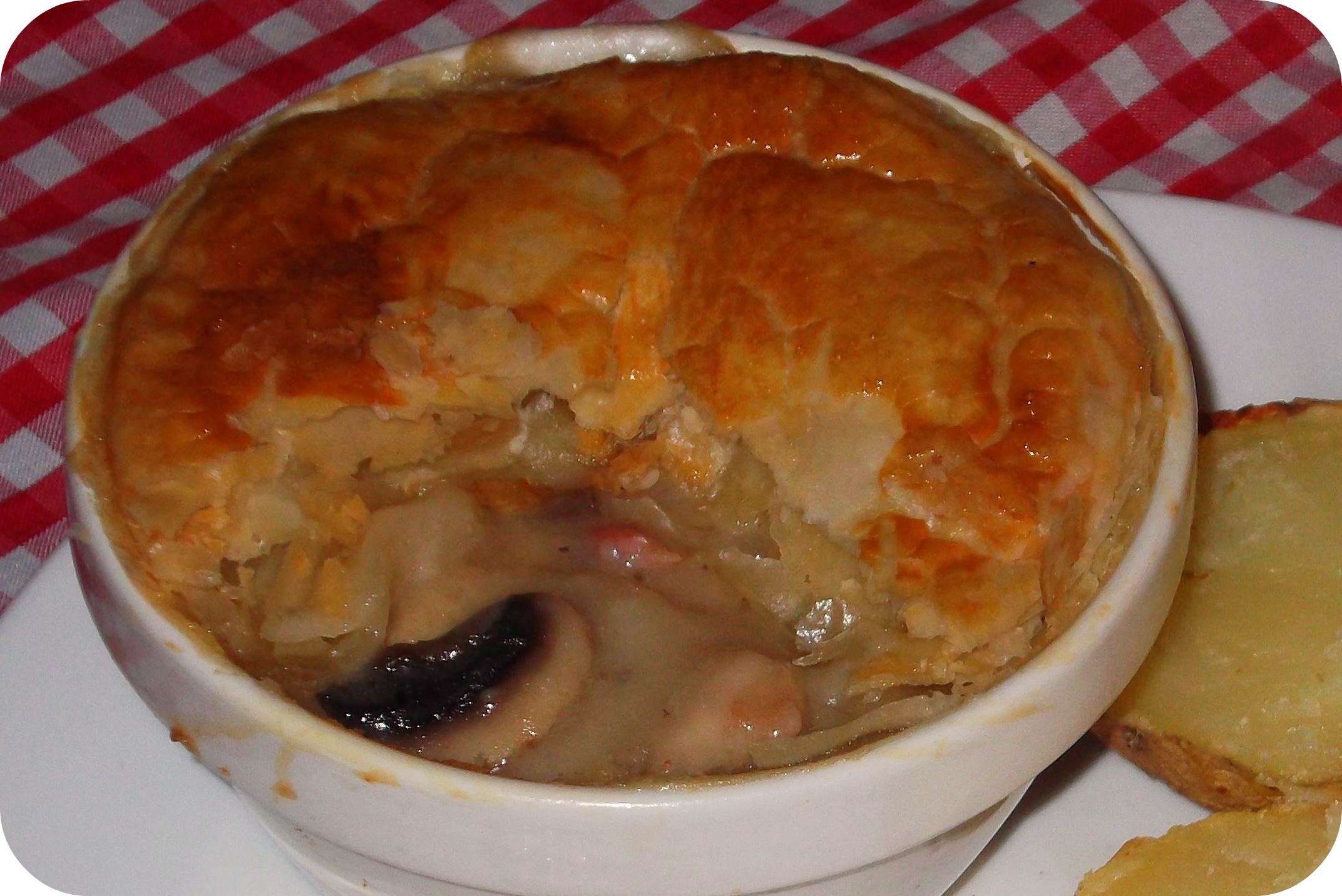
Of course, once I was home, I couldn´t get the thought of a chicken, mushroom and bacon pie out of my head. The rain came down, the fog closed in, the tiny hole in the roof that we think we´ve fixed each year started its relentless drip, drip, dripping. It was time to make that pie.
I´d bought two old fashioned pudding basins in a junk an antique shop in Lewes, a beautiful town where a friend of mine is hoping to move. As I´d managed to get them home without breaking them, I needed to road test them.
Making a pie is a straightforward business if you´re using ready made puff pastry – which was the case for me. If you´re making your own pastry (flaky or shortcrust), it´s not all that much extra work, just a little waiting time while it rests in the fridge.
To make two hearty pies I used
2 small chicken breasts, cubed
About 4 slices of thick cut bacon, cut into small cubes (or use lardons or pancetta)
6 mushrooms thinly sliced
2 cups of chicken broth (or you can use a mixture of milk and water)
3 tablespoons of olive oil
4 tablespoons of flour
Seasoning
Puff pastry
One beaten egg
Put the chicken into the flour which you will have seasoned and toss it around. Heat the oil in a deep frying pan remove the chicken from the flour and seal it. Don´t throw the flour left in the bowl away. Now add the bacon and mushrooms and cook on a medium heat until the mushrooms have softened.
Add the remaining flour to the pan and stir with a wooden spoon to slightly cook the flour and then gradually add the stock whilst stirring to prevent lumps forming. Once the liquid has all been added, turn up the heat and let it bubble gently until it reaches the consistency of pouring custard.
Put the mixture into a pie dish or small oven proof dishes if you want to do individual portions. Lay the puff pastry over the top, trim if necessary and cut a couple of small slits in the top to let the steam escape. Brush with the beaten egg and bake in a medium over (about 180º C) for about 25 mins or until the pastry is golden brown and risen.
Delicious served with baked or mashed potatoes and vegetables. I made runner beans in garlic and tomato, we drank wine and watched the rain dripping down the windows. Big Man voted the pie a big hit, and now wants to know if I can make him a beef one. I think we can safely say that we have another pie eating convert in the family.
For an idea of what to do with any leftover puff pastry, check out this tasty recipe.
Another “Plato de Cuchara” or spoon dish – we like our pulses here in Spain. Many of these dishes were traditional as you could feed large families with few ingredients which were not costly. Meats are typically added at the end (usually pork products) so the beauty is that they can be vegetarian dishes too, if you prefer.
Lentils are great, as apart from being cheap, they cook fairly quickly and only need rinsing but not presoaking.
For four people as a main dish or six as a starter you´ll need
About 500g of lentils – we have the flat green ones here
Water to cover
3 tablespoons of olive oil
1 medium onion, quartered
Half each of a red and green pepper, chopped into bite sized chunks
Two tomatoes cut into bite sized chunks
1 bay leaf
A couple of carrots peeled and finely diced
A stick of celery plus the leaves (if it has leaves). Finely dice the celery but not the leaves.
4 or 5 whole fat cloves of garlic
2 medium potatoes peeled and cut into small cubes (keep these in a bowl of water separately)
Sprig of fresh thyme or rosemary if you have it
¼ teaspoon each of pimentón and paprika
Salt to taste (at end of cooking)
Optional – a couple of chorizo and/or morcilla or your favourite sausages
Rinse the lentils then add all the vegetables and spices apart from the salt to a large cooking pot. Cover well with water, add the oil and bring to the boil. Reduce the heat slightly but don´t let them come off the boil while cooking as this will make the lentils hard. They will probably take about 45 minutes or so.
When the lentils are soft, add the potato and meats (if using) and continue cooking until the potatoes are cooked. Remove the bay leaf and celery leaves and add salt (and pepper too if you like) to taste and you´re ready to serve. Slice the sausages into smaller pieces before serving. A drizzle of extra virgin olive oil and a squeeze of lemon over the top really lifts the flavour, but that´s just the way I like it!
I was going to give this post a Christmas heading, but it´s about fruit flavoured liqueurs, and who needs Christmas as an excuse to open a bottle and share with friends?!
Every year for the last few years, I have made a batch of orange flavoured liqueur (which is made from vodka as it´s virtually impossible to buy pure alcohol here). It´s rather like Limoncello and the recipe comes from the BBC Good Food website.
I won´t reproduce it here, just click on the link above and you can see how easy it is to do. And if you fancy a batch for Christmas to either drink at home or to put into pretty bottles as gifts…well, you still have time.
I have also now “tested” my Cherry Brandy which I made back in the summer. Remember this? Well, all I can say is “wow”! I´m so pleased with how it has turned out and I know we´ll be enjoying it over the coming months. The cherries are amazing too and I am planning to serve a few this weekend with a citrus sponge cake and vanilla ice cream.
Digressing a little, Cherry Brandy always reminds me of my Great Aunt Joan, my darling Grandmother´s older sister. Joan was a stout old spinster, a little gruff, but caring deep down as she dedicated her life to running children´s homes. She spent her spare time entering competitions and must have been pretty good at it as she won things like holidays, cars and cruises. My lucky grandmother was often chosen to accompany her on these little jaunts, and it was mostly good fun for them both.
I say mostly, because Aunt Joan was teetotal, and always frowned at anyone letting the smallest drop of alcohol pass their lips. My Grandmother, on the other hand, enjoyed a drink almost right up to her dying day aged 93 – she said it kept her young. They were on a cruise on the QEII, when a young boy was taken ill with appendicitis and the Captain announced that the ship would turn back to the last port so that he could be operated on. This would cause a delay of about 10 hours to their journey, and during this period the bars would be open free of charge to all guests.
My grandmother happily planned an afternoon of white wine drinking and sun bathing when Aunt Joan had a bit of a panic attack. The already over worked Ship´s Doctor was called and prescribed a small glass of Cherry Brandy to calm Joan´s nerves. As it was being “prescribed” rather than poured by a bar tender, Aunt Joan felt that this was acceptable. It seems she took to keeping bottles of Cherry Brandy all over the place which she took frequent “nips” of as her “calming tonic”. My grandmother was able to spend her afternoon as planned as Aunt Joan lay in her cabin dozing, happy and taking little sips of her Cherry Tonic.
Fish Man took a week off recently and oh how we missed him! Fortunately, he came back refreshed and with a van packed full of gorgeous things for us to enjoy.
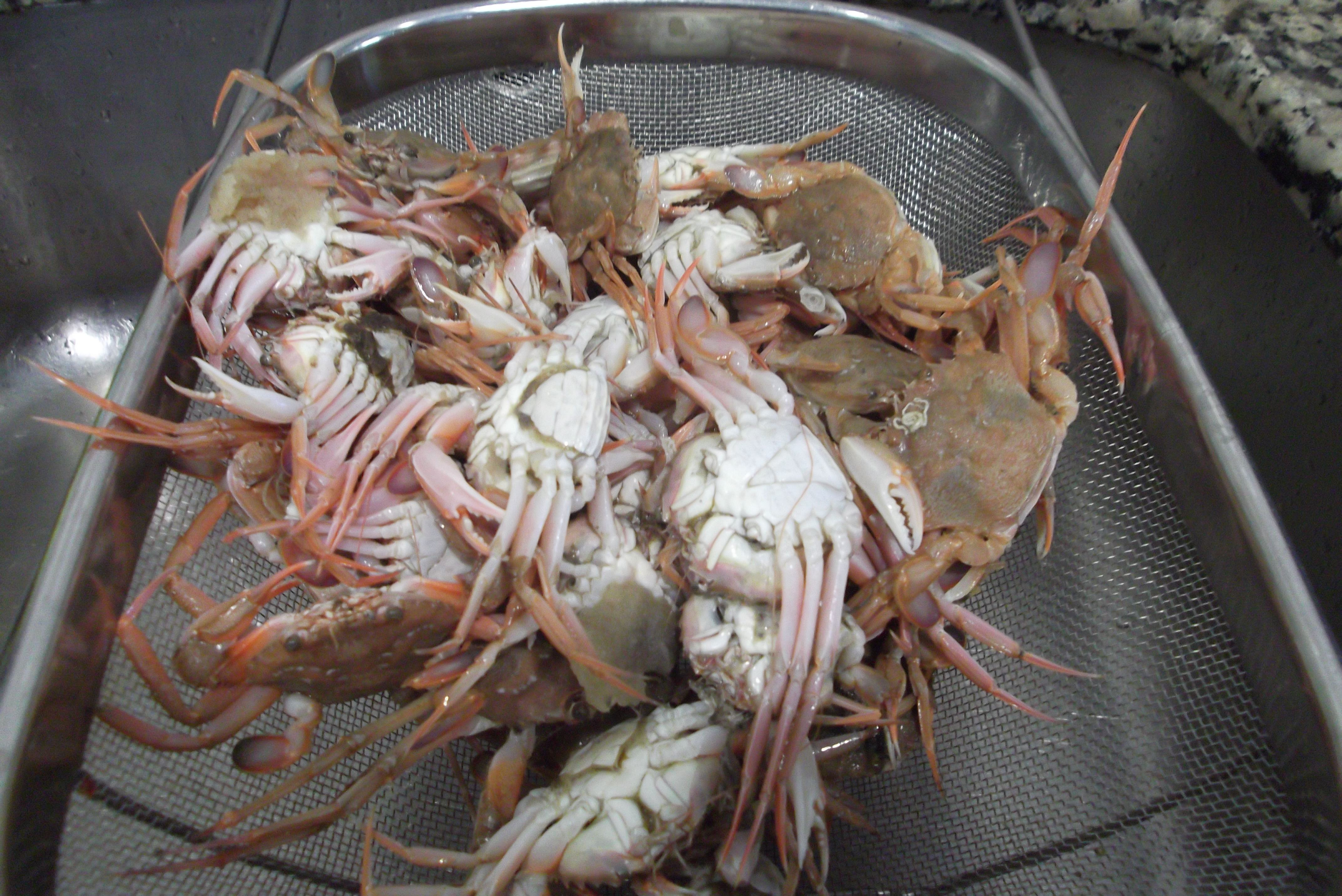
After our enforced fish free week, I went a bit mad, and bought some tiny little crabs and a large fillet of rosada (a firm white fish) for us to enjoy.
The crabs were simple to deal with – a good rinse then plunged into boiling, salted water. You need to be quite heavy handed with the salt as they are usually cooked in sea water. In the absence of this up our mountain, a little extra salt goes a long way. After about two minutes they will turn a darker pink colour, drain them and then put into a bowl of iced water to stop them cooking further. It´s the same process that you would use for cooking prawns.
Eeek....
These were then chilled and served as a starter with alioli and lemons. It looks like a huge portion, but there is not a lot of meat inside these little critters. The fun is in chomping, slurping and licking your fingers!
The rosada was treated equally simply. I sautéed red peppers with onions and courgettes until soft, lay the fish fillets over the top and seasoned everything. After covering the pan with a lid I let them cook through gently for about five minutes (until they were no longer opaque), then squeezed plenty of lemon juice over.
Fabulous FIsh
Healthy, light and delicious…all we needed was the sound of the waves lapping against the shore.
Ok, so I know that for most people, pickling their own olives is fairly unrealistic. Having said that, my parents have been on holiday around this time of year and bought olives in local markets abroad and then successfully pickled the olives back in London.
We´re getting to that time of year here were the olives are fattening up nicely after the rain finally started and the boughs are beginning to bend under their weight. Custom here says that they should be picked when the moon is waning, that is, in the week following a full moon. I expect we´ll be picking early December for crushing and making olive oil, but this month I picked a few buckets full for us to eat over the coming months.
We have a few varieties growing in our little olive grove. Large fat olives, the kind they often put in a dry martini. They´re called Manzanilla and have a pleasant nutty taste. These are the olives in the bowl on the left.
The most common variety round here is called Verdial (right bucket) and makes excellent olive oil for eating “raw” i.e. in salads or on bread. They are medium sized and have a sweet fruity flavour.
We also have some tiny olives (centre bucket) which are a variety called Picual with a slightly more bitter and peppery taste.
I picked a mixture of these and put them into my most glamorous buckets, and covered them with water. Luckily we can get spring water here as chlorinated or tap water does tend to give them a slightly different taste.
The water is changed daily until they lose their bitterness. Smaller ones take less time, and if you split them first they take even less time. The process can take anything from a few days to a month…patience, patience.
Finally, when they´ve reached the right stage (and you´ll be tasting them to check them), they get a final rinse and are packed into containers, flavoured with herbs (I used dried chili, garlic, lemon peel and rosemary) and covered in a salty brine.
Just a few days more of patience and they´re ready to enjoy. They´ll keep for months, up to a year if you´ve made enough to get you through to next November. As time goes on they may get a little softer and a harmless scum, which can just be removed, will appear on top of the brine.
Now, how do you like your martini – shaken or stirred?
PS. For some other great ways of making your own olives to eat, check out these great posts here and here from Olives and Artichokes
You have probably noticed that there are not so many dessert recipes on my blog. There are several reasons for this. First of all, I don´t really have a sweet tooth, and as I´m the cook in this house, if you want sweet, there´s always chocolate in the larder! Secondly, and perhaps most importantly, Big Man and I do need to be a bit sensible about the calories – so dessert is a special treat for us rather than an everyday occurrence. Finally, Spain doesn´t really have a culture of home made desserts. Yes, we have our Flan (Crême Caramel), Arroz con Leche (Rice Pudding) and Natillas (Cold Custard) but mostly it´s a piece of fruit to finish the meal. As we are able to get hold of such delicious seasonal fruit, that´s mainly what we eat and enjoy.
Having said that, quince are now in season, and we´ve made our annual supply of Quince Jelly or Carne de Membrillo. Our kindly neighbour is still providing us with a couple of quince (or is that quinces?) as the last few ripen and a nearby village has some delicious sweet, crunchy apples…which make a lovely change from the usual inspid, spongey monsters that are typically available to us.
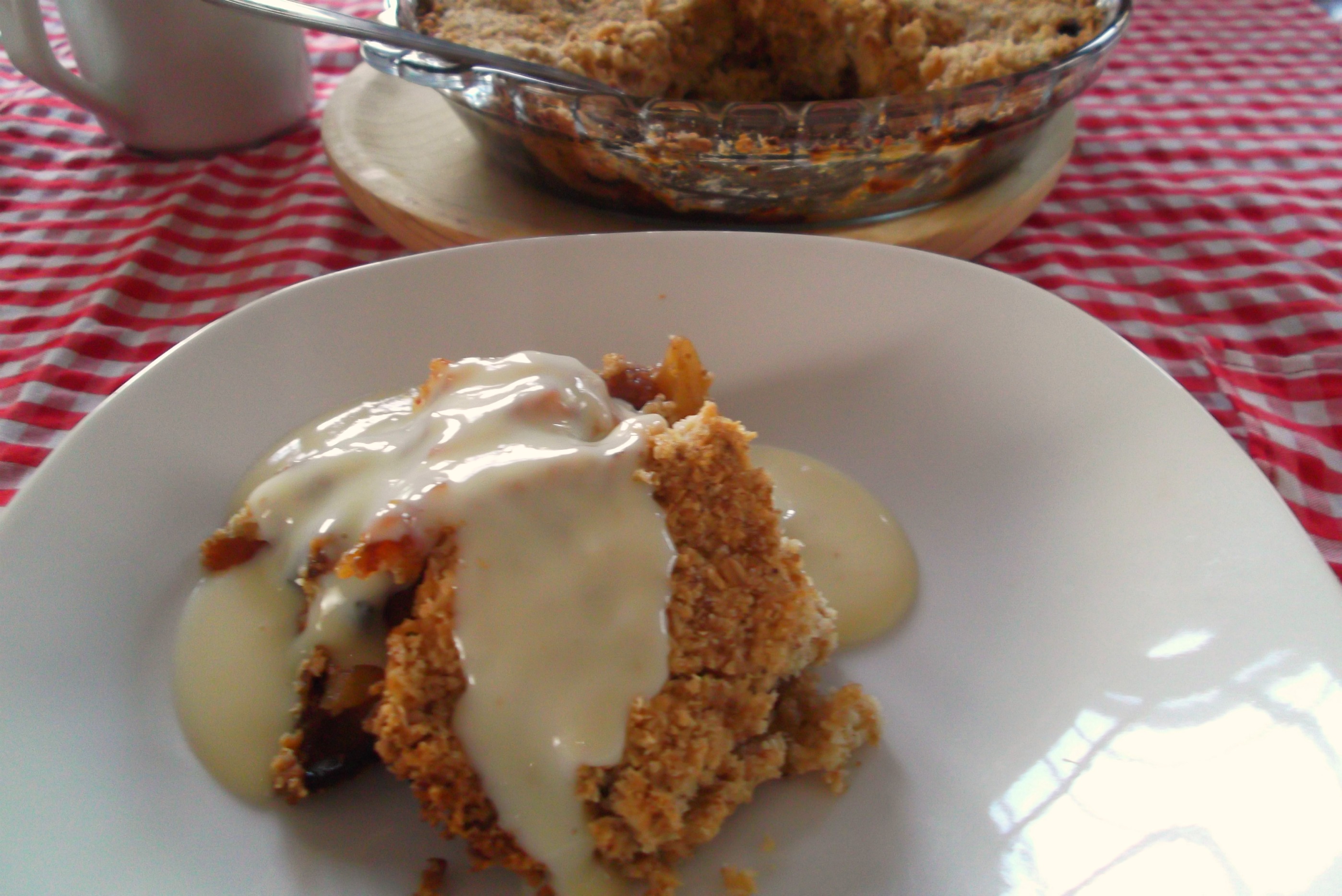
Sunday lunch recently, after a hard morning´s work on the house and garden, most definitely warranted a delicious dessert and I must have been feeling nostalgic for England. I decided to make a delicious autumnal crumble with quince and apple and to serve it with hot creamy custard.
Ingredients
1 large quince peeled and chopped (or one large sour cooking apple)
½ teaspoon of ground cinnamon
2 tablespoons of honey and 1 tablespoon of water
Put the above ingredients into a saucepan with a lid and simmer until soft and all the liquid has evaporated
Peel and slice two large apples and stir into the cooked quince and sprinkle over 1 teaspoon of mixed spice. If you like your desserts sweet, add brown sugar to taste.
For the crumble
One cup of plain flour, half a cup of oats, 100g grams of grated chilled butter and half a cup of brown sugar.
Put all the above ingredients into a food processor and blitz for a few seconds until the mixture resembles fine breadcrumbs. You can also do this by hand.
Put the fruit mixture into a pie dish, cover with the crumble topping and bake on high for about 30-40 minutes until slightly browned on top. Some of the fruit mixture is likely to bubble out and caramelize, so I recommend putting your pie dish onto a baking tray lined with foil.
Serve with custard and fight your nearest and dearest for the crispy caramelized bits. Serves four. ¡Buen provecho!
Who needs bouquets when your loved one brings you cauliflower?!
Recently Big Man came home with one of his horticultural “surprises” for me. Five cauliflowers! We both love cauliflower, but after giving some away and eating cauliflower with vinaigrette, buttered cauliflower and cauliflower cheese, we were still looking at a cooked cauliflower in the fridge wondering what to do with it.
Inspired by a potato and garlic soup recipe over at Rufus´ Food and Spirits Guide, this cauliflower´s destiny was decided. Of course, I was in a rush and didn´t have exactly the ingredients to hand, so I made do.
I loved the idea of the roasted garlic, but as I had nothing else to cook in the oven, it felt extravagant to turn the oven on just to roast one head of garlic. I decided to experiment and try to cook it in the microwave to see how it turned out. I usually use my microwave to store my bread in (a kind of electrical bread bin if you like!) so for me to actually cook something in my microwave is rather unusual…
I put a whole head of garlic in on medium for about 3 minutes and I was amazed when it was done. Of course, there were no lovely toasty edges, but the garlic smelt great and each clove was perfectly soft and ready to pop out of its skin to use.
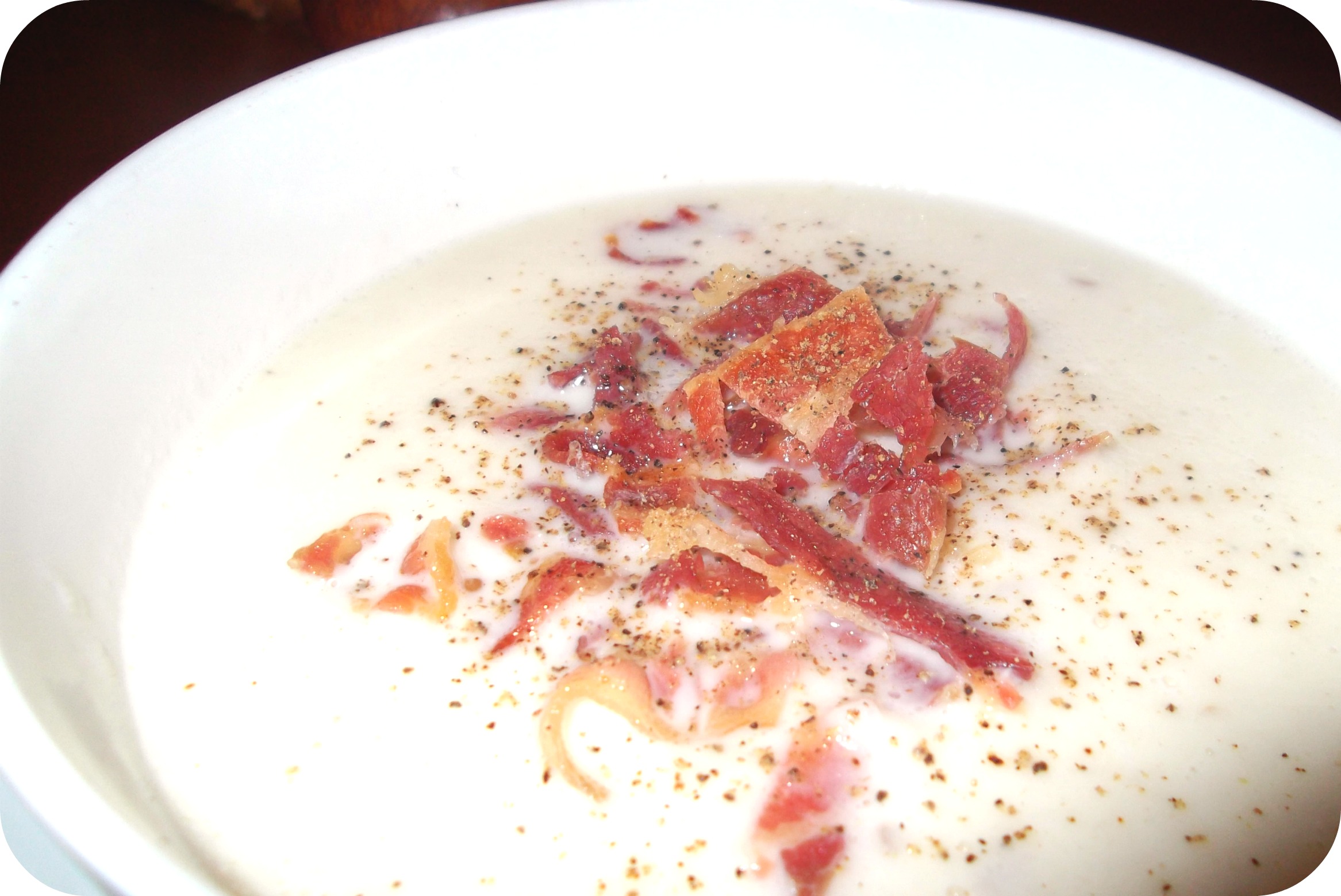
I put the cloves of garlic in a saucepan with a little olive oil and warmed them through whilst mashing them with the back of a spoon. I added the cooked cauliflower broken into florets, a teaspoon of ground cumin seeds and covered with vegetable stock (although water would also be fine). After bringing it to the boil I reduced the heat and let it simmer for about 10 minutes.
In the absence of cream I then added half a cup of milk and a tablespoon of mascarpone cheese and then blended with a stick blender.
A few left over rashers of bacon which I also cooked in the microwave – I was feeling adventurous – were cut into small pieces and sprinkled over to finish the dish off. I put a kitchen towel on a plate, put the bacon on top and covered with another sheet of kitchen towel and cooked on high for 5 minutes. This gave me beautifully dry, crisp bacon, and no greasy pan to wash.
So in 2016 I turned 50. I was in Italy for my 21st, 30th and 40th. To keep this birthday tradition going I always knew I'd be in Italy for my 50! This blog starts with my 5 week adventure in Puglia but my love affair with Italy continues.....
 Over time the mixture became sweeter and all that now remains of its meaty ancestor, is an ingredient called suet, which is usually beef or mutton fat. This melts down into the mix to preserve it. Vegetarian suet it now also available.







 Chica Andaluza