Puchero or Olla Andalúz – Andalucían Chick Pea Stew

Well, what a weekend of e-mails many of us have had. Thanks a bunch WordPress (not!) for inundating us all. It´s been quiet on the blog front as many of us have held off from posting or commenting for fear of drowning in a sea of unwanted e-mails. Hopefully we are all daring to put our toes back in the water…but please don´t forget to remove that tick from the box below the comments one so that you don´t receive all those messages if you´re brave enough to leave messages again!

It´s been a strange weekend here too weather wise up the mountain. Saturday was like the depths of winter, Sunday got better and this week it looks as though summer is on its way with temperatures predicted in the high twenties. Feeling grey and damp on Saturday, we indulged in a big bowl of comforting Olla (pronounced Oya) or Puchero.

The word Olla in Spanish is a big cooking pot.  Often this dish is named after the pot it is cooked in. It´s a hearty, filling winter warmer that if eaten for lunch (it´s never eaten for dinner here, probably because of the “natural effects” of chick peas) will keep you going all day . This version lists the ingredients typically used locally, but also gives options for making it outside of Spain where not all of the ingredients will be so easily available. The salted bones and fat add flavour and give the broth a cloudy or white appearance, which is the sign of a good stock in Andalucía.  Clear stock, I think I´ve mentioned it previously when talking about Chicken Soup, is considered to be lacking in flavour!

If you use the salted bones, you won´t need to add much in the way of seasoning at the end. If not, add salt after the chick peas have cooked, otherwise they will never soften.

Ingredients for 4 people

  • 2 cups of dried chick peas soaked overnight in water with a pinch of bicarbonate of soda and drained
  • 2 large chicken legs and thighs (you will see that the meat in the photo is very dark as this was one of our “old boiler” cockerels…very tasty)
  • 1 piece of pork (typically here it comes from the leg or shoulder) weighing about 250g
  • Salted pork bones (replace with 2 or three pork ribs)
  • A small piece of salted pork fat (omit if you cannot find)
  • A piece of fresh or salted pork belly (with plenty of fat)
  • Optional – a few peeled carrots and sticks of celery
  • 3 or 4 cloves
  • 2 bay leaves
  • 2 small dried chillis (optional)
  • Water

Put all the ingredients into a large stock pot, pushing the meat and bones down to the bottom.  Add water to cover everything well and bring to the boil. Skim off any froth that rises to the surface during the first 10 minutes of hard boiling then reduce the heat to a very low simmer, cover and either simmer gently for about an hour and a half until the chick peas are completely tender or cook in a very low oven for 3 to 4 hours.

Remove the bay leaves, chilli, pork skin and bones, shred the meat and chop the carrots and celery if you prefer, season if necessary and serve in deep bowls with plenty of the delicious stock poured over.

Variation. Some people also add pig´s trotters to this dish, so if you enjoy them, do feel free to add. This weekend I omitted the pork fat and added celery and carrots to make it a lighter but still filling dish. My stock is probably not up to Spanish Housewife standards this time as it´s on the verge of being clear!

This is a dish which will improve and develop flavour if prepared a day ahead.

Pinto Bean “Paté” or Dip

I make a lot of soup, especially vegetable soups using whatever I have available.  To make them more filling, I often add lentils, pearl barley or beans. Today I fancied making a mixed plate of tapas to eat before lunch and had paté cravings.

Instead of making a meat paté I took about a cup of dried beans that I had soaked overnight  (the other half of which were destined for the soup pot) and made them into a tasty, garlicky paté which we served with pickled courgettes, our home cured olives, pickled onions from Cook, Eat, Live Vegetarian´s lovely recipe, salami made by a neigbour and some dried oven baked rolls.

To make one bowl of paté cook about a cup of your favourite dried beans until tender and drain (or use a can of beans).  I cooked them with a few sticks of celery and a chopped carrot for extra flavour.

Put the cooked beans into a blender jug and add 2 tablespoons of olive oil, the juice of half a lemon, 2 cloves of garlic, salt and pepper and a small bunch of fresh parsley.  Blend using an immersion(stick)  blender or a food processor.  If the texture is too thick, taste and then add either extra oil, lemon juice or water depending on which flavours you want to dominate. Adjust seasoning if necessary.

Quick, easy, tasty and economical.  Pass the bread please!

Codillo de Cerdo con Fabas – Pork Shank with Giant Beans

Last year I posted a recipe for a similar dish, this is a variation.  Two pork shanks here serve four people in a very warming winter casserole.

We need more wine, the bottle is almost empty!

Ingredients

  • 500g of large white beans (large cannellini or butter beans would be good) soaked overnight in water with a pinch of bicarbonate of soda
  • Two large tomatoes, quartered
  • 1 large leek, roughly chopped
  • 4 sticks of celery and some of the celery leaves if you have them
  • 2 large carrots
  • 1 large onion peeled and quartered
  • 4 large cloves of garlic, peeled and left whole
  • A dried chili (optional)
  • Approx two cups of water (enough to cover the pork and beans)
  • Four slices of smoked bacon, diced
  • Salt and pepper (don´t season until the beans are cooked)
  • 4 whole cloves or a ½ a level teaspoon of ground cloves

Put all the  ingredients into a large pot with a lid and cook very slowly for about 2 or 3 hours (or longer) in a low oven or on top of the stove.  If you have time, it´s best left overnight before eating to allow the flavours to really develop.

When the beans are soft, strain the liquid off (reserving it) and take as many of the vegetables out from the meat and beans as you can and put into a blender jug.  Blend the vegetables with a little of the cooking liquid then stir into the remaining liquid.  Add the beans and meat (which will have fallen off the bones) into the thick soup, check for seasoning, reheat and serve with a drizzle of olive oil over the top.

Ginger Spiced Carrot and Split Pea Soup

Winter and soups go together. As do winter and colds and I´ve got one right now. Fortunately it´s not too bad, as I´m still cooking and enjoying my food. Shame really, as a day or two of fasting is probably no bad thing for me.

I fancied soup this morning but didn´t want to wait for hours for stock to simmer. Now that I´ve realised I can buy split yellow peas in our supermarket, I don´t even have to wait overnight for other legumes to soak before cooking.  They´re also super healthy, packed with protein and fibre and low in fat.  This means they fill you up without filling you out.

As my sense of taste and smell is a little dulled at the moment due to my cold, I decided to make a warming spicy soup to try and wake those senses up a little.

To serve 4 as a main course

  • 1 cup of split yellow peas (or you could use lentils) rinsed
  • 5 cups of water
  • 3 medium carrots, peeled and finely diced
  • 1 cup of minced tomatoes or conserva
  • 1 heaped tablespoon of tomato purée
  • 1 teaspoon of ground cumin
  • ½ teaspoon of chili powder
  • 1 piece of fresh ginger (about the size of your thumb) peeled and grated or use a teaspoon of dried ginger
  • 3 cloves of crushed garlic
  • Salt to taste (but do not add until the soup is cooked)

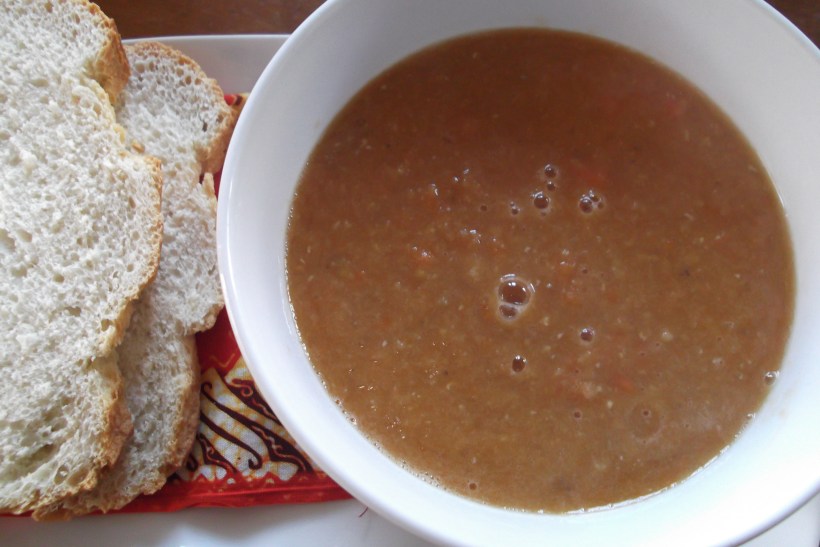
Put all the ingredients into a large saucepan, bring to the boil then cover and reduce to a simmer for about 30 minutes until the split peas and carrots are cooked.  Season to taste and either eat as is or purée with an immersion stick blender or in your regular blender.  It´s good with a dollop of creamy natural yogurt but I prefer a drizzle of olive oil, a squeeze of lemon juice and a sprinkle of extra cumin.  Serve piping hot, sitting by the fire.

Split Pea & Squash Curry

Now that we seem to have caught up (vegetable-availability-wise) with everyone who was posting squash and pumpkin recipes back in the autumn, I am finally cooking lots of warming winter dishes which include this fantastic ingredient. Having said that, it´s not actually very cold here at the moment, but it is Janaury, so I feel justified in making wintery food.

Although we didn´t put on any extra kilos over Christmas, no one could ever accuse either me or Big Man of being under weight, so recipes which are healthier and packed with vegetables are perfect for us.

A mild flavoured curry was on my list – Big Man doesn´t like them hot, and I can always add a little dried chilli at the end to turn up the heat in my own portion.

Ingredients (to serve 4 as a hearty soup or more as a side dish)

  • 200g split yellow peas (the last of a stash bought over by visitors…so sad)
  • 500g squash peeled and cut into slices
  • 1 cup of tomato conserva or chopped tinned tomatoes
  • 1 onion peeled, halved and cut into thin slices
  • 1 head of garlic (you will be roasting this and only using half)
  • 2-3 cups of vegetable stock or water
  • 3 heaped teaspoons of your favourite curry mix (I usually make mine with ground turmeric, chilli, cumin, dried coriander, black pepper and cardamom seeds and then add a little fresh grated ginger when I cook)
  • 1 teaspoon of mustard seeds
  • 1 dried chilli crumbled (optional)
  • Oil for frying

Turn the oven onto a high setting and place the squash on a tray lined with foil. Sprinkle with salt and drizzle a little oil over.  Roast for about 30 minutes until soft and brown at the edges.  Put the garlic in at the same time, wrapped loosely in foil.

Start by dry frying the mustard seeds until they pop. Remove them from the pan. Add a little oil to your pan and fry the onion and garlic until they are soft, then add your curry powder and mustard seeds and fry until the lovely aromas start to come out, then add the split peas (or you could use lentils).  Now add the tomato conserva and 2 cups of the stock or water plus the crumbled chilli if using.

Cook gently until the split peas are almost soft (you may need to add more liquid, just keep an eye on them). Remove the squash and garlic from the oven and cut the squash into smaller bite sized chunks.  Add these to the split peas.  Pop half of the garlic cloves out of their skins and add to the curry. Mash the other half and cover with a little oil, it will keep for at least a week in the fridge and can be used in other dishes or dips.

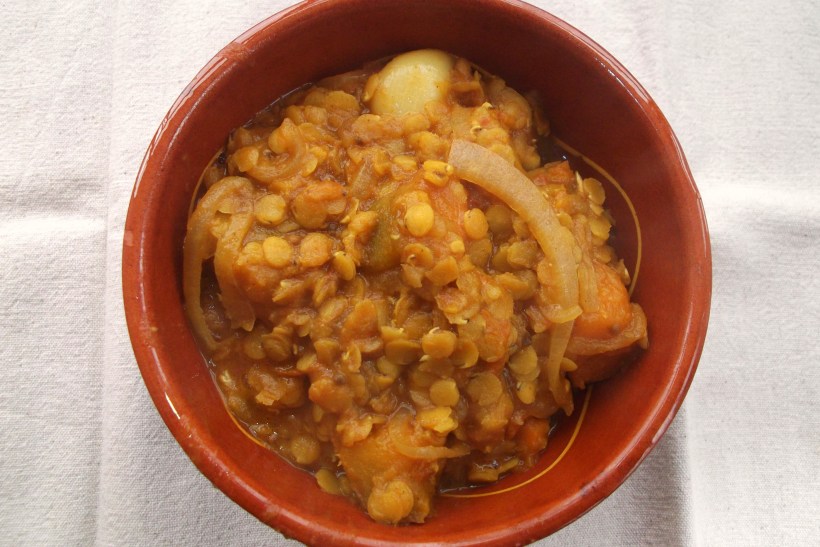
Add a drop more liquid to the vegetables if necessary, cooking the curry for about 10 more minutes until everything is soft and cooked through.  You can mash some of the squash, garlic and split peas with the back of a wooden spoon, leaving some chunky.  Add salt, you´ll probably find it can take quite a lot, but the choice is yours. Eat as a thick soup or a side dish and it´s lovely served with rice or naan bread.

Delicious with a squeeze of lime juice and chopped coriander, but I didn´t have either of them so I just used lemon juice. If you like it even milder and more creamy, stir in a couple of big spoonfuls of thick creamy yogurt.

We had some leftovers, so the next day I added some more stock, yogurt and some finely chopped chard (you could use spinach, kale, cabbage) and warmed it through to make a delicious soup – I´m not sure which version I liked best!

Callos a la Andaluza – Andalucían Tripe Stew – or Everything But The Oink

Watch out for those mountain winds

Ok, I know this is going to sound quite off putting for many people.  Tripe is a scary old thing.  But fear not, although the word “Callos” translates as tripe, I don´t actually put any into this dish (although you could).  Confused eh?

Well, let me explain.  The first time I ever ate this dish was at a Feria in a nearby hamlet.  It´s tiny, probably only a dozen houses, but it belongs to our “Municipio” and puts on an amazing fiesta every year.  One of the first of the summer in fact. They always seem to attract a good flamenco singer, they do a fantastic paella at lunchtime, and they always have plenty of good food apart from the usual pinchitos (kebabs) and montaditos (fillets of pork on bread).  Hundreds of people attend, it´s a great event apart from the winds which whip down the mountain and make hairstyles, skirts, old people and small children blow all over the place.

So, Big Man ordered me a portion of Callos which was essentially a chick pea stew with tiny chunks of meat, chorizo and morcilla in it.  I loved it and looked up the word when I got home and though “oh lord, I´ve been eating tripe”! During the almost six years I´ve lived here, I´ve only eaten it a couple of times a year as not many people make it anymore – it´s not complicated to make, but it takes time.

Of course, I recently decided that I wasn´t prepared to wait until next summer for my fix, I´d make my own.  This is where the fun started.  I asked the butcher to prepare me whatever I needed for this dish (meat wise) and that´s when I found out that her version would not include tripe.

Strange, I thought, but let´s crack on. She (yes, we have two butchers locally, and one is a woman who looks exactly like a lady butcher should look – big and jolly with fingers like sausages) got things ready.  The goodie bag included (per four person serving):

  • Two pigs trotters split down the middle
  • Some finely chopped pork tongue
  • A finely chopped pigs ear
  • Some chopped pancetta or pork belly
  • Some finely chopped cooked pigs blood

See – not so scary after all (well, maybe apart from the blood)!  I also had to buy some chorizo and morcilla and chick peas.  I´m not giving measurements here as it´s a kind of “make it up as you go along” dish.  I then asked about 20 different people how they made Callos.  Half had never made it so were of no help at al.  The others gave me 10 different ways of making it, each with their own little “twist”.

This is what I eventually came up with, and I have to say it tasted as good as the Fiesta version, and Big Man thought it was better…modesty prevented me from saying that myself of course!

Soak the chick peas overnight and the next day cook slowly for a couple of hours with a few bay leaves, 4 cloves, and a dried chilli until completely tender.  Don´t rush this, you´ll have plenty to be getting on with while they cook.

In a separate pot blanch the all the pork products, drain and put into fresh water.  Now cook slowly for a couple of hours until really tender and drain again.  Get those kitchen gloves on and pull all the tender meat off the trotters and discard the bones (or give them to your dog who will love you forever).  Now add the chunks of meat to the cooked chick peas (still in their water).  Add about 5 or 6 whole cloves of raw or roasted garlic, some saffron dissolved in water, ½ a teaspoon of sweet or hot pimentón, the whole chorizo and morcilla (which you will slice before serving) and cook for about 30 minutes.  Leave to stand for at least 15 minutes before serving (but it´s even better prepared the day before) and remove the cloves, bay leaves and dried chilli.

Make sure you have a table full of very hungry people, don´t tell them what´s in it if they´re a bit squeamish, and enjoy.  Now go for a lie down…you´ll need it!

Potaje de Lentejas – Lentil Stew

Another “Plato de Cuchara” or spoon dish – we like our pulses here in Spain.  Many of these dishes were traditional as you could feed large families with few ingredients which were not costly.  Meats are typically added at the end (usually pork products) so the beauty is that they can be vegetarian dishes too, if you prefer.

Lentils are great, as apart from being cheap, they cook fairly quickly and only need rinsing but not presoaking.

For four people as a main dish or six as a starter you´ll need

  • About 500g of lentils – we have the flat green ones here
  • Water to cover
  • 3 tablespoons of olive oil
  • 1 medium onion, quartered
  • Half each of a red and green pepper, chopped into bite sized chunks
  • Two tomatoes cut into bite sized chunks
  • 1 bay leaf
  • A couple of carrots peeled and finely diced
  • A stick of celery plus the leaves (if it has leaves).  Finely dice the celery but not the leaves.
  • 4 or 5 whole fat cloves of garlic
  • 2 medium potatoes peeled and cut into small cubes (keep these in a bowl of water separately)
  • Sprig of fresh thyme or rosemary if you have it
  • ¼ teaspoon each of pimentón and paprika
  • Salt to taste (at end of cooking)
  • Optional – a couple of chorizo and/or morcilla or your favourite sausages

Rinse the lentils then add all the vegetables and spices apart from the salt to a large cooking pot.  Cover well with water, add the oil and bring to the boil.  Reduce the heat slightly but don´t let them come off the boil while cooking as this will make the lentils hard. They will probably take about 45 minutes or so.

When the lentils are soft, add the potato and meats (if using) and continue cooking until the potatoes are cooked. Remove the bay leaf and celery leaves and add salt (and pepper too if you like) to taste and you´re ready to serve. Slice the sausages into smaller pieces before serving. A drizzle of extra virgin olive oil and a squeeze of lemon over the top really lifts the flavour, but that´s just the way I like it!

Tastes even better the next day.

Falafel – Chick Pea Patties

My birthday falls at the end of January.  A month of cold and damp here and after the excesses of Christmas, it feels like a time to shy away from more celebration.  Especially when you´re suffering from bronchitis like I was.  Big Man asked me what I wanted to do to celebrate my birthday and I told him I wanted to be like the Queen of England and celebrate on a second date, preferably when the weather was warmer.  Anyway, last year he surpassed himself and surprised me with our rescue puppy, Luna, so I didn´t think a bottle of perfume or a box of chocolates was going to tick the boxes for me. Selfish moo that I am.

The local town hall often organises “cultural activities” for the village folk, not something I have ever been interested in.  Probably a bit of smug self importance creeping in, thinking I´m already culturally aware enough already and mixed with a healthy dose of a severe fear of group activities of any kind.  When Big Man surprised me (again!) on my birthday by telling me that we were going to join 35 other villagers on a three day trip to Tangier at the end of February, I wasn´t really sure what to think.  It´s a destination I´ve always wanted to visit, but Big Man had always said it didn´t interest him, and we both hated anything that involved coaches and tour guides.  I decided to keep an open mind about the whole thing, dose myself up with cough medicine and make Falafel to get us in the mood.

Here´s how we got into the Moroccan vibe and made six Falafel.  Enough for 2 as a light lunch or 6 “tapas” sized servings:

  • 1 tin (400g) or jar of cooked chick peas
  • 2 spring onions
  • 1 large clove of garlic
  • Salt
  • Half a teaspoon of ground cumin
  • Half a teaspoon of ground coriander
  • Large pinch of chili powder (optional) or a chopped fresh green chili
  • 2 level tablespoons of flour plus extra for dusting.
  • Parsley (enough to chop down to about 2-3 tablespoons according to taste)
  • Oil to fill a frying pan to a depth of about 1cm (I used olive oil)

Serving Suggestion

  • Pitta or flat bread and chopped lettuce and mint, a squeeze of lemon juice (optional)

This is a dish which is very fast to prepare if you have a food processor.  It took me longer to wash up than to whizz the ingredients.  It can also be done by hand with a potato masher and a bit of fine chopping and mixing in a large bowl.

Put all of the ingredients apart from the oil and serving suggestions in a food processor and whizz them up for about 30 seconds then pulse until they reach the texture of grainy, wet cement. If it looks really sloppy add a little more flour but it will still be fairly wet when it´s ready.  Add salt to your taste.

Put a couple of tablespoons of extra flour in a bowl and drop in a heaped tablespoon full of the chick pea mixture and using two spoons get it lightly covered in flour.  If you can work quickly just drop this straight into your frying pan of hot oil, or if you prefer to work more slowly, prepare the falafel first and put them onto a plate, then heat the oil and drop them in.

Sizzle those Patties!

Make sure your oil is hot, let is start to smoke then turn the heat down slightly.  You only want to get a nice crust to the outside, the chick peas are already cooked.  Flatten the balls of mixture down as you put them into the pan and after about a minute flip them over (but make sure they´re nice and browned first).

The second side will take slightly less time, so just check on them, take them out and place onto kitchen paper to blot the excess oil and you´re ready to serve.  They´re great with a squeeze of lemon juice then stuffed into pitta bread with some finely chopped lettuce and mint and a spoon full of natural yogurt mixed with an equal quantity of mayonnaise.  I´m not sure how authentic that is – but it´s delicious!

The Missing Falafel was Eaten By The Chef!