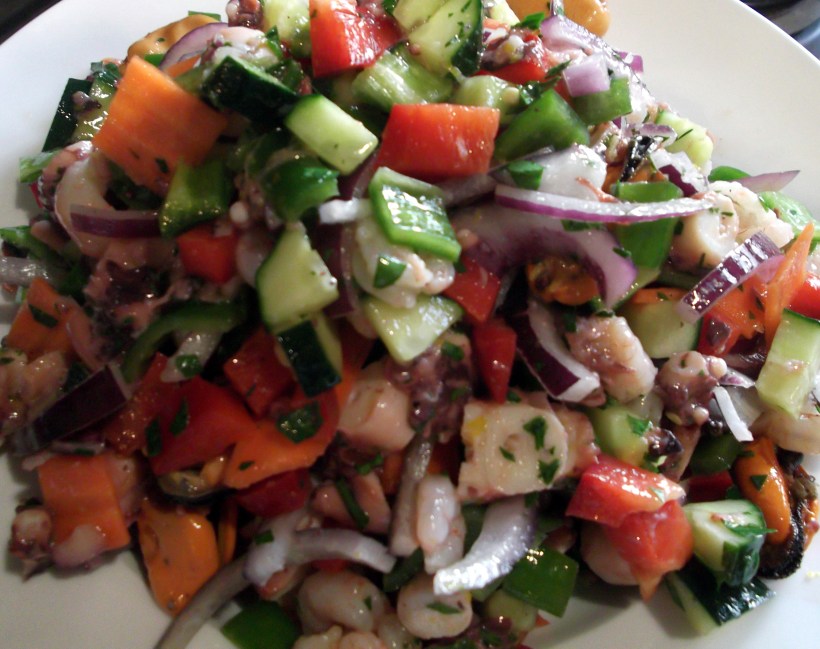
Salpicón De Mariscos – Seafood Salad

So many colours!

A typical tapas here which offers the best from the sea and the best from the salad garden is a Salpicón de Mariscos. We also enjoy it as a light lunch or supper dish or a starter.  Of course, there are many ways of making it, depending on what you have available.  Avocado? Yes, put some in. Don´t like cucumber? Leave it out.

Here´s my version which I also made a lemon vinaigrette for.  Typically though it would just be dressed with salt, white wine vinegar and olive oil.

Serves four as a starter or two as a main course.

Vegetables (all to be chopped into roughly 1cm squares)

  • Two long thin green peppers or one green bell pepper
  • Half a large red bell pepper
  • One medium red onion (or a sweet white onion). Tip…if you thinly slice and then leave in iced water for about 30 minutes and then drain before adding to your salad, it will remove any harshness of flavour
  • One small cucumber, partly peeled
  • Two carrots peeled and cut into thin strips with a peeler (this is not typical, but I enjoy the crunch and colour) and then cut into smaller pieces
  • One large salad tomato (add this just before serving)
  • Two heaped tablespoons of chopped flat leaf parsley

Seafood

  • A mixture of cooked prawns, octopus, mussels – I had about 2 cups in total

Dressing

  • One clove of crushed garlic, half the juice of a lemon, olive oil (you want 3 measures of oil to one of lemon), salt, pepper, half a teaspoon of sugar, a quarter teaspoon of English mustard powder (or use half a teaspoon of made up mustard)

Also – the grated zest of one lemon

Method

Mix together the salad and seafood.  If you are using tomato (and/or avocado) add just before serving.

Shake the dressing ingredients in a jar, taste and adjust seasoning to your preference.  Pour over the salad and mix gently.
This benefits from sitting somewhere cool  (but not cold) for at least an hour before eating. Otherwise you can make ahead, store in the fridge and then remove it an hour before serving.  Add the tomatoes and/or avocado if using, grate over the lemon zest and give it one final stir.

Have plenty of crusty bread to hand to mop up all those lovely lemony juices.

Back to the 70´s – Prawns in Lettuce Cups

Getting Groovy with the Prawns

Do you remember the 1970s? Well, I am sure some of you do, even if you were only babes in arms.  I was a young teenager at the end of the 1970s but it was a time in London when great changes were afoot in the world of food.  The height of sophistication at the time for a dinner party was probably something along the lines of prawn and avocado cocktail, steak with pepper sauce and Black Forest gâteau for dessert. And nothing wrong with any of that I say…but the 80s were soon going to herald the advent of Nouvelle Cuisine (or really tiny portions) and strange mixtures of ingredients such as Loin of some Obscure and Almost Extinct Creature Marinated in a Gooseberry and Guinness Jus. Well, you know what I mean.

Having watched a DVD of Abigail´s Party (I wish I knew how to insert video clips), I was clearly feeling nostalgic and decided to go a bit retro with my peeled prawns. Sometimes you just have to go with the flow and accept you´re getting old…

Ingredients for 4 people as a starter

  • Two lettuce hearts (use 8 of the bigger outside leaves and use the rest for salad)
  • 1 cup of peeled prawns, cooked and cut in half if large
  • 2 hard boiled eggs, chopped (not too finely)
  • 1 ripe avocado (chopped into small cubes)
  • 1 tablespoon of chopped parsley
  • Salt & pepper to taste
  • Half a cup of Marie Rose sauce (I made mine using 3 tablespoons of tomato ketchup, 3 tablespoons of mayonnaise, 1 heaped teaspoon of horseradish sauce, 1 teaspoon of Lea & Perrins Worcestershire Sauce and 1 tablespoon of sweet chili sauce)
  • Pimentón to taste

Simply mix all the ingredients together and spoon into the lettuce leaves.  Sprinkle with hot or sweet Pimentón.

Now, put some groovy 1970s dinner party music on the built in Hi-fi, slip into a glamorous kaftan and enjoy the evening….

Baked Cherry Cheesecake

A slightly sad looking final slice of cheesecake....

I am sure we all have “go to” recipes for times when we are in a hurry, or just want to return to an old favourite.  I adore baked cheesecake and have been using an adapted version of a BBC Good Food one for several years now.
When I found out that I had been asked to make a dessert for lunch with friends, I got out my cream cheese and eggs and quickly got to work. Apologies for the photo, I forgot to snap it in all its glory before we attacked it!

Ingredients

  • 12 crushed digestive biscuits (graham crackers)
  • 50g melted butter
  • 600g cream cheese
  • 2 level tablespoons of flour
  • 175g sugar
  • 3 eggs
  • 150ml whipping cream (or heavy cream)
  • 1 teaspoon vanilla essence
  • 1 jar of cherry jam plus I used some of my cherries in brandy (drained)
  • 1 sachet of flavourless gelatine or vegetarian substitute

Heat the oven to 180º C or gas mark 4.  Mix the crushed biscuits with the butter and press into a springform tin. Bake for 10 minutes and leave to cool.

Beat the cream cheese, flour, sugar and eggs together then add the cream and vanilla essence and then any fruit filling (not the jam).  Blend gently, pour into the tin and bake for 45 minutes.  It will still be slightly wobbly in the centre but leave to cool out of the oven.  It will continue to cook slightly.  I have to confess mine always cracks, I don´t know if there is a way around this – I´d be happy to learn!

For the topping you can either just cover with fruit or make a jelly fruit topping.  I did this by adding a sachet of powdered gelatine to about 4 tablespoons of cold water.  In a small pan warm the jam until it starts to bubble then pour it over the gelatine and mix well until all the granules have dissolved.  Leave it to cool down until almost cold and starting to set then pour over the cheesecake (still in the tin).  Refrigerate for at least 2 hours and remove from the fridge an hour before serving to reach room temperature.

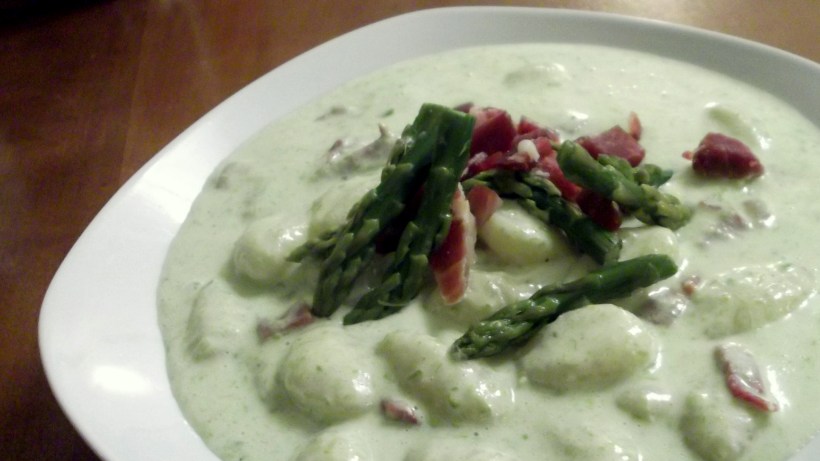
Gnocchi in a Creamy Asparagus Sauce

I have previously mentioned my love of potatoes, and being a big fan of carbs, a plate of gnocchi really hits the spot.  Today we´ll be using a packet of ready made gnocchi, as this is a speedy dish that looks gourmet, and we all like those.

Would Madam like a lifejacket with her sauce?

The sauce is enough for four.  Of course, rather than save half for another day, we used it all and had our gnocchi swimming in a delicious creamy sauce.  Shame on us.

Ingredients

  • 1 packet gnocchi
  • 200ml of pouring or single cream
  • 2 tablespoons of milk
  • 1 bunch of asparagus
  • 2 tablespoons of soft blue cheese (optional but highly recommended)
  • Fresh parmesan for grating
  • Some chopped cooked lardons, bacon or jamon for sprinkling over the finished dish (or leave these out if you want to keep it vegetarian)
  • Seasoning

Start by finely chopping the asparagus, leaving the aside the tips.  Cook in salted water (not the tips) until tender and remove with a slotted spoon. Now cook the tips, drain and set aside, keeping warm if possible. You can always save the cooking liquid to add to vegetable stick or soup.

In a blender jug put the cream, milk, blue cheese (if using), asparagus (again, not those tips!) and plenty of black pepper.  Blitz until you have a smooth thick cream and put into a small saucepan.

Boil the water for your gnocchi, add salt, and cook until they float to the top.  While they are cooking, gently warm the cream sauce, taste and add salt if necessary.

When the gnocchi are done, drain and mix the cream sauce in, place into warmed serving dishes. Sprinkle over the asparagus tips and jamon or bacon (if using) and grate over some fresh parmesan.  Speedy, luxurious, delicious.

For some other wonderful suggestions of what to do with asparagus, check out RaeDi´s Pizza recipe here and Greg´s Lemon Asparagus here.

On Thursday Big Man and I are heading to London for a week to catch up with family, friends and food. My parents are probably one of the few families on the planet who don´t have internet, so although I may post again before Thursday, I won´t be able to read blogs or comment from Wednesday evening until we get back when I will do a big “catch up”.  Hopefully we´ll come home with lots of lovely foodie goodies and some good eating experiences to share with you all.

Update – I have added this recipe to Greenslove´s recipes, check out Linda´s link here at Savoring Every Bite for more info

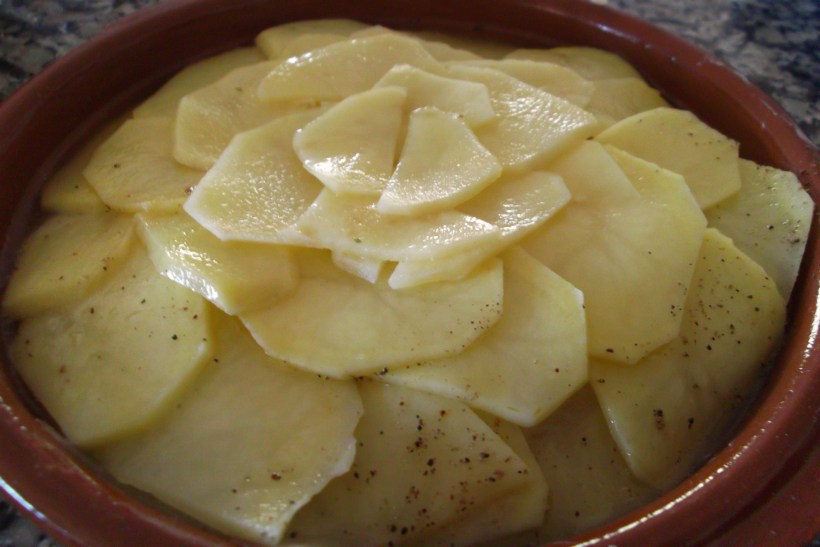
Boulangère Potatoes

I have a rather too close relationship with potatoes. Damn Christopher Columbus or whoever it was who bought them back from the Americas.  I particularly like them smothered in butter if they are baked in their jackets, or cooked in olive oil when roasted.  Or how about butter, cream and cheese if they are mashed? Oh dear, I can´t always have naughty potatoes and sometimes plain boiled with a drizzle of olive oil just doesn´t do it for me.

Boulangère Potatoes are a good option if you are trying to be a little sensible with the calories, or if you just want to go mad with the dessert. They´re also wonderful when you are entertaining, as apart from tasting fantastic, they can sit quite happily in a warm oven for quite a while and come to no significant harm. Boulangère is the French word for Baker.  Many families in the past did not have ovens in their own homes.  They would take a dish of these down to the village baker who would kindly pop them in to cook in his still warm oven when the bread baking was done. What nice people bakers are.

To serve four people you´ll need about 1kg of potatoes peeled and thinly sliced (I used a mandolin slicer but you can also do this by hand or in a food processor), 2 medium onions thinly sliced, olive oil, seasoning and about half a litre of vegetable or chicken stock.  If you have it, some fresh thyme is also good but right now I´m in a bit of a huff with Big Man as he dug all mine up a while back thinking it was a weed! Rosemary also works well with this dish.

Lightly oil the base of an oven proof dish and start making layers of potato, onion, herbs and seasoning. Finish with a layer of potatoes, season and then pour over stock to completely cover.

Cover the dish with foil and bake in a at 200ºC/Gas 6 for about 45 minutes, then take off the foil.  The potatoes and onion will be soft now and most of the liquid will have disappeared.  Continue to cook for another 15 minutes or until the liquid has all gone and the potatoes have browned.  If you find it has cooked through but the potatoes are still a little pale, put under the grill for a few minutes.

Either serve immediately or leave at the bottom of a low oven until you are ready to eat.

Up the Mountain Chicken in a Pot – Poule au Pot

My understanding is that King Henry IV of France hoped that, as a wealthy nation, all his people could eat stew (or a chicken) once a week.  Poule au Pot became a favourite dish, and the fact that it is so simple to produce and tasty to eat makes me understand its popularity.

I cannot attest to the authenticity of this recipe, I didn´t set out to cook the famous French dish, but when I took it to the table, wafting delicious chicken and vegetable smells, Big Man asked me what we were eating and I told him “Chicken in a Pot”. Et voilà!

Ingredients for 4-6 people depending on the size of your chicken

  • 1 free range chicken
  • 1 large potato per person, peeled and cut into quarters
  • 2 carrots, 2 sticks of celery and a leek per person (peel and roughly chop)
  • A few pieces of fresh thyme and some fresh parsley
  • 2 lemons cut into quarters
  • A large head of garlic, broken up a little but not peeled I used two small ones)
  • Olive oil
  • Seasoning
  • A glass of white wine
  • A large ovenproof pot with a lid (big enough to take all the ingredients)

Set the oven to low before assembling the dish. Rub the chicken inside and out with olive oil and season and stuff half the lemon, half the thyme and half the garlic inside.

Place into the pot, scatter the vegetables around, add the remaining garlic, lemon, parsley and thyme and season. Drizzle with a little more olive oil and pour a glass of wine over. Put the lid on and then place the dish in the oven on low for 2-3 hours depending on the size of your chicken.  Check that the juices run clear before serving. A wonderful tasting, easy meal all cooked in one pot.

For some other fantastic chicken in a pot dishes, check out Food Photography and France (it´s also a very funny read), Savoring Every Bite (for a romantic recipe) and Fired Up Cooking (if you´re planning on some outdoor entertaining) to see their delicious recipes.

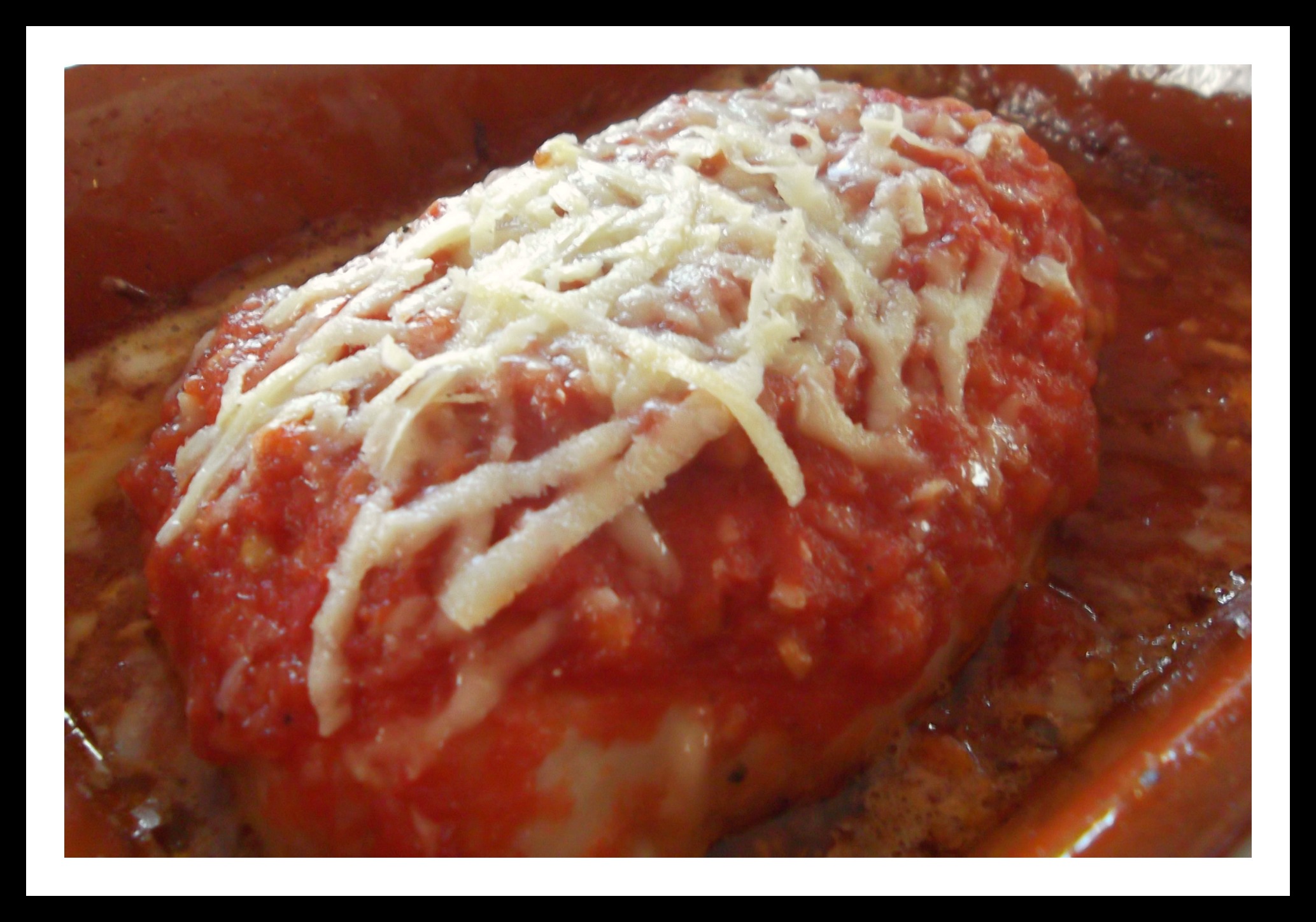
Baked Chicken Breast with Cream Cheese Stuffing and Tomato Sauce

When you breed chickens for eating, you´re going to have to deal with the chicken, the whole chicken, and nothing but the chicken.

Most of our Fat Boys end up being cut up into individual portions with the skin off – they´re easier to store in the freezer that way and you don´t have to pluck them.  Chicken Breast has always been my least favourite part…typically it can be a little dry and bland.  Now that we get to eat our own chickens, I can at least say that the breasts are neither dry nor bland and taste great just done on the griddle with olive oil and salt and a squeeze of lemon juice at the end.

Some of our chickens are real monsters though – and with no artificial feed.  Just corn, wheat and a long-ish life (at least in terms of chickens for eating) pecking around our olives.  One chicken breast can weigh about 500g and is plenty to feed two.  Sometimes it´s nice to jazz it up a little, and this is a firm favourite.

  • One monster chicken breast or two regular
  • Two tablespoons of cream cheese mixed with one crushed clove of garlic, a sprinkle of salt and a tablespoon of your favourite herb finely chopped (I like basil or chives with this)
  • About four tablespoons of tomato sauce (i.e. made from fresh or tinned tomatoes)
  • Grated cheese
  • Seasoning
  • Olive oil

Split the chicken breast in two without cutting all the way through.  Fill with the cream cheese and close.  Season with salt and pepper and drizzle a little olive oil over, massaging it in all over.

Put into a baking dish and pour over the tomato sauce.  Bake on medium for about 30 minutes.  Check that it is done by piercing it – if the juices run clear, you´re done.  If not, cook for a further 10 mins, check and repeat if necessary.  When cooked, grate cheese over the top, pop it under a hot grill until the cheese is melted and bubbling, and serve.

This is a great prepare ahead dish (up to the stage before you start to cook) and if the breast is large, serve cut into slices with a little extra tomato sauce on the side for your loved ones who prefer things saucy!

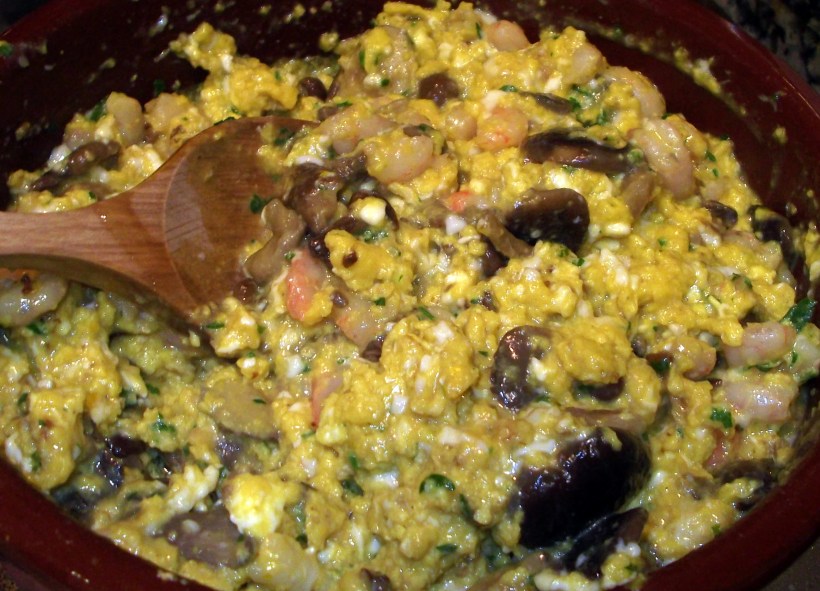
Huevos Revueltos con Gambas y Setas – Scrambled Eggs with Prawns and Mushrooms

This is a bit of a “non recipe” recipe, as scrambled eggs are not really so tricky to do.  And as for my photos of the end result – well, not so appealing.  I know that many of you out there can make them look creamy and gorgeous but it was a case of “snap ´em quick as we don´t want to eat cold, dried out scrambled eggs”. Sorry.

Funnily enough, these are such highly prized dishes here that scrambled eggs (in different variations) often appear on restaurant menus as starters and top chefs demonstrate the art of cooking them on TV cooking programmes.  I do find that a little odd, as scrambled eggs was the first thing I was “taught” to cook by Sister Sylvia in my convent school cookery lessons.  I had already been baking and making meals at home so was a little insulted when a tiny chain smoking nun who wore high heels and a very elaborate hair do told me off for not getting into the corners of the pan with my wooden spoon.

When I told her that round saucepans don´t have corners (and between us convent girls we all knew she bought cigarettes and sherry with our cookery money) a wary truce was established but, much to my family´s surprise, I loathed cookery lessons at school. I was quite a bratty and opnionated 13 year old as you can see…

So, I digress.  Back to a quick and tasty and very Spanish supper dish for two.

Ingredients

  • About a cup and half of mixed mushrooms (they sell very good bags of mixed frozen mushrooms here which, when defrosted, are perfect for this and other dishes)
  • A cup of peeled prawns (shrimp) – or keep it vegetarian by leaving these out
  • One clove of crushed garlic
  • Four eggs (free range if possible)
  • A splash of milk
  • Seasoning
  • Olive oil or butter for frying (we use oil and I sometimes stir in a knob of butter to the eggs at the end)
  • A heaped tablespoon of finely chopped parsley,

Beat the eggs, milk and seasoning together and put to one side.  Now slowly fry the garlic and mushrooms until the mushrooms have given off their juices and are tender. How long this takes will depend on your mushrooms. Now turn the heat up, add the prawns and stir fry until pink.

Keeping the heat at medium, add the eggs and scramble to your liking (don´t forget the corners!). When they are a few seconds away from being done, stir in the parsley and serve with crusty bread or toast and a glass of something gorgeous.

Osso Buco – Braised Veal (or Pork) Shank

When I was little my dad used to go crazy for Osso Buco, which translates from Italian as bone with a hole in.  I just didn´t “get” it but I enjoyed dipping my bread in the sauce.  My, how times have changed.  I go crazy for it now as my dad did.  Like many dishes, it used to be a poor person´s meal, made from the sliced shank bone of a young (or otherwise) cow.  Of course, it´s now a rather grand restaurant dish and veal is more typically used. It´s not found that often on menus as it is a long, slow cooked recipe. It´s also often made with white wine and no tomato and served with a gremolata.  Naturally, I ignored all this and did it my way!

When I saw in our local supermarket that they were selling sliced pork shank bones, I snapped up two packs (there were four in each) and decided to give making this delicious dish a go.  If you´ve ever cooked oxtail, the process is pretty much the same.  I also found that it was best made a day ahead to allow the flavours to really develop and to also be able to remove any fat from the top of the dish before heating and serving.

Ingredients

  • To serve four people I used two fairly meaty slices of shank per person
  • 1 large onion, peeled
  • Four carrots, peeled
  • 2 large sticks of celery cleaned and tough “strings” removed
  • Four fat cloves of garlic
  • 2 cups of crushed tomato
  • 2 heaped tablespoons of tomato purée or concentrate
  • ½  a bottle of red wine
  • A bay leaf and about 5 whole peppercorns
  • Olive oil for frying
  • Flour for coating the meat
  • Seasoning

You will also need a deep heavy based (preferably oven proof) dish with a lid

Start by dealing with the vegetables. You can either finely chop or process.  I chose the latter as I wanted the vegetables to cook down to a thick sauce, but the choice is yours.

Season the flour and coat the pieces of meat in it, reserving any that is left over.  Cover the base of your cooking pot with oil and at a high heat, brown the meat on all sides and remove to a plate. Turn the heat down and add all the vegetables, make sure they are coated in oil then put the lid on and let them sweat gently until soft for about 10 minutes. Now stir in up to a heaped tablespoon of any left over flour, cook for a minute or two then add the crushed tomato, the concentrate and the wine.  Bring it up to a bubble and have a little glass of wine while you are waiting.

When it is bubbling away nicely, add the meat back into the pot, season lightly with sea salt and freshly ground black pepper and add the bay leaf and peppercorns.  Cover the pot and either cook very slowly on the hob for about 2-3 hours or in the oven at the lowest setting for about 5 hours.  I prefer to use the oven as there is no chance of anything sticking to the bottom of the pot and I think the longer, slower cooking really does add something to the flavour.

The dish is done when the meat is making only a token gesture to hold on to its delicious centre bone.  Taste for seasoning and adjust if necessary.

This is a real winter warmer dish and is perfect served with mashed or boiled potatoes or plain boiled rice or wet polenta.  Recommend you eat it with a fork and spoon as you won´t need a knife and you won´t want to miss any of that rich sauce. Fingers of course, are obligatory for sucking on the bones.

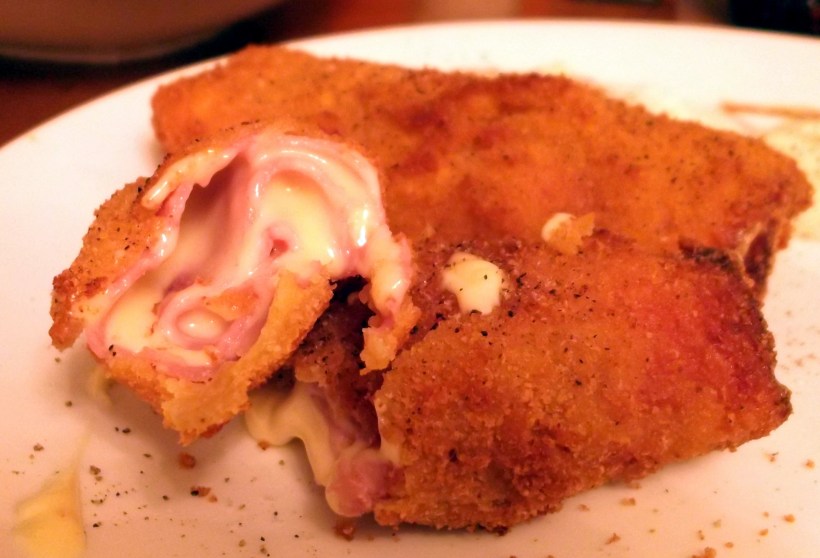
Saint Valentine…don´t you mean San Jacobo?

I have a work project on at the moment which is keeping me busy, so at home we´ve got a week or so of quicker to cook dishes coming up, or slow cooked dishes that I can put in the oven and then forget about for a few hours.

This speedy light lunch or supper is often served as a “child friendly” dish here in Spain. Sometimes you just don´t fancy “fancy” food. Something simple and speedy, and just a little naughty is required.  Deep fried ham and cheese coated in breadcrumbs hits the spot.  And if you serve it up with a dollop of ketchup and a fried egg with a runny yolk – well I won´t tell anyone that you´re not 9 years old!

Per person you´ll need

  • 2 large slices of your favourite ham
  • Enough thin slices of cheese to almost cover the ham (choose one that melts like cheddar, mozzarella etc)
  • A beaten egg plus 2 tablespoons of milk (this is enough for 4 slices of ham)
  • Dried breadcrumbs to coat the ham
  • Hot oil for frying

Place the cheese on the ham and either roll it up or fold it over to make a “sandwich”. Use a toothpick if necessary to keep your San Jacobo closed, but don´t forget to remove before eating…!

Dip the ham in the egg then the breadcrumbs and then repeat. This will give you a good seal so that the cheese doesn´t ooze out as it melts when it cooks, and a super crispy coating.

Get your oil very hot and fry (you can deep or shallow fry – your decision). Remove when browned and serve immediately.

I tried to find out why these little fried ham parcels are called “Saint Jacobs” but no one seems to know.  At least it makes the meal sound a little more gourmet than it actually is.  Make sure you have a cold beer to hand as a medical aid in case you burn your tongue on that lovely melted cheese.

PS. Happy Valentine´s Day to you all – young. old, single or happily with someone, it´s all about love…so go on, go out today and hug someone!