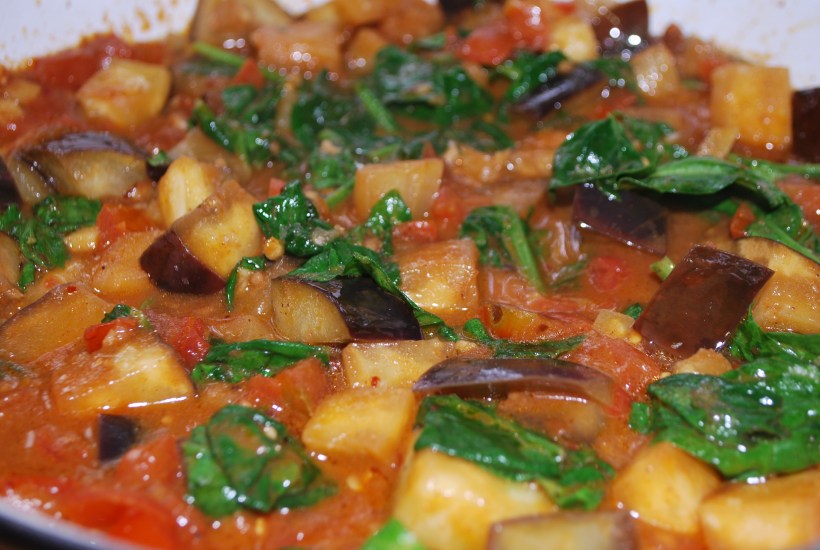
The Veggie Garden, although planted sparsely and late this year, continues to reward us with a bounty of aubergines. Always on the lookout for new ways to prepare old favourites, and in the midst of spring autumn cleaning, I came across a packet of tamarind paste from one of my UK trips. Perfect!
Internet searches came up with curry recipes, so thinking of a curry type base as inspiration, I made it up as a I went along, and oh my goodness…what beautiful flavours emerged from a few very simple ingredients.
Ingredients (to serve two as a main course with rice or four as a side dish)
1 large aubergine cut into small dice
1 large tomato, diced
1 medium onion, finely chopped
About 1 heaped tablespoon of fresh garlic and ginger paste (make this by finely chopping or mincing equal quantities of garlic and ginger, it can be stored in the freezer, and you can scrape off what you need)
About 2 cups of chopped fresh spinach
2 teaspoons of tamarind paste soaked in a little hot water
1 teaspoon of brown sugar
Salt to season
Water or vegetable stock
Half a teaspoon of hot chili powder (or to taste)
1 teaspoon of garam masala
Oil for shallow frying
Fry the aubergines until lightly browned and remove from pan. You can omit this step if you like but will need to cook the dish when all the ingredients have been added for about 10 minutes longer. Both methods are good. Add a little more oil if necessary and fry the garlic and ginger paste and onions until the onions are soft but not browned.
Add the tomatoes and cook until softened then add the chili powder and garam masala. After a further minute, add the aubergines, sugar and tamarind, season and pour over enough water or stock to cover the vegetables.
Simmer gently until the aubergines are completely tender (about 15 minutes) and just before serving add the spinach and cook until wilted.
Serve with a little chopped coriander and some plain boiled rice. Observant readers will note, however, that in the first photo I picked parsley by mistake!
In Spain we can easily buy chick pea flour as it’s used to make Tortillitas de Camarones, little deep fried “pancakes” made with the tiniest prawns imaginable. They are so very, very good. My previous experience of cooking with chick pea flour (or gram flour, garbanzo flour or besan) was in Indian cookery to make bhajis.
In my search for other uses, I kept coming across recipes for Socca, a chickpea flour pancake, usually cooked at high heat in the oven in a small cake tin or tray. I also found a version in my wonderful River Cottage Bread Handbook which was cooked in a frying pan. Perfect for summer when you want food you can cook quickly without using the oven. We ate this with Chargrilled Aubergines in Tomato Sauce – tearing up pieces of the pancake and dipping. Fantastic if you enjoy sharing dishes and are not too proud to slurp and lick your fingers!
Ingredients (per pancake)
100ml chick pea flour
100ml water
A good pinch of salt
Olive oil for frying
Mix the flour, water and salt together and leave to stand for a few minutes. Put a couple of tablespoons of oil in a frying pan and heat until it sizzles (this pancake is meant to be oily, so go on, be heavy handed with the oil!)
Pour the mix in, it should be thick in the pan and cook until it starts to char on the edges. Flip it over and cook the other side. Serve immediately and imagine you are eating it sitting in a bustling bar in the South of France sipping an ice cold beer and watching the world go by from under the brim of your slightly battered panama hat….
On Thursday morning we’ll be heading off down the mountain and driving north across Spain. Hopefully we’ll get our heads down for the night near Bordeaux and onwards Friday morning towards Calais and an early evening crossing to Dover. Then we go west to our little home in Bexhill. Just for a few weeks you understand, we have a Golden Wedding Anniversary to celebrate with my parents and walks along the beach with the pups. We will enjoy the last of the beautiful English summer before we head back to our mountain home for the September fiestas. I’ll still be checking in here, but perhaps not as often as usual. See you when we get there!
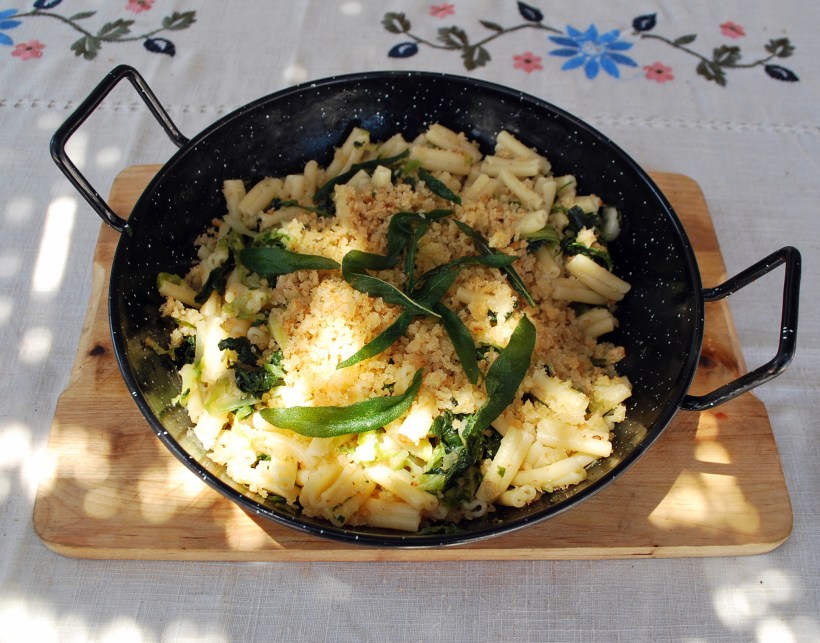
Well, anchovy and garlic too, plus a little parmesan at the end but it’s not such a snappy title that way. Big Man came home from one of his little excursions with a beautiful cabbage. I think in England they are called Spring cabbages, the lighter green ones with very tight leaves.
We enjoy it simply shredded and cooked for a few moments until wilted and then served cold with vinaigrette. But this was a whole lot of cabbage and I needed to find other ways to use it. I remembered a lovely Italian pasta dish made with Cavolo Nero (Tuscan Kale) and decided to make something similar.
If you prepare everything before you start cooking it’s quick to pull together, you just need to work methodically and in the time it takes for your pasta to cook (well, dried pasta at least) you’ll have a beautiful meal ready to take to the table.
Ingredients (per person, just multiply per number of diners but don’t worry about being too exact)
3 tablespoons of olive oil
6 fresh sage leaves
About 100g finely shredded cabbage
About 50g fresh white breadcrumbs
2 fat cloves of garlic, crushed
2-4 tinned anchovies (omit for a vegetarian version)
Parmesan Cheese
Your choice of pasta
Start by putting the water for the pasta on to boil and then blanching the shredded cabbage until it wilts. Remove from the water with a slotted spoon and drain, add your pasta to the water and, as long as you have your other ingredients prepared, you can get on with pulling the rest of the dish together.
Heat two thirds of the oil and when it is very hot drop the sage leaves in and cook for about 30 seconds. Remove with a slotted spoon and set aside.
Now add your fresh breadcrumbs and with the oil still on high, move them around in the pan (it helps to use a deep frying pan or wok for this dish) until they start to turn golden. Remove from the pan and put them onto a flat dish to cool slightly and crisp up.
Add the remaining oil to the pan and turn the heat down slightly before adding the garlic and anchovies. When the anchovies have “melted” (this won’t take long at all, a minute or so) add the cabbage and turn the heat back up to high. Stir fry for a couple of minutes (you can allow the edges to brown a little if you like) then add most of the breadcrumbs, reserving some to sprinkle over the top of the dish.
Drain the pasta and mix it in with the cabbage. It helps to add a tablespoon or two of the cooking liquid, but don’t overdo it.
Sprinkle over the remaining breadcrumbs and crispy sage leaves and serve with plenty of parmesan. Buon appetito!
Big Man and I are heading west on Saturday with the pups for a week in Portugal, the Eastern Algarve to be precise. I’ll try to post once more before we head off but it’s turning into one of those weeks. I know we won’t have internet coverage where we’re staying, but fingers crossed that I’ll be able to get online at some point. So…if I go quiet for a while it’s because I’m eating seafood or bacalao and sipping Portuguese wines whilst watching the sea. I’m sure you’ll understand!
I don’t know who discovered that by grinding grains, flour could be produced. And whoever then went on to figure out that by adding simple ingredients like water and air, you could end up with a delicious loaf of sourdough bread. As for pasta, whoever had that great idea of adding an egg and a pinch of salt to make a beautiful silky dough….well, I raise my glass of wine to them.
Not really much of a recipe today, more an acknowledgement that good food doesn’t need to be complicated or sophisticated. Ingredients, as long as they are fresh and good can produce the most incredible tasting meals with just a little effort and time invested. Oh yes, and love. Good food needs to be made with love.
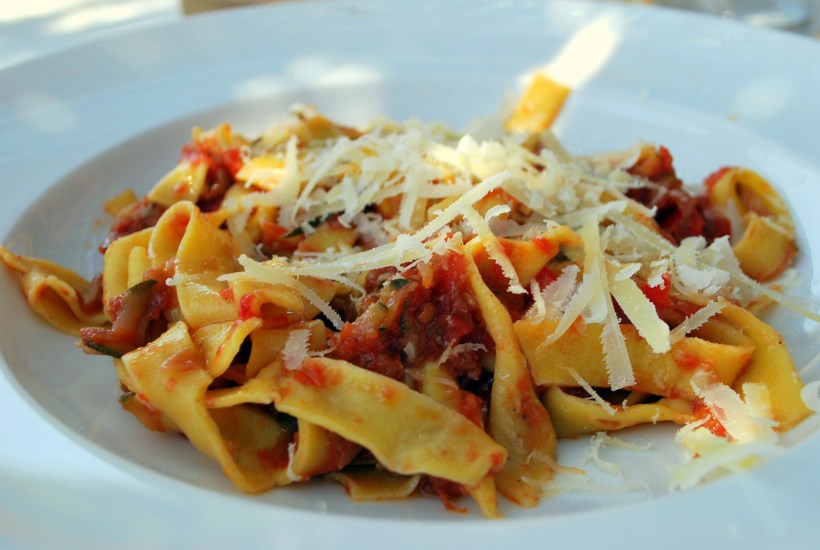
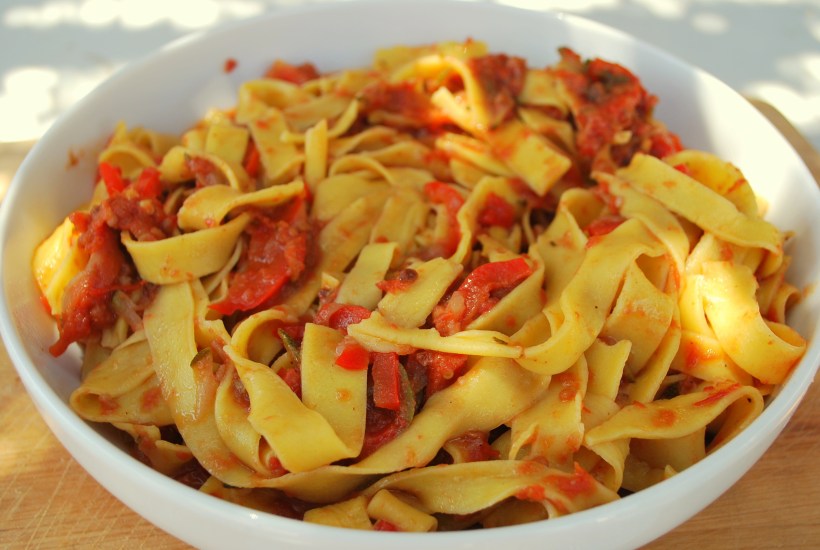
Lunch the other day was a homage to simple ingredients. Home made pappardelle (thick pasta as opposed to thin as the pasta cutting attachment on my machine has died, so I had to cut by hand) served with a (home grown vegetables) tomato and vegetable sauce with anchovies. Home made bread, dipped in our own olive oil and a glass of not home made wine. I’ll leave that to the experts!
Slow Cooked Vegetable Sauce with Anchovies (serves 2-4)
3 cloves of crushed garlic
Half a courgette (zucchini) coarsely grated
One carrot peeled and coarsely grated
One stick of celery, finely chopped
Half a red pepper thinly sliced
1 heaped tablespoon of tomato purée
1 cup (or can) or chopped tomatoes
Olive oil
Seasoning
Herbs (I used basil)
A small glass of red wine
About 4-6 fillets of salted anchovies
Start by slowly braising the garlic, courgette, celery, carrot and pepper (but don’t brown them) until they start to soften. Add the tomatoes, the purée, the wine and the herbs and bring to a gentle simmer. Season lightly and cook slowly for about an hour (or longer). If the sauce becomes too thick, add a splash of water. When nearly ready, remove the herbs if you have kept them whole and stir in the anchovies (leave these out if you want a vegetarian dish). Check for seasoning (you probably won’t need more salt) and serve.
Home Made Pasta
I use (per person as a main course) 100g strong plain flour, 1 egg, a tiny splash of olive oil and a tiny pinch of salt. Mix together by hand or in a machine and knead for a few minutes until the dough becomes soft and silky. Leave to rest for 30 minutes. Check out Chgo John’s excellent recipe for more tips and help.
I confess, I have been gripped by sourdough fever, and am now searching the internet for ways to use my starter.
A logical place for me to veer off to was a pizza base. We do enjoy homemade pizza here Up the Mountain on a fairly regular basis, and toppings usually involve a fridge clear out with half the pizza (I always make a big rectangular one, the same size as my oven tray) topped with meat and the other half vegetables. You all know I’m not a veggie, but one of my little quirks is that I’m not crazy about meat or fish on my pizza. So there!
When are the other 8 guests arriving?!
Ingredients (dough)
1 ½ cups of starter
1 ½ cups of plain flour
2 tablespoons of olive oil
1 teaspoon of salt
Mix all ingredients together and knead for a few minutes (I used my mixer with the dough hook). No need to leave to rise but if you don’t want to use it immediately, put into an oiled bowl and cover with oiled cling film. When you are ready to make the pizza, knock back the dough and roll out as thinly or thickly as you like.
This amount would make 2 large pizzas, I think I could have made less (using a cup each of flour and starter) as my pizza was thicker than I normally make it. Instead of being sensible (and healthy) and using less of the dough, I just left it more thickly rolled out than usual and made it fit my oven tray (heated) before spreading with home made tomato sauce, peppers and mushrooms on one side and jamon on the other and sprinkling with cheese before backing for about 25 minutes in a very hot oven.
It sounds so exotic doesn’t it…Cuban Style Rice? Well, sorry to disappoint, but it’s not at all! Arroz a la Cubana is a store cupboard, go-to dish. Often served in restaurants as part of the mid day “menu” and eaten by impoverished students all over Spain. What is it? Simply rice with tomato sauce and a fried egg on top.
As with many simple dishes, they can be comforting and filling. And they can be dressed up too, if this is what takes your fancy.
I almost always have some home made tomato sauce in the fridge. In the summer our little huerto provides me with tomatoes to see me through most of the year, and even though we missed the end of the summer in Spain, I managed to freeze plenty of tomatoes which will keep me going for a month or so until this season’s vegetables are available to me.
There may be a different way of making Arroz a la Cubana, this is my method which gives you a slightly soupy textured rice, almost like a risotto.
Ingredients (for two as a main course)
1 cup Spanish paella rice
1 ½ cups of water
1 cup of tomato sauce (sofrito) Recipe below
Salt and pepper
Start by bringing the rice and (salted) water to the boil, reduce the heat and continue to cook slowly until most of the water has evaporated. Now add the tomato sauce, check for seasoning and continue to cook for a few minutes more until the rice is almost done. Turn off the heat, cover the rice and leave to stand for 5 minutes, by which time the rice will be done.
Typically served with a fried egg on top, a great veggie meal, I added some cooked green beans and topped the rice with griddled loin of pork. Delicious with a drizzle of extra virgin olive oil and a squeeze of lemon juice.
Fresh basil or oregano (stalks and leaves, not chopped)
A glass of red wine
About half a teaspoon of sugar
Put the garlic into a few tablespoons of olive oil (do not heat the oil first, we don’t want the garlic to brown) and cook slowly for a few minutes until it starts to soften. Now add the tomatoes, the tomato purée, the wine and the herbs. Season lightly and simmer for about 30 minutes until thickened. Check for seasoning and if it is a little sharp, add the sugar (this is not always necessary). Cook for a few minutes more, remove the herbs and you’re done.
Yes, my sourdough starter is now up and running and ready to make bread with. Apologies for the length of this post, it’s hard to explain what I did in just a few words, so if you’re not interested in the process, have a look at the photos and come back again soon for some quicker recipes – you’re always welcome here!
Third TIme Lucky Loaf!
First up I tried a recipe from the very good River Cottage Bread handbook, but it involved proving the bread 4 times (yes, 4 times!) which felt rather too much like a chore to me. The gas oven did not behave well and the recipe also involved trays of water and spraying the bread.
I did get a lovely tasting loaf, but the process was amazingly labour intensive. A recipe from the lovely Moro Cookbook involved very little work but my brain told me as I did it that it wasn’t going to work for me. And it didn’t. Flat as a very thick pancake bread.
I would have liked more holes in it, but it tasted wonderful…
I also struggled with proving and baking trays and came across a few folk who had used oven dishes with lids (or casserole dishes or Dutch ovens). Some dusted them with oatmeal to stop the bread from sticking and one person used greaseproof paper. I wish I could track her recipe down to acknowledge properly, but I can’t find it again…..apologies to the person who had this great idea.
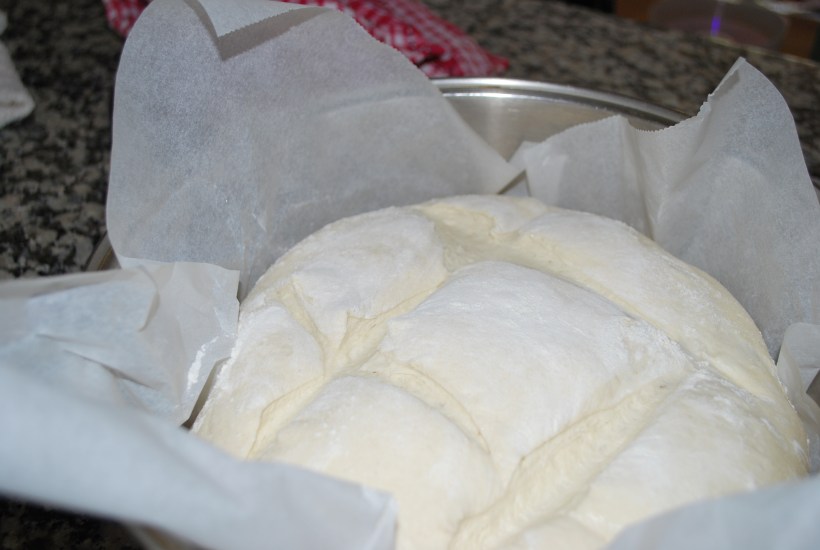
So, with no further ado, I used a recipe from the River Cottage website, with a few tweaks of my own and the oven dish/greaseproof paper method of baking. Result? A beautiful looking and tasting loaf of sourdough bread. Now, if someone can advise me on how to make the bread denser and more sour tasting I’ll be a very happy bread baker!
For the sponge
•About 100ml active starter
•250g strong bread flour (white, wholemeal or a mixture)
•300ml warm water
For each loaf
•300g strong bread flour (white, wholemeal or a mixture)
•1 tbsp olive or rapeseed oil (optional)
•10g salt
The night before you want to bake your loaf, create the sponge: take about 100ml of your active starter, and combine it with 250g fresh flour and 300ml warm water in a large bowl. Mix well with your hands, or very thoroughly with the handle of a wooden spoon, then cover with clingfilm and leave overnight. In the morning, it should be clearly fermenting – thick, sticky and bubbly.
Moby Dick – a beast of a sourdough starter
Now make your loaf: add a fresh 300g flour to the sponge, along with 1 tbsp oil, if you like (it will make the bread a touch softer and more silky, but is not essential), and 10g salt (which is essential). Squidge it all together with your hands. You should have a fairly sticky dough. If it seems tight and firm, add a dash more warm water. If it’s unmanageably loose, add more flour (but do leave it as wet as you dare – you’ll get better bread that way). I did this and the next stage in my mixer with the dough hook.
Turn out the dough on to a lightly floured surface and knead until smooth and silky. This takes in the region of 10 minutes, but it can vary depending on your own style and level of confidence. Put the dough in a lightly oiled bowl and turn it so it gets a light coating of oil. Cover with lightly oiled clingfilm, or put the bowl inside a plastic bag, and leave to rise. Don’t expect it to whoosh up to twice its original size in an hour, as a conventional loaf does. Sourdough rises slowly and sedately. The best thing is to knead it in the morning then simply leave it all day (or knead in the evening and leave overnight) in a fairly cool, but draught-free, place, until it is more or less doubled in size and feels springy when you push your finger gently into it. Knock it back (deflate it) on a lightly floured surface.
The dough has risen – hallelujah!
You now need to prove the dough (i.e. give it a second rising). You are also going to be forming it into the shape it will be for baking. If you have a proper baker’s proving basket, use this, first dusting it generously with flour. I lined a bowl (which was roughly the same size as my oven dish) with greaseproof paper and sprinkled it with a little flour). When the dough had doubled in size (it only took a couple of hours as it was a warm day) I lifted the bread out with the paper and placed both the paper and bread into the oven dish (which I had heated for about 20 minutes) slashed the bread with a sharp knife, sprinkled it with a little flour and put the lid on the pot.
I cooked it on the high temperature the entire time for about an hour and removed the lid for the last 20 minutes of cooking. Leave to cool completely (it’s hard to resist, but your bread really will have a better texture if you allow it to cool), enjoy!
A week, so it is said, is a long time in politics and an extended absence from the mountain is a long time in terms of what arrives at our doorstep. Bread Man was a bit all over the place for the first few days, but we seem to have settled back into a routine. I’m also getting going with my sourdough starter, using Sawsan’s brilliant tutorial, so I’ll let you know how my adventures in sourdough bread making go once I’m ready.
Fish deliveries continue but Fish Man has been replaced by a very jolly young lady who hails from Big Man’s home town, so she can clearly be trusted to bring us nothing but the best (according to Big Man). Yesterday she had some beautiful mussels, and for once they didn’t need too much scrubbing to get them ready for the pot.
A simple, hearty lunch of mussels with chorizo was made in minutes, and thanks to Bread Man, we were able to mop up any juices that had escaped our slurping.
Ingredients (for 2 as a main course or 4 as a starter)
1kg cleaned mussels (discard any broken or open shells)
4 cloves of garlic peeled and thinly sliced
2 fresh chorizo sausages (or about 30cm of dried chorizo) sliced
A small glass of white wine
Freshly chopped parsley and lemon wedges to serve
Simply sauté the chorizo until it starts to brown (no olive oil needed usually as chorizo is quite fatty) then add the garlic. Stir into the oil for a minute or so until it starts to soften then add the mussels and wine (or a glass of water if you don’t like to cook with alcohol). Cover with a lid and continue to cook for a few more minutes until all the shells are open.
Serve with all the juices poured over, sprinkle over the parsley and let each person add lemon juice to taste. ¡Buen provecho!
If you haven’t seen the film Groundhog Day, you won’t know what I’m talking about. In summary, it’s about a man who wakes up each morning and experiences the same day over and over and over again. Of course, he learns from his experiences and it all ends well.
When we got back Up the Mountain we were dreaming of months of rest and long lazy days which did not involve DIY, house repairs or anything to do with a paintbrush. There was a slightly damp smell in the house which we put down to the very wet winter which Andalucía has experienced and the fact that our house has been unheated and unlived in for quite some time.
Alas, we were deluding ourselves and some damage caused a few years back by a leak in the roof plus the wet winter has caused a significant amount of damp, particularly in my beloved “despensa” or larder. Today we had to remove everything, including the shelving, from the despensa.
The house is in chaos and we are climbing over things to get from one place to another. It will all be put right soon, I know, but I think we both had a moment or two today of wanting to run away and hide from it all.
Salvation lay in the freezer and with the arrival of Fish Man with fresh calamares. Last summer’s produce was tucked into the freezer and there it awaits us. I cooked a quick peperonata (for which there are quite possibly as many recipes as there are Italian Mammas) and served it with calamares cooked on the griddle pan and drizzled with our olive oil and some sweet balsamic vinegar.
Ingredients for the Peperonata (serves 4) Serve hot or cold
About 500g of crushed tomatoes
1 large onion finely sliced
About 4-6 large peppers (use a mix of colours if you can) cut into bite sized chunks
2-3 large clove of garlic, crushed
A small glass of red wine (optional)
Fresh herbs (I used oregano but basil is also good)
Olive oil
Seasoning
Simmer the garlic and onions in a little oil until soft, then add the peppers. Turn up the heat and fry until the edges of the peppers start to turn brown. Add the tomatoes, herbs and wine (if using) season lightly and simmer for about 30 minutes until reduced and the sauce thick and the peppers starting to melt.
Taste and adjust the seasoning and remove any large pieces of herbs. Great too stirred into pasta but I love it best eaten cold with a little squeeze of lemon juice and plenty of crusty bread.
For a quick lesson on how to clean squid (calamares) if you can’t find it ready prepared, take a look here.
So…tomorrow we move from house renovation Number 2 into our little second home by the sea. It’s been a long 9 months on and off between England and Spain and in other ways it’s flown by. What an experience, we’re lucky to have had it!
The plan is to head back to Spain in about 2 weeks and take a very long rest until we head back to England late autumn and do it all over again. Of course, now it’s become a joint enterprise/job for us and we plan to continue this way for another year or two. Who would have thought this City Slicka turned Chica Andaluza would now become a Lady Builder (as one of my neighbours calls me)?!
I was a sad Chica because all the windows and doors were rotten and had to come out
Moving on from one home to another, even if it was only a temporary one, still involves packing up belongings that have accumulated (mostly in the kitchen, I confess) and the little flat is starting to look like home as the furniture goes in.
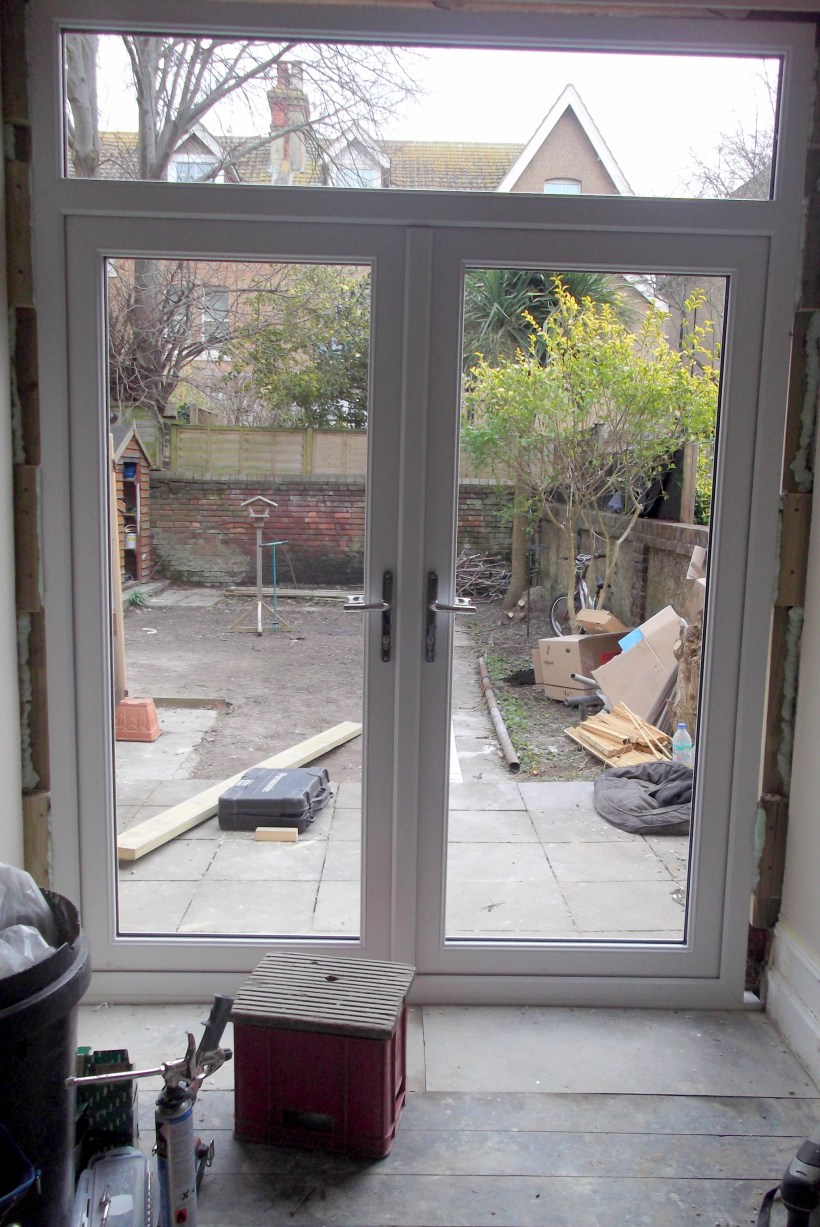
Coming to terms with the new French Doors
And in the same way as a major move, or before the start of a holiday you have to clean the fridge out. Well, you have to eat the contents first before you clean and for people like Chgo John who makes Frittata, this is a challenge which is risen to with pleasure. As we have no chickies here to feed, there were vegetable delights to be made. Here are a few ideas, not exactly recipes, for those days when you need to go shopping but still have a few things to finish off, or you’re eating the contents of your fridge before a holiday or a house move!
Finally…loving the light in our new kitchen!
First up was a salad using up cold boiled potatoes, an avocado which wouldn’t last another day, a bag of spinach and a handful of mushrooms. The potatoes were lightly sautéed then the sliced mushrooms added until they were cooked. The spinach was chopped then added and a lid put over the pan until it wilted. Chopped avocado was stirred in and the whole things was dressed with olive oil and balsamic vinegar.
The next day leftover cooked green beans were stir fried with mushrooms and dressed with olive oil and lemon juice while still warm and the zest of a lemon grated over for extra “oomph”.
Finally, a few rashers of grilled bacon made a light supper salad dish with rocket, raw spinach, avocado, baby plum tomatoes and chunks of fresh parmesan and a dressing made with mustard. On the side we ate grilled ciabatta rubbed with a clove of garlic and then drizzled with olive oil and sprinkled with rock salt.
I suspect tomorrow may well have to be a take away…well, the fridge is empty!
So in 2016 I turned 50. I was in Italy for my 21st, 30th and 40th. To keep this birthday tradition going I always knew I'd be in Italy for my 50! This blog starts with my 5 week adventure in Puglia but my love affair with Italy continues.....










 Chica Andaluza