Morrete de Setas – Mushrooms with Potatoes

If like me, you are the sort of person who is not put off by strange translations into your native tongue of a dish you encounter on your travels, this one is for you. Coming across this dish in a small local restaurant near our mountains in Southern Spain, you’d probably read something like “Mushrooms to the wild, cooking with soft potatoes of the saffron dressing up in vinegar”. Or some such bizarre description.

It doesn’t even look that pretty, as the end dish is indeed “with soft potatoes” and has rather a look of mush about it. What you would be served with, however, is a dish with simple ingredients combined in a way you’ve probably never tasted before, and a flavour that makes you say “ooh, that’s so good…I really didn’t expect that”!

Morrete de Setas 004

Around our neck of the woods (or Up Our Mountain), the most commonly eaten mushrooms are Oyster mushrooms. We have grown them ourselves in the past and Big Man would often come home with a crate of them for me to turn into dishes like Mixed Mushrooms with Cinnamon and Lemon or Braised Mushrooms. This dish is made across Andalucía but is probably known by other names outside of the radius of our local villages. Here’s our local version, the simplicity of the ingredients hides a wonderful combination of flavours. It is vegetarian/vegan and can be served alone as a tapa or starter, or alongside other dishes as part of a meal. A poached or fried egg is a wonderful accompaniment.

Ingredients (to serve 6-8 as a tapa, 4 as a starter or 2 as a hearty main course)

  • 1 kg peeled and cubed potatoes (cut into small cubes)
  • About 600g of thickly sliced mushrooms (I used a mix of Shitake, Chestnut and Forestiere Mushrooms)
  • Olive oil for frying
  • 1 level teaspoon of sweet pimentón
  • ½ level teaspoon of hot pimentón
  • A pinch of saffron or turmeric (in Spain though you find they usually use food colouring)
  • About 60g of stale bread
  • 2 cloves of garlic, peeled
  • About 240ml water
  • About 2 tablespoons of white wine vinegar
  • Salt and pepper

You will need 2 frying pans (or you will need to cook the potatoes and mushrooms separately. In one pan with about ½ cm of oil to cover the bottom, slowly cook the potatoes until they are soft and just starting to brown at the edges. Mix occasionally as they cook. You don’t want them to be crispy like chips.

In another pan, add a little oil, the mushrooms and some salt and cover with a lid. Slowly braise the mushrooms until soft and releasing their juices. The potatoes and mushrooms both take about 20 minutes to cook.

Meanwhile, put the bread, water, garlic, spices and 1 tablespoon of vinegar into a blender jug and blend (I use a hand blender) until you get a mix which resembles slightly runny porridge.

Drain the potatoes from the oil and add to the mushrooms and pour in the bread/water mix. Cook gently for about 10 minutes until it all thickens up (you may need to add a splash more water). Just before serving, taste and season and add a further tablespoon of white wine vinegar. Think of the resulting taste in the same way that you would use lemon juice to “lift” a dish.

Serve with plenty of crusty bread and if you’re feeling a bit cheffy, some chopped parsley on top makes it look pretty. But don’t tell the local village ladies I said that as they’d be horrified at any such nonsense.
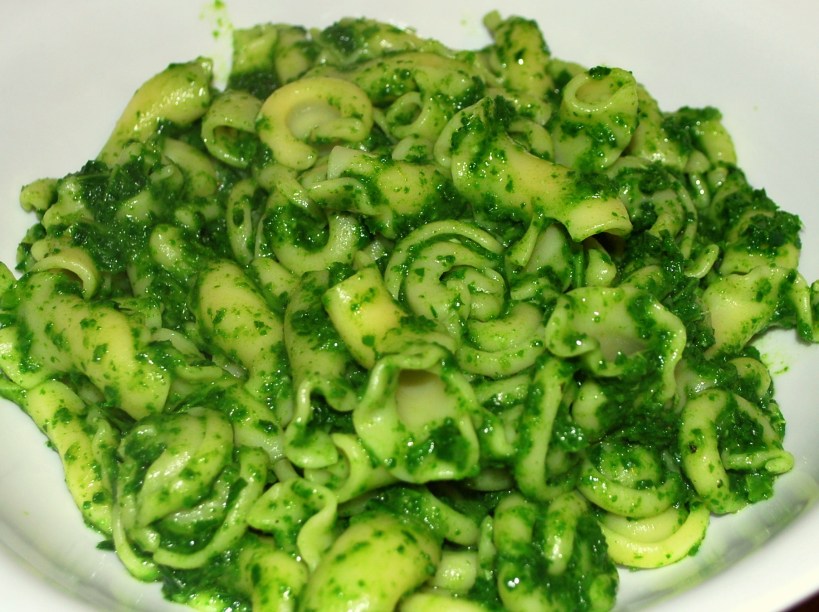
Pasta with Kale (in the absence of Cavolo Nero)

January is a dark, gloomy month for those of us in the Northern Hemisphere. For many of us it is a month of tightening the financial belt and loosening the trouser belt (whilst making plans to get fit) after the excesses of Christmas.

This is a dish which ticks all those resolution boxes – healthy, economical and it looks like Spring in a bowl, which is no bad thing. The garlic will ward away germs (or so my old Italian aunties always told me), it’s quick to prepare and you’ll feel comfortably full but without the feelings of guilt after eating this. Sounds good to me!

Even looking at it fills you with vitamins!

This dish was food for the poor folk…simple ingredients (although if you can afford to use your best olive oil, I’d highly recommend it) and no fuss to make.

Quantities are easily halved or doubled, I used regular kale as I didn’t have cavolo nero (also known as black leaf kale), and it was delicious. The colour was a more vibrant green than the almost black-green you get with cavolo nero.

Ingredients (to serve 2 people very generously)

  • 200g of kale leaves
  • Approx 100ml of extra virgin olive oil
  • 3 cloves of garlic, peeled
  • Maldon (or coarse) sea salt and black pepper
  • Grated parmesan to serve (optional)

Bring a large pot of salted water to boil and cook the kale and 2 of the garlic cloves for about 5 minutes until soft. It needs to be slightly more than wilted, but not soggy. Drain and put into a food processor.

As you start processing the kale, add slugs of olive oil to the mix until you have a slightly sloppy paste – rather like pesto.

Pasta with Cavolo Nero (1)

Crush the remaining clove of garlic with a teaspoon of rough salt and add 2 teaspoons of olive oil then stir this into the kale mixture. Taste and season with extra salt and black pepper if necessary and then stir into your favourite pasta, making sure you keep a little of the cooking water to loosen up the pasta if necessary once you have added the kale.

To serve, add grated parmesan if liked and some folk even add a little extra drizzle of olive oil. Go on, I won’t tell anyone!

If you’d like to see how we make our olive oil in Spain, click here.

Mixed Bean, Pork and Sausage Hot Pot

When in England we get to enjoy a wide variety of different foods that we wouldn’t normally have access to in Spain. Sometimes though, we long for the taste of our other home. If we lived in London, it would be easier to get hold of some of the more authentic ingredients to recreate certain dishes, outside of London it’s a bit trickier. Sometimes, London or not, you can’t get hold of them at all.

Our beloved Fabada, from the north of Spain, is one dish that it’s particularly tricky to replicate exactly without the traditional beans and smoked meats. No matter, we make do and end up with a delicious variation of the original. Fusion cooking? No….we’re not that trendy! Make do and mend? You bet!3 bean & sausage potaje (1)


This is a dish you need to plan in advance (especially if you are going to use dried beans which will need soaking overnight). It tastes even better the day after you’ve made it, so is a great one to prepare ahead, or use the slow cooker.

In Spain, this style of dish using dried beans is called a Potaje (pronounced po-tah-heh) which is similar to the French word Potage and the old English word Pottage. All three dishes seem to have much in common with each other as well as the name – do check out the links if you have time.

Ingredients (to serve 6 as a main course)

  • 500g mixed dried beans, soaked overnight
  • 6 fresh chorizo sausages
  • 4-6 slices of pork belly
  • A length of black pudding (or morcilla or boudin noir) about 25cm in length
  • 2 bay leaves
  • ½ teaspoon of saffron (or turmeric)
  • 1 teaspoon of smoked pimentón
  • Salt (smoked if you can get it)
  • Water

Cover the soaked beans with plenty of cold water and bring to a fast boil. Boil hard for 10 minutes, skimming off any froth that appears on the surface.

Now add the rest of the ingredients except the salt, and bring back to the boil. You can now either put the whole thing into a slow cooker and cook on low for about 8-10 hours, simmer on the stove top for about 2 hours or cook on low in the oven for 4 hours. Make sure you use a dish which has a lid.

When the cooking time is up, test the beans. They should be soft and creamy, even a little mushy. Season to taste. When you are about to serve, put the pot back onto the stove top (transfer to another pot if you used the slow cooker) and return to a fast boil for about 5 minutes. The liquid will turn from a clearer state to cloudy, and thicken at the same time.

Slice the pork belly and black pudding into smaller pieces and serve each person with beans, a chorizo and some pork belly and black pudding. A final drizzle of fresh, fruity olive oil over each dish will really lift the flavour. A perfect dish for a hearty lunch on a cold day.

If you like this kind of dish, why not check out this dish of Pork Shanks with Giant Beans

We need more wine, the bottle is almost empty!

or Cod with Butterbeans?

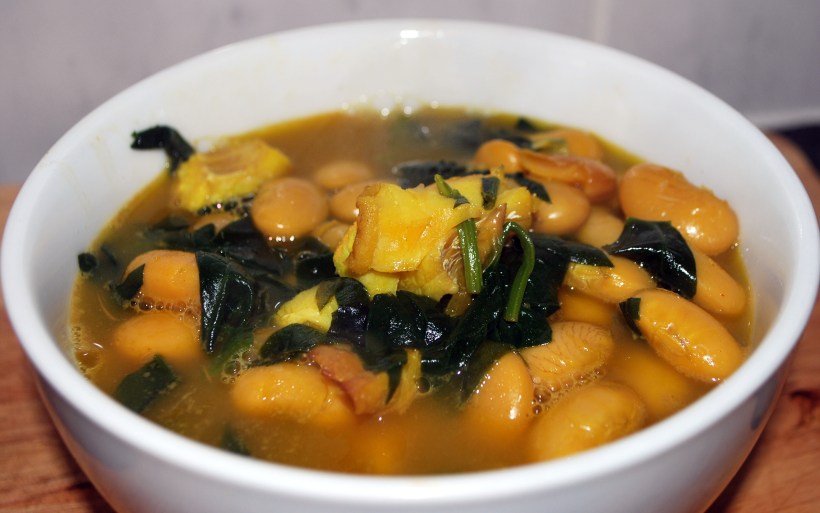
Smoked  Cod & Butterbean Stew (1)

Honey, Ginger and Soy Glazed Salmon

It’s summer and some days the weather turns warmer, hurrah!  Lighter, quicker to prepare dishes are firmly on the menu.

This is not an unusual dish, I am sure we all have variations of something similar in our repertoire, but sometimes it’s good to be reminded of ways of preparing dishes that we’ve loved and then forgotten.

Sticky Soy Salmon (3)

Ingredients (per person)

  • 1 salmon fillet (sustainably farmed if you can find it)
  • ½ teaspoon runny honey
  • 1 teaspoon of light soy sauce
  • 1 teaspoon dark soy sauce
  • 2 teaspoons of rice vinegar
  • ¼ teaspoon finely chopped ginger (or grated)
  • ½ clove of crushed garlic

Mix all the marinade ingredients together and leave the salmon in it for at least 15 minutes but up to a few hours if you have time (remember to turn it over occasionally).

Drain then fry the fillets in a non stick pan (you won’t need any oil) for a couple of minutes each side until lightly browned. Remove from the pan and pour in any remaining marinade and cook quickly until it bubbles, pour this over the fish. I served this over a green salad packed full of gorgeous things like rocket and asparagus. A cheeky glass of white wine is most definitely recommended!


Ham Hock Persillade

Some neighbours of ours in England recently moved from Bexhill on Sea to the wilds of Bonny Scotland. As with most house moves, it was a chance for them to de-clutter. Fortunately for me Mr Neighbour managed a local bookstore and as a result of this had a house packed full of a wide variety of books. I assume these had been come by through honest means and he didn’t shove a book down his trousers each night as he went home. It would have been churlish to ask as I was the lucky recipient of an eclectic collection of books.

One of them was Gordon Ramsay’s Sunday Lunch. I have to confess that in the past I have had no f*****g time for him, he swears too much…Jokes aside (yes, that was a little joke) I just hadn’t ever bought any of his books or watched any of his programmes so I was a little reluctant to even read the book, let alone use it. I’m so glad I did delve into its pages…a lot of very uncomplicated recipes and menus, dishes that I actually wanted to cook. Sorry Mr Ramsay, you bl**dy surprised me!

Persillade (1)

A local butcher regularly sells cooked ham hocks. It’s the knee basically, cooked and then sold with the gelatine (formed by the cooking liquid) for a bargain price of less than £3 (that’s about the same in Euro and a few US dollars more). I often buy them as the ham picked off the bones is great in sandwiches or soup and the dogs love the bones which keep them entertained in the garden for hours. Result all round.

I came across a recipe in the book, very grandly titled Ham Hock Persillade which reminded me of the delicious brawn my mum makes. The recipe called for cooking the ham and reducing the stock with gelatine to solidify it. No need for that, my hock was already cooked and covered in the delicious stuff. I halved his recipe which he says serves 6-8. Even my halved version (using pickled garlic instead of gherkins as I didn’t have any) would easily have fed 8 as a starter, probably with a little left over. I served it as a starter (for 5 people) thickly sliced on top of a salad of spinach and watercress and also as canapés (there were 6 of us for drinks and nibbles), cut into little cubes and served with some very retro cocktail sticks!

Persillade (6)

Ingredients

  • 1 large cooked ham hock and its gelatine
  • 2 tbsp large capers, cut into slices
  • 2 tbsp pickled garlic, thinly sliced
  • Handful of flat leaf parsley finely chopped

You will need a loaf tin or a deep plastic container.

Remove the gelatine and skin from the hock and place into a saucepan with about half a cup of water.

Pull the meat off the bones (the bones will now also go into the saucepan) and shred it. Set the meat aside.

Boil the skin, bones etc for about 7 or 8 minutes then drain the liquid and leave it to cool slightly.

Mix the shredded meat with the capers, garlic (or use gherkins), parsley and some freshly ground pepper. You probably won’t need salt as ham hocks tend to be quite salty. Put this mixture into a loaf tin or plastic tub lined with cling film then pour the liquid over until the mix is completely covered. Tap the tin or terrine gently to get rid of any air bubbles, cover with cling film and place a weight on top. Chill overnight or until it has set.

Persillade (10)

When you are ready to serve, peel off the cling film on the top and invert the container onto a serving plate. It should slide out easily, then you can peel the remaining film off. Serve cut into thick slices (Mr Ramsay serves his with piccalilli which I imagine must be very good). A really impressive but not too tricky to make dish. Would be great for a picnic too as it’s very portable when still in its mould.

Thanks Mr Ramsay, a flippin’ marvellous recipe!

Green Lentil Curry

We all know (and some of us love) dhal made with little red lentils. It’s fast and simple to cook and immensely gorgeous. This curry takes longer to prepare as the green (or you can use brown) lentils need about 45 minutes to an hour of cooking to become tender and delicious. It’s worth the wait though, I promise.

The recipe comes from Anjum Anand’s book Anjum’s New Indian and is perfect as a vegetarian main course or as a side dish in a larger meal. Economical to make and if you make curries regularly you’ll have most of the ingredients to hand. Delicious eaten with naan bread and/or plain boiled rice – I added a dollop of creamy yogurt and a sprinkle of chopped fresh coriander.

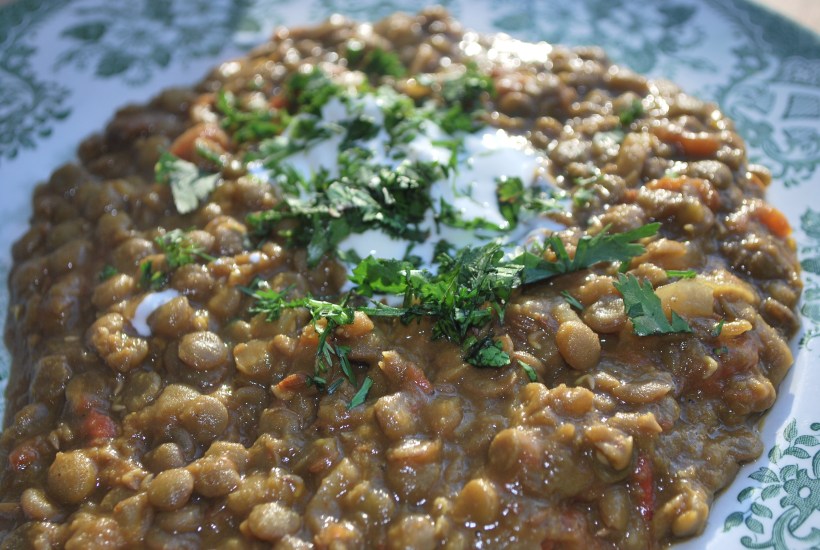
Green Lentil Curry (9)

Ingredients (to serve 4-6 as a side dish)

  • 250g green lentils
  • A paste made from about 6g of peeled fresh ginger and about 4 cloves of garlic
  • 3 tbsp vegetable oil
  • 2 tsp cumin seeds
  • ½ small onion, peeled and chopped
  • Salt
  • 1 rounded tsp ground coriander
  • ½ tsp garam masala
  • ½ tsp red chilli powder (or to taste)
  • ½ tsp turmeric
  • 3 small tomatoes puréed or grated or finely chopped
  • Finely chopped fresh coriander leaves and stalks

Rinse the lentils and simmer in plenty of water until soft (about an hour).

Heat the oil and add the cumin seeds until they give off their scent then add the onion and cook until golden brown. Pour in the garlic and ginger paste and cook until this turns golden then add the salt and powdered spices and cook for 10 seconds.

Pour in the tomatoes and simmer until the moisture has cooked off and the oil has separated from the mix to form the masala. Taste and adjust the seasoning if necessary. Add the masala to the lentils and simmer for about 10 minutes. Check the seasoning again, sprinkle with coriander and enjoy.

Sweet Potato Gratin

In our little Up the Mountain village, sweet potatoes are only available to buy in the local shops during late summer and autumn. They even sell them ready roasted as there are still folk who don’t have ovens and do most of their cooking on the stove top. Of course, if we venture down to the coast and the big supermarkets, we can buy sweet potatoes whenever we want, but the choice of variety is still fairly limited to the large orange fleshed, thick skinned varieties.

Time spent in England Down by the Sea brings a world of vegetables to us in a local supermarket whenever we want. I try to buy seasonally, but with vegetables flying in from all over the world it’s sometimes hard to know what is in season and what is not. It’s also tempting to buy things just because you fancy them. This was the case with some very small, thin skinned sweet potatoes I spotted the other day. They were about 25cm long and just a bit thicker than a fat sausage. I was intrigued and couldn’t resist.

Sweet Potato Gratin (3)

Two were simply roasted and utterly delicious but a lot sweeter than the ones we’re used to. I turned to my old pal Ottolenghi for inspiration and his cookbook delivered with a sweet potato gratin which I chopped and changed (adding in regular potatoes with the sweet ones and changing the chopped sage for parsley as I am being over run by the stuff, and using milk instead of cream). Go back to the original ingredients for a really stunning and luxurious dish (I’ve eaten that version too – it’s incredible) or stick with my recipe for a more every day dish.

This is pretty filling and is great as a vegetarian main course or as part of a larger meal as a side dish.

Ingredients (to serve 2 people as a main course)

  • 2 small sweet potatoes, thinly sliced but with the skin on
  • 2 medium potatoes, peeled, halved and thinly sliced
  • 3 tsbp finely chopped parsley
  • 2 cloves of peeled garlic, crushed
  • A tablespoon of olive oil
  • Salt and pepper
  • About 120 ml (1/4 cup) of semi skimmed milk

Preheat the oven to 180 degrees C. Mix together the two types of potato and the parsley, garlic and olive oil.

Layer the slices in an ovenproof dish and season. Cover with foil and bake for about 30 minutes then remove the foil and pour over the milk. Roast for a further 30 minutes and check that the potatoes are cooked by testing them with a sharp knife.

The dish will be bubbling and hot, serve in the baking dish. Tastes great too at room temperature or even cold the next day.

Chorizo en vino con cebolla – Spicy Sausage with wine and onion

Chorizo in Spain is not like the chorizo you used to be able to buy in England – it was the hard, dry variety, rather like a little salami. In Spain chorizo is sold fresh – it looks like a bright red sausage and if you buy it at the butchers it’s sold in strings. You will be asked if you want it “fresco o seco” “fresh or dry”. The fresh variety is like a recently made sausage and is for cooking on the “plancha” or in a pan. The drier will have been made a few days or weeks previously and can be sliced and eaten as it is, in the same way as a salami.

Chorizo con Cebolla (5)

It’s typical to buy a good supply and then hang some up for eating later and cook the fresh chorizo. I’ve noticed that in England, in some butchers at least, they are coming up with some wonderful and authentic tasting varieties of fresh chorizo, but if you can’t get hold of any, use your favourite sausage and add a little spicy pimentón to give it a warm Spanish taste.

This is a very typical dish served as tapas, with or without the addition of the onions. As we were still working our way through the onion glut, I did it with onions!

Ingredients (to serve as many as you like)

  • For every chorizo you cook, you’ll need about half a medium onion finely chopped and a splash of medium dry Spanish sherry

Slice each chorizo into 4-6 pieces and fry in a little olive oil until the outside is slightly charred. If you are lucky enough to have a terracotta cooking pot, use this as it really does add something special to the flavour.

Chorizo con Cebolla (1)

Remove the chorizo and put to one side. Add the onions to the olive oil (and the chorizo will also have released some oil) and if you are using it, add a little pimentón. Fry the onions until they start to soften, but not caramelize and then add the wine. Cook until the liquid has almost completely disappeared and the onions are soft and coloured from the juices.  Add the chorizo back into the dish and cook for a couple of minutes more until warmed through.  Normally you won’t need any seasoning as the chorizo is highly spiced and salted, but check to taste and adjust if necessary.  Serve with a glass of ice cold fino and plenty of delicious bread.

Carrots with Cumin and Garlic Dressing

Well, the party’s over, the “Spanishes” have all gone home and fortunately Big Man and I walked miles and miles doing touristy things which helped burn off the excessive drinking/partying/eating calories which have been consumed over the last few weeks. I’ll share some photos of places we visited once I’m a bit more organised but for the moment it’s noses to the grindstone and back to renovations and a bit of healthy eating needs to be done.

Here’s another lovely, and very simple, recipe from the Moro Cookbook. In their version it´s billed as a salad and has coriander sprinkled over. I didn´t have coriander, so I made do! The dressing was fabulous and as I only made enough carrots for the two of us, there was plenty left over to dress a salad the next day.

Carrots with Cumin (3)

The Moro version cooks the carrots whole and then chops them when cooled but mine were too big to fit into the pan whole so I peeled and chopped them first.

Ingredients to serve 4

  • 450g carrots, peeled and thinly sliced
  • 2/3 teaspoon cumin seeds, dry fried
  • 1 garlic clove
  • Juice of ¾ lemon
  • Sea salt
  • 1/3 teaspoon caster sugar
  • 1 tablespoon olive oil
  • Some roughly chopped coriander


Cook the carrots in boiling salted water until tender, drain and leave to cool.

Pound the cumin in a mortar then add the garlic and ½ teaspoon of salt and continue to pound. Add the lemon juice, sugar and olive oil and mix before dressing the carrots with this delicious smokey, tangy dressing.

This recipe is made thinking especially of a wonderful fellow blogger, Fran, aka narf7 over at Serendipity Farm. With her husband Steve and beautiful dogs Earl and Bezial they are based in Tasmania and living a life which is as self-sufficient as possible. Miss narf is vegan and I’m not, but she makes wonderful comments on my posts (even those pork and beef laden ones!) and makes me laugh with her brilliant sense of humour. Do take the time to pay her a visit, you won’t regret it!

Pollo al Ajillo – Chicken with Garlic

Well, it’s been quiet around the blog for the last week or so. But for good reason. We’re in England with family visiting from Spain and we’ve been having a wonderful time doing family and tourist things, walking our feet off, talking our heads off and eating and drinking far more than is probably necessary…but such fun!  As a little reminder of Spain, here’s a Spanish dish which is equally good for an informal meal or a special event, Chicken with Garlic.

Ajo (the “j” is pronounced like the “ch” in the Scottish word Loch) means garlic and ajillo translates as “little garlic” which is ironic as this dish contains plenty of garlic! It’s a simple cooking technique which is used with various meats in Spain and is served as both a main dish and as a tapas (usually with the meat cut into bite sized pieces). Don’t let the simplicity of this dish trick you into believing it doesn’t taste special, it packs a lot of flavour and because it can be prepared ahead and in large quantities, it’s a fantastic dish for entertaining.


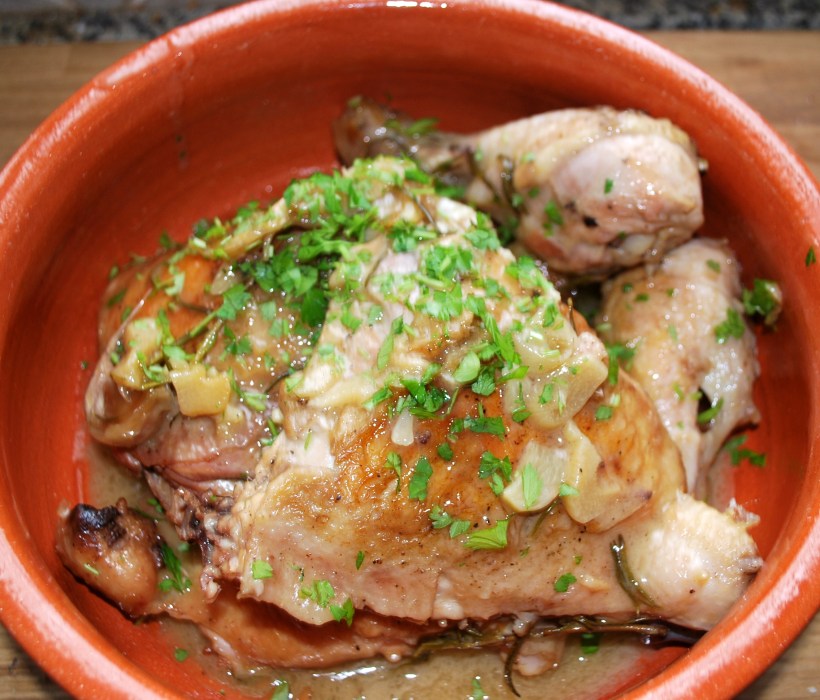
Pollo al Ajillo (1)

To serve 6 people

  • 1 whole chicken cut into joints (or use individual joints)
  • 1 head of garlic, about a third of the cloves peeled and cut into thin slices, the rest left in their paper skins
  • Olive oil
  • A glass of fino or white wine
  • A few sprigs of rosemary (optional)
  • Seasoning

Pollo al Ajillo (3)

Season the chicken then fry in a little oil until browned all over. Now add all the garlic, the rosemary and the wine, reduce to a gentle bubble and cover with a lid. Cook for about an hour (turning a couple of times during cooking) until the chicken is cooked through). Check the seasoning and adjust if necessary. Sprinkle with some chopped parsley and serve with plenty of bread to mop up the juices.

For another, more elaborate, chicken dish, why not take a look at my recipe for Pollo en Pepitoria?