Morrete de Setas – Mushrooms with Potatoes

If like me, you are the sort of person who is not put off by strange translations into your native tongue of a dish you encounter on your travels, this one is for you. Coming across this dish in a small local restaurant near our mountains in Southern Spain, you’d probably read something like “Mushrooms to the wild, cooking with soft potatoes of the saffron dressing up in vinegar”. Or some such bizarre description.

It doesn’t even look that pretty, as the end dish is indeed “with soft potatoes” and has rather a look of mush about it. What you would be served with, however, is a dish with simple ingredients combined in a way you’ve probably never tasted before, and a flavour that makes you say “ooh, that’s so good…I really didn’t expect that”!

Morrete de Setas 004

Around our neck of the woods (or Up Our Mountain), the most commonly eaten mushrooms are Oyster mushrooms. We have grown them ourselves in the past and Big Man would often come home with a crate of them for me to turn into dishes like Mixed Mushrooms with Cinnamon and Lemon or Braised Mushrooms. This dish is made across Andalucía but is probably known by other names outside of the radius of our local villages. Here’s our local version, the simplicity of the ingredients hides a wonderful combination of flavours. It is vegetarian/vegan and can be served alone as a tapa or starter, or alongside other dishes as part of a meal. A poached or fried egg is a wonderful accompaniment.

Ingredients (to serve 6-8 as a tapa, 4 as a starter or 2 as a hearty main course)

  • 1 kg peeled and cubed potatoes (cut into small cubes)
  • About 600g of thickly sliced mushrooms (I used a mix of Shitake, Chestnut and Forestiere Mushrooms)
  • Olive oil for frying
  • 1 level teaspoon of sweet pimentón
  • ½ level teaspoon of hot pimentón
  • A pinch of saffron or turmeric (in Spain though you find they usually use food colouring)
  • About 60g of stale bread
  • 2 cloves of garlic, peeled
  • About 240ml water
  • About 2 tablespoons of white wine vinegar
  • Salt and pepper

You will need 2 frying pans (or you will need to cook the potatoes and mushrooms separately. In one pan with about ½ cm of oil to cover the bottom, slowly cook the potatoes until they are soft and just starting to brown at the edges. Mix occasionally as they cook. You don’t want them to be crispy like chips.

In another pan, add a little oil, the mushrooms and some salt and cover with a lid. Slowly braise the mushrooms until soft and releasing their juices. The potatoes and mushrooms both take about 20 minutes to cook.

Meanwhile, put the bread, water, garlic, spices and 1 tablespoon of vinegar into a blender jug and blend (I use a hand blender) until you get a mix which resembles slightly runny porridge.

Drain the potatoes from the oil and add to the mushrooms and pour in the bread/water mix. Cook gently for about 10 minutes until it all thickens up (you may need to add a splash more water). Just before serving, taste and season and add a further tablespoon of white wine vinegar. Think of the resulting taste in the same way that you would use lemon juice to “lift” a dish.

Serve with plenty of crusty bread and if you’re feeling a bit cheffy, some chopped parsley on top makes it look pretty. But don’t tell the local village ladies I said that as they’d be horrified at any such nonsense.

Pasta with Kale (in the absence of Cavolo Nero)

January is a dark, gloomy month for those of us in the Northern Hemisphere. For many of us it is a month of tightening the financial belt and loosening the trouser belt (whilst making plans to get fit) after the excesses of Christmas.

This is a dish which ticks all those resolution boxes – healthy, economical and it looks like Spring in a bowl, which is no bad thing. The garlic will ward away germs (or so my old Italian aunties always told me), it’s quick to prepare and you’ll feel comfortably full but without the feelings of guilt after eating this. Sounds good to me!

Even looking at it fills you with vitamins!

This dish was food for the poor folk…simple ingredients (although if you can afford to use your best olive oil, I’d highly recommend it) and no fuss to make.

Quantities are easily halved or doubled, I used regular kale as I didn’t have cavolo nero (also known as black leaf kale), and it was delicious. The colour was a more vibrant green than the almost black-green you get with cavolo nero.

Ingredients (to serve 2 people very generously)

  • 200g of kale leaves
  • Approx 100ml of extra virgin olive oil
  • 3 cloves of garlic, peeled
  • Maldon (or coarse) sea salt and black pepper
  • Grated parmesan to serve (optional)

Bring a large pot of salted water to boil and cook the kale and 2 of the garlic cloves for about 5 minutes until soft. It needs to be slightly more than wilted, but not soggy. Drain and put into a food processor.

As you start processing the kale, add slugs of olive oil to the mix until you have a slightly sloppy paste – rather like pesto.

Pasta with Cavolo Nero (1)

Crush the remaining clove of garlic with a teaspoon of rough salt and add 2 teaspoons of olive oil then stir this into the kale mixture. Taste and season with extra salt and black pepper if necessary and then stir into your favourite pasta, making sure you keep a little of the cooking water to loosen up the pasta if necessary once you have added the kale.

To serve, add grated parmesan if liked and some folk even add a little extra drizzle of olive oil. Go on, I won’t tell anyone!

If you’d like to see how we make our olive oil in Spain, click here.

Syrian Style Roast Leg of Lamb

I was very lucky to have been given some fabulous cookbooks by my best buddy Ria. Ah she knows me so well! One is titled Almond Bar, written by Sharon Salloum, co-owner and chef of Almond Bar restaurant in Sydney, who was bought up in a traditional Syrian household. Ooh I’d love to go and eat there! Her recipes are based on family traditions, but adapted for the modern kitchen.

Syrian Lamb

As soon as I saw her recipe for roast leg of lamb, I knew I would make it for New Year’s Eve. We had family visiting from Spain and were going to have a fairly typical Spanish Family Celebration meal – masses of seafood and shellfish to start, lamb for main course, flan (or crème caramel to us!), fruit, Spanish biscuits, turrón and 12 grapes at midnight. The lamb was not typically Spanish because of the spices, but it was a big hit with everyone. The meat is cooked on high to start with then slowly cooked to tender perfection. Don’t wait until next New Year’s Eve to try this, I know I won’t be waiting that long!

(Apologies for the photo, it’s a cropped section of a family snap which also featured the lamb…)

Serves 8-10 (but you can scale it down for a smaller leg of lamb)

  • 2.5kg leg of lamb, bone in
  • 60ml olive oil
  • ¼ teaspoon ground cinnamon
  • ¼ teaspoon freshly grated nutmeg
  • ¼ teaspoon ground cumin
  • ¼ teaspoon sweet paprika
  • ¼ teaspoon freshly ground black pepper
  • ¼ teaspoon ground cardamom
  • 8 cloves crushed with a pestle and mortar
  • 3 teaspoons salt flakes
  • 6 cloves of sliced garlic
  • About 10 small sprigs of rosemary
  • 1 glass of white wine (not in the original recipe)

Preheat the oven to 200C (fan)/425F/Gas 7

Mix the oil with the spices, salt and pepper in a bowl. Rub the mix all over the leg of lamb then cut small incisions all over the lamb with a sharp pointed knife. Push the garlic and rosemary sprigs into the incisions.

Place the lamb in a deep oven dish and bake on high for an hour, turning after 30 minutes to brown on both sides. Pour the wine over the meat, cover the dish with foil to make a tent and reduce the oven temperature to 170C (fan)/375F/Gas 5 and return to the oven. Cook for another 2 ½ – 3 hours, basting every 20 minutes (but don’t stress if you do it a little less).

When the lamb is cooked, remove from the oven, keep it warm (I wrap it in foil and a couple of towels) and leave to rest for 15-30 minutes and serve with all the beautiful juices you will have left in the pan.

A Vegetarian Feast – Mushroom Risotto with Asparagus

We love risotto and I make it often. Some folk are nervous about it, thinking it will be a pain to stand and stir, and worrying if the rice will be over cooked or undercooked. Relax, pour yourself a lovely glass of wine and just enjoy about half an hour of gently attending to your dish while your mind sorts out the worries of the day. The diners will eat when the risotto is ready. No sooner, no later. And if you don’t like your rice too “al dente”…well you’re in charge, you can cook it for longer.

It’s a great dish too for using up whatever you have to hand. Personally I’m not so keen on meat risottos so this is a good option for us on the days when we choose not to eat meat or fish. To make this vegan you’d need to use vegan cheese and leave out the splosh of cream at the end – it will still taste amazing, I promise.

Arroz con Champinones y Esparragos 042

Ingredients to serve 6 as a starter, 4 as a main

  • 3 tbsp olive oil
  • 400g carnaroli or arborio rice
  • 1 finely chopped onion
  • 2 peeled and crushed cloves of garlic
  • About 10g of dried porcini mushrooms soaked in boiling water, drain and finely chop the mushrooms and reserve the liquid. Make the liquid up to 1.5 litres with vegetable stock and keep it hot
  • About 300g chestnut mushrooms, thinly sliced or finely chopped
  • A tablespoon of butter
  • Fresh parmesan
  • A good splosh of cream

Start by warming the oil in a deep frying pan and sweating the onions and garlic until soft. Add fresh mushrooms and cook gently until they are also soft then add the rice. Stir the rice in the pan to make sure all the grains are coated in oil then add the chopped reconstituted dried mushrooms.

Slowly add the hot stock, a couple of ladles full at a time, stir into the rice and when it has been absorbed, add more liquid. When the rice is almost cooked to your liking, turn the heat off and stir in the butter and cream, cover and leave to stand for 5 minutes.

Serve with griddled asparagus and large mushrooms (brush them with olive oil and season before cooking on a hot griddle) for a filling main course. Sprinkle with fresh parmesan as you serve if that takes your fancy.

Cranberry, Orange and Raisin Cake

Cranberries are not just for cranberry sauce and cranberry juice! And we all know they’re good for us, don’t we?! I love that sour taste of Cranberries, Big Man…less so. Oh dear. But he loves cake, so a perfect compromise is to make cake with cranberries in it. I do love a Win/Win cooking situation.

Cranberry & Orange Cake 001

This is a cake for people who are not very good with measuring ingredients as they can find the scales but not the old fashioned weights that go with it. It’s good for folk who have trouble finding the mixer or the electric whisk, who then accidentally turn the oven off for 5 minutes while baking a cake thinking they’ve turned the hob off, then open the oven door to see why the light in the oven seems to have stopped working. Yes, that was me, but this cake is like the hardiest Marine in the Cake Corps – nothing can defeat it, it WILL turn out fine no matter how badly you treat it. You can even half drop the tin as you’re turning the cake out – oh yes, I did that too – but it’s probably going to be prettier if you leave that bit out.

Ingredients for one large cake (serves about 12 – 14 slices)

  • 2 ¼ cups of self raising flour
  • ¼ teaspoon baking powder
  • ¼ teaspoon salt
  • ¾ cup sugar
  • The grated zest of one orange and the juice from the orange made up to 1/3 cup with water if there is not enough
  • 2 eggs
  • 1 cup yogurt
  • ¾ cup of oil (I used a mix of vegetable oil and olive oil)
  • 1 cup fresh cranberries
  • ½ cup raisins (or any other dried fruit you fancy)

Grease and flour a large baking tin. I used an 11” bundt tin, but a 9” square tin would also work well. Set the oven to 175 degrees C.

Mix together the sugar, orange juice, eggs, yogurt and oil. If you can find your electric whisk, go ahead. If not, use a hand whisk with a bit of fury until all the ingredients are well blended.

Not much left...
Not much left…

Add the dry ingredients and mix with a spoon, then stir in the fruit and zest. Pour into the prepared cake tin and bake for 45-50 minutes until the cake is pulling away from the sides of the tin, is browned on top and a skewer inserted into the middle comes out clean.

If you want to top it, mix 8 heaped teaspoons of sifted icing sugar with about 2-3 teaspoons of orange juice (add gradually) until you have a thick pouring paste, and drizzle over.

Make a pot of coffee, cut yourself a good slice of cake, put your feet up and relax…

For another olive oil cake recipe, take a look at my orange and raisin cake.

Slow Cooked Mustard and Cider Chicken

Beautiful Bexhill on Sea (ok, I’m biased!) has a wonderful library, housed in a very lovely Victorian Building which, I understand, was once a school.

Bexhill Library (I came across this photo on the internet – happy to acknowledge if it’s yours!)

We have access to books in Spanish for Big Man, books about Quilting for me, novels, internet, and pretty much everything you’d expect from a good library. We have a particularly good section of cookery books which allows me to try out ones I’m thinking of buying and to check out ones I’d never previously come across.

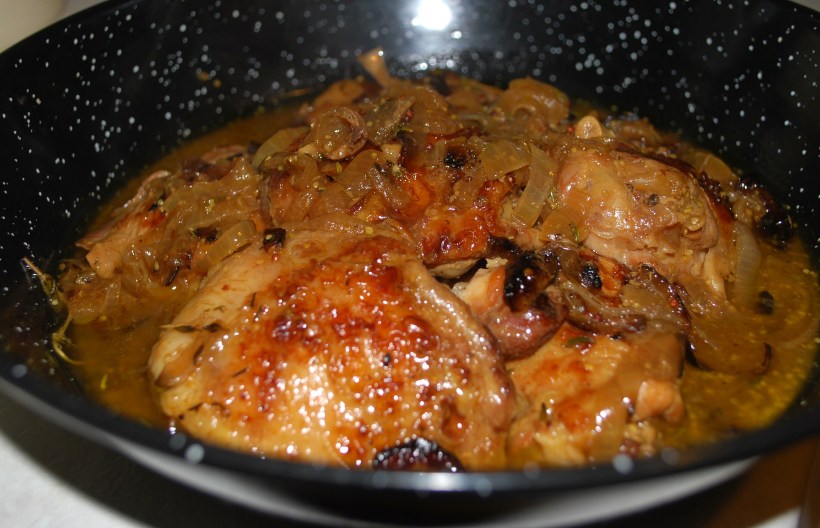
Mustard and Cider Chicken 001

Because of my recent new love affair with my slow cooker, The Slow Cook Book caught my eye. What I like about this book is that apart from some really good recipe ideas (soups, stews, casseroles, tagines and curries) it details two ways to cook each recipe – both in the slow cooker or in the oven or stove top if you don’t have a slow cooker. What a great idea!

Most slow cook recipes are pretty flexible and forgiving, so you don’t need to follow them slavishly. The main thing to remember is that slow cookers don’t need quite as much liquid as conventional cooking as this cooking method tends to conserve most of the liquid.

A mustard chicken casserole caught my eye and as Big Man is a fan of English cider, I thought I’d add that in as the flavours would work well together. It was a simple dish to pull together, with a little preparation before putting it into cook and then forgetting about it for a few hours. It tastes even better made a day ahead.

Serves 4

  • 2 tbsp wholegrain mustard
  • 1 tbsp English mustard
  • 2 tbsp runny honey
  • 8 large chicken thighs, skin on
  • Salt and freshly ground pepper
  • 2 tbsp olive oil
  • 2 large onions, halved and sliced (not too thin)
  • 4 cloves of garlic, peeled and halved lengthways
  • A few sprigs of thyme
  • 300ml or chicken stock mixed with 300ml of your favourite cider (or use just stock) which you need to warm – this is sufficient for the slow cooker. For the conventional cooking method you will need 900ml of liquid.

Mix the mustards and honey, season the chicken thighs and smother them with the mustard mixture. Leave for at least 30 minutes (or prepare ahead and leave overnight).

If cooking in the oven, preheat to 160C/325F or Gas 3. Heat half the oil in a frying pan and on a medium heat, fry the chicken in batches until it is browned all over. Put the chicken pieces in the slow cooker or a casserole dish.

Mustard and Cider Chicken 003

Add the remaining oil and fry the onion and garlic until the onion starts to turn brown, Add this with all the sticky bits from the pan and any marinade that remains from the chicken, plus the hot liquid to the slow cooker/casserole dish. Add the time and stir everything gently before covering and cooking in the slow cooker on high for 4 hours, or low for 8 hours or in the oven for 2 hours.

When prepared, taste and adjust the seasoning and serve with mashed or boiled potatoes and steamed or lightly boiled greens.

Solomillo Asado con Champiñones y Beicon – Roast Pork Fillet with Mushrooms and Bacon

Finally, back to the cooking. An easy recipe which looks like you´ve put lots of effort in and hours of work! This would also work well with pork loin or chicken breast.

You´ll need for 2 people (with leftovers which is always a good thing)

  • 1 pork fillet
  • A sprig of rosemary (discard after cooking)
  • About 10 mushrooms thinly sliced
  • 2 rashers of bacon finely chopped
  • ½ a medium onion finely chopped
  • 2 cloves of crushed garlic
  • Small glass of dry white wine or sherry
  • Seasoning
  • Olive Oil
  • Set the oven to about 180ºC (medium)

Put the pork fillet on a sheet of aluminium and rub in about 2 tablespoons of olive oil, and season all over with pepper and salt.  Tuck the rosemary spring under the meat and bring the aluminium up to create a basket for the meat, but don´t cover it completely.  This basket will save the cooking juices.

Put the meat onto a baking tray and into the oven and cook for about 30-40 minutes until the juices run clear when you put a skewer into the thickest part.  Remove from the oven, remove the rosemary, wrap the foil tightly round it and keep it warm for about 5 minutes to let it rest a little.

While the meat is cooking, put a few tablespoons of oil into a deep frying pan and cook the onion, garlic and bacon together gently until the onions are soft.  Add the mushrooms and a grind of pepper, stir over the heat until the mushrooms have all absorbed a little oil then add the wine and a few grinds of black pepper (no salt usually needed because of the saltiness of the bacon).  Put a lid on the pan and simmer gently for about 10 minutes or until the mushrooms are cooked and the liquid has reduced by about half.

Now pour in the meat juices and stir in.  At this point you could add a dash of cream if you fancy a creamy sauce.  Slice the meat and either pour the bacon and mushroom sauce over or serve separately.

Any leftovers of meat can be finely chopped, mixed with the mushrooms and bacon with a little cream and are delicious on pasta!

Apologies to my veggie pals and readers (you know who you are 🙂 ) this is an unashamedly porky plate with little room for adaptation but I hope you will understand and forgive….

Mixed Bean, Pork and Sausage Hot Pot

When in England we get to enjoy a wide variety of different foods that we wouldn’t normally have access to in Spain. Sometimes though, we long for the taste of our other home. If we lived in London, it would be easier to get hold of some of the more authentic ingredients to recreate certain dishes, outside of London it’s a bit trickier. Sometimes, London or not, you can’t get hold of them at all.

Our beloved Fabada, from the north of Spain, is one dish that it’s particularly tricky to replicate exactly without the traditional beans and smoked meats. No matter, we make do and end up with a delicious variation of the original. Fusion cooking? No….we’re not that trendy! Make do and mend? You bet!3 bean & sausage potaje (1)


This is a dish you need to plan in advance (especially if you are going to use dried beans which will need soaking overnight). It tastes even better the day after you’ve made it, so is a great one to prepare ahead, or use the slow cooker.

In Spain, this style of dish using dried beans is called a Potaje (pronounced po-tah-heh) which is similar to the French word Potage and the old English word Pottage. All three dishes seem to have much in common with each other as well as the name – do check out the links if you have time.

Ingredients (to serve 6 as a main course)

  • 500g mixed dried beans, soaked overnight
  • 6 fresh chorizo sausages
  • 4-6 slices of pork belly
  • A length of black pudding (or morcilla or boudin noir) about 25cm in length
  • 2 bay leaves
  • ½ teaspoon of saffron (or turmeric)
  • 1 teaspoon of smoked pimentón
  • Salt (smoked if you can get it)
  • Water

Cover the soaked beans with plenty of cold water and bring to a fast boil. Boil hard for 10 minutes, skimming off any froth that appears on the surface.

Now add the rest of the ingredients except the salt, and bring back to the boil. You can now either put the whole thing into a slow cooker and cook on low for about 8-10 hours, simmer on the stove top for about 2 hours or cook on low in the oven for 4 hours. Make sure you use a dish which has a lid.

When the cooking time is up, test the beans. They should be soft and creamy, even a little mushy. Season to taste. When you are about to serve, put the pot back onto the stove top (transfer to another pot if you used the slow cooker) and return to a fast boil for about 5 minutes. The liquid will turn from a clearer state to cloudy, and thicken at the same time.

Slice the pork belly and black pudding into smaller pieces and serve each person with beans, a chorizo and some pork belly and black pudding. A final drizzle of fresh, fruity olive oil over each dish will really lift the flavour. A perfect dish for a hearty lunch on a cold day.

If you like this kind of dish, why not check out this dish of Pork Shanks with Giant Beans

We need more wine, the bottle is almost empty!

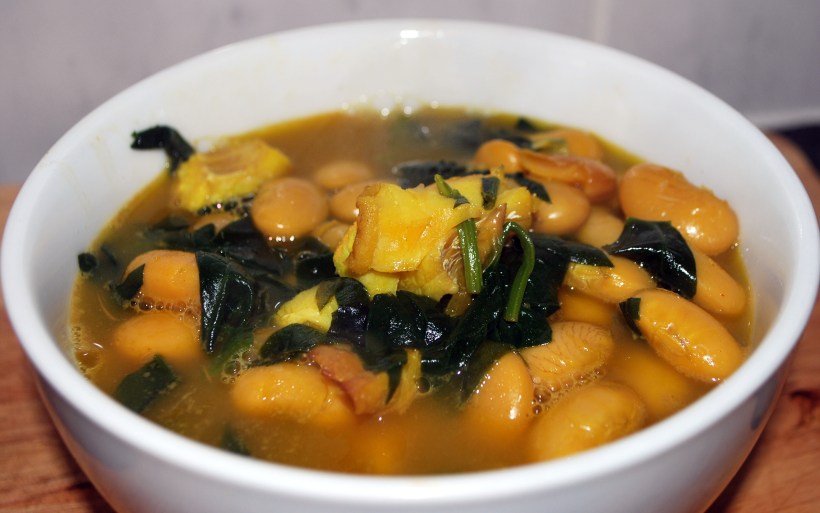
or Cod with Butterbeans?

Smoked  Cod & Butterbean Stew (1)

Roast Chicken

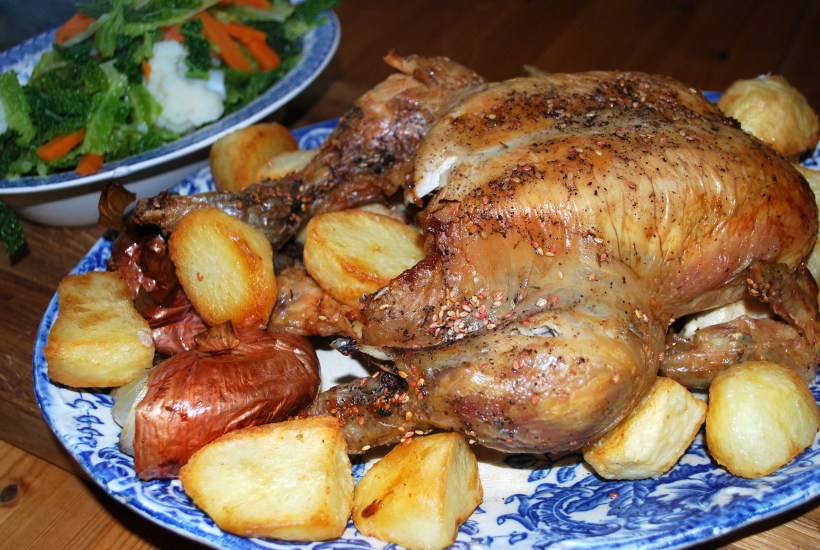
Yes, a delicious chicken rubbed in za’atar, stuffed with a lemon and roasted with onion and perfect potatoes cooked in goose fat. So what? I hear you say, nothing special about that. Well, a roast chicken can mean only one thing – AN OVEN!!

Sunday Roast 007

Yes, although the full refurb of our new home is still only in the planning stages, the dismal cooking arrangements have moved into the slightly more modern era with the purchase of a very nice, temporary, second-hand oven.

Hurrah, almost normal service will be resumed. If I don’t smoke us out (no extractor) in the meantime…

Spicy Pumpkin and Pear Soup…and a little sewing

So, remember our pear tree? Yes, the one with an awful lot of pears on it. We’ve been really enjoying eating them in crumbles, purées, stewed but mainly au naturel and sometimes with cheese. Delicious. But they don’t store. I know, I tried it out. I spent ages wrapping a load up in newspaper and storing them somewhere cool and dark only to find a horrible, stinky mush a few days ago. Nasty.

Luckily we really did make the most of them and one of the dishes I made was a hearty soup using some of the crisper, under ripe pears left at the very end.

Varios 039

Ingredients (serves 4 as a main course)

  • About 1kg of pumpkin or squash (peeled, seeded and cut into cubes)
  • 3 medium pears (peeled and cut into cubes)
  • 50ml olive oil
  • 1 teaspoon each of ground cumin and ground coriander
  • 1 teaspoon of fresh ginger (peeled and grated)
  • 1 level teaspoon of hot chilli powder (or to taste)
  • 3 cloves of garlic (peeled and crushed)
  • 1 tin (400g) coconut milk
  • 1 litre vegetable stock
  • Salt and pepper to taste
  • Smoked pimenton to serve

(Inspired by a recipe from the book Economy Gastronomy)

Heat the oil and add the pumpkin. Fry on a medium heat until it starts to colour a little (you may need to do this in batches) then add the spices and garlic. Cook for a minute then add the pear, coconut milk and stock. Simmer for about 30 minutes, blend to a texture you enjoy (I used a stick blender) season to taste and serve with a sprinkle of smoked pimenton.

For any of you who are wondering what the heck I’ve been up to in the absence of great cooking facilities (and apart from house renovations), I decided to set myself up with a little winter project. I am hand making a patchwork quilt, following (sort of) a design pattern.

Varios 013

Am really enjoying making the quilt top but may back out of hand quilting it myself. We’ll see.  Perhaps next year I’ll be eating this soup snuggled under my quilt!