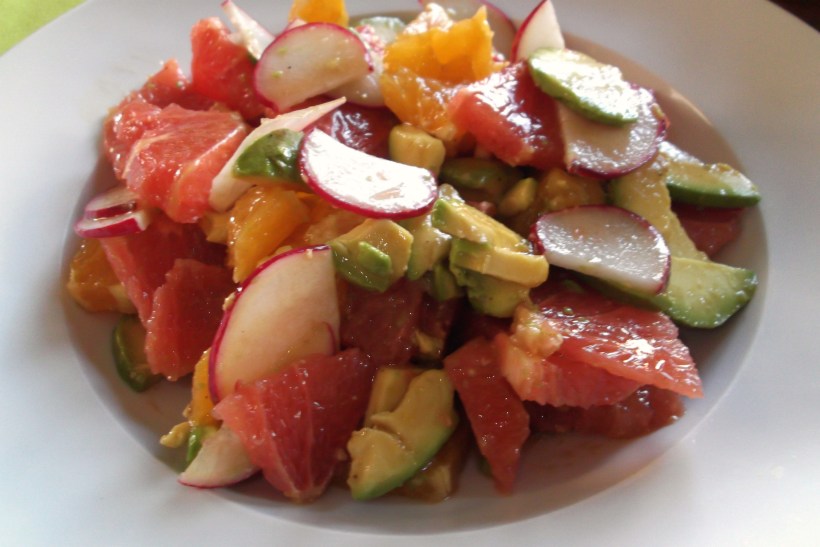
Citrus, Avocado and Radish Salad

We love our citrus fruit here in Andalucía.  Our lemon tree, after 3 years, now keeps us well provided in lemons all year round.  We have planted 3 orange trees too, so in a year or two, we´ll be enjoying our own oranges.

In the meantime, we rely on the kindness of friends and neighbours who keep us well supplied in oranges from about November to March, which is when Andalucía is lit up in the colour orange.  Fields of orange trees are a delight to the eye, and so too are the city streets lined with the trees of bitter oranges which are destined for England and its world famous Orange Marmalade.  But more of marmalade another day.

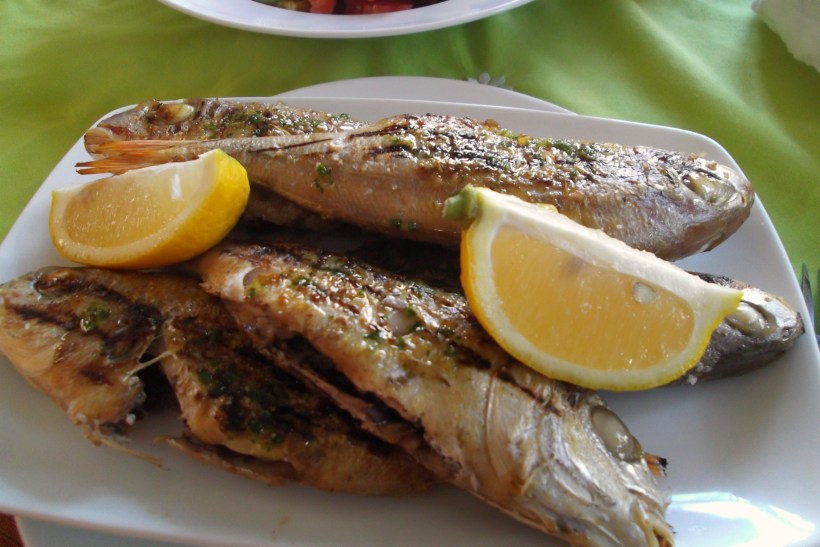
I was inspired by a stunning recipe from Sawsan over at Chef in Disguise for a beautiful orange and avocado salad. Grilled fish was on the menu for lunch, but sadly I have no idea what it is called in English.  As it´s a fairly oily fish, I thought that the tangy flavours of a citrus salad would complement the fish perfectly.  I was right!
Ingredients for 2 people

  • 1 large pink grapefruit and 1 large orange peeled and cut into bite sized chunks
  • 1 ripe avocado peeled and cubed
  • Radish – our radishes here are HUGE so I only used one finely sliced, but use however much you like (or not)
  • Dressing:  any juices that run off the fruit as you peel them plus a teaspoon of lemon juice, the juice of an orange and twice the volume (of the citrus juices) of olive oil, a pinch of sugar if your orange is sour, half a teaspoon of mustard powder, a grind of pepper and a pinch of salt.

Mix up the salad ingredients gently or layer onto a plate.  Mix the dressing ingredients in a jar, taste and adjust seasoning if necessary and pour over the salad.  Any remaining dressing can be stored in the fridge for use another time.

So pretty, so tasty, and so good for you.

Caponata – Calabrese Style

When I was young we used to spend summers in Calabria, Southern Italy, where my father is from.  He was the youngest of 9 children, 6 of whom were girls.  His older sisters all used to fight over who we would stay with during our holiday, as most of them had had a hand in bringing him up and treated him almost as a son.  We used to try and divide our time up with the various families, but my happiest memories were of staying with my Zia Santa.

Grazie Zia - ti voglio bene

When I mentioned this once to someone in the UK they asked me if it was strange having an aunt named after Santa Claus.  How bizarre, I thought, it had never once crossed my mind that her name might sound unusual to anyone else.  In Italian Santa is a female saint, or a “blessed one”.  My Zia Santa was indeed a saint, she had a hard life and lived in very basic simplicity for the whole of her married and then widowed life.  But we loved being with her.  She had one bedroom where my parents slept in her huge dark wood framed bed with my younger brother on a fold out bed.  Her bathroom only had a toilet and a sink where she also washed all her clothes.  The only other room was a large living, dining, kitchen area which looked onto the main street of the little village, called Longobardi.  I slept here with my aunt, her on a bed and me on a mattress – and every night we would giggle together like two little schoolgirls rather than an aunt and niece who were separated in age by over 40 years.

There was a small balcony which served as the telephone. If people wanted to give you a message they stood in the street and whoever was nearest the window stood there and took the message.  Likewise, if you wanted to let a neighbour know some news, all you had to do was stand on the balcony and tell a passer-by.  You were in no doubt that the message would reach its recipient almost as instantly as an e-mail or text nowadays.

Zia Santa was an incredible cook.  August was always taken up with drying tomatoes on her flat roof, or bottling tomatoes to go into the huge storage area on the ground floor.  It never struck me as odd that there was this enormous space downstairs that could have been converted into a bathroom, bedroom, laundry room…whatever.  It was more important back then to have a good space to store the cheese, salami, prosciutto, olive oil and tomatoes for winter.

I´m trying to write down all the recipes that Zia Santa taught me, my mother and, some years, my English grandmother to cook.  Today it´s Caponata.  I had to call my mum to ask her what the special ingredient was.  Our family caponata was never the same as any other I´ve tasted.  I´m sure there are thousands of family recipes, each one different from the other.  This is ours.

  • About 1kg of aubergines (eggplant, melanzane) finely chopped and salted, then left to drain for about 30 minutes then rinsed and patted dry
  • Olive oil – plenty for frying
  • 1 onion finely chopped
  • 3 sticks of celery finely chopped
  • 4 tablespoons of red wine vinegar (although I used white as that´s what we have here and it was delicious)
  • About 500g of ripe tomatoes peeled and finely chopped
  • Up to 2 tablespoons of sugar
  • About a quarter of a cup each of chopped capers and chopped stoned olives (black or green)
  • Seasoning
  • The grated zest of half an orange – the secret ingredient!

Fry the aubergine chunks (which in all other recipes I´ve seen is left much chunkier).  Zia Santa used to deep fry, I shallow fry.  The choice is yours.  Set them aside when they are browned and soft.

Now add the onion and celery to the pan with more oil if necessary and fry with the lid on until soft and translucent.  Turn up the heat and add the vinegar and allow it to reduce almost completely. Turn the heat back down and add the tomatoes, seasoning and about half the sugar and simmer for about 15 minutes or so or until the celery is tender but still retains a little crunch.  Stir in the aubergines, olives, capers and orange zest and taste.  It should be “agrodolce” sweet and sour – add the rest of the sugar if necessary and allow it to dissolve.

This dish is best served the next day and will sit quite happily in your fridge for several days.  We used to eat it at room temperature as part of the antipasto but it´s also good as a side dish.

And don´t forget, do shout out of the window to let me know if you enjoyed it!

Tasty Tabbouleh

Fresh and delicious

When you are lucky enough, as we are, to have a vegetable garden full of tasty summer tomatoes, cucumbers and peppers, you are always looking for new ways to serve them. Arriving home from our holiday, we found the veggie garden over run with peppers plus we had a few cucumbers and the first of our new batch of tomatoes turning red.  A neighbour had also left four huge and sweet onions in a bag hanging on our door.  What a great homecoming!

I love tabbouleh, but had forgotten about making it until another kind neighbour bought me round a bag of bulghur wheat.  I have very kind neighbours! It reminded me of how much I enjoy it and what a great use of my summer vegetables it would be.

It´s very easy and quick to prepare and can be made a little in advance of eating so that all the seasoning is absorbed and flavours your salad.

As I was finely chopping a mixture of tomato, cucumber, onion and garlic I realised how similar the base ingredients are to an Andalucían gazpacho, both the blended and the chunky versions.  I also added chopped green and red peppers. I´m not sure how traditional they are but we still have so many, it seemed silly not to.

The wheat had been cooked according to the instructions on the pack, all very simple and straightforward, and when it had cooled a little I added my chopped vegetables, chopped mint and parsley, salt, olive oil and plenty of lemon juice.

And that was it. I left it to chill a little then bought it back to room temperature before eating.  How simple and delicious was that?!

Gazpacho as we know and love it

In Andalucia we don´t eat tomatoes...we drink them!

So, now we come to the Gazpacho most people are familiar with – the iced tomato and vegetable soup famed the world over (well, almost!).

It is served both as a soup here and as a drink.  In most homes it comes in a glass.  In fact there is a wonderful advert for my favourite Spanish beer, Cruzcampo, which celebrates all things Andalúz.  One line in the voice over says something along the lines of “In Andalucía we don´t eat tomatoes, we drink them!” (If you have time to watch it, it´s worth it, even if you don´t understand Spanish, just to see a few snippets of summer life in Andalucía).

Every housewife will give you a slightly different recipe, adding her own little tweaks (more of this, less of that). Some use stale bread, some don´t. I tend not to unless I want to serve it a little thicker as a soup which can then be garnished with little chopped cubes of the same vegetables that go into it.

So, without further ado, here´s how I make mine.

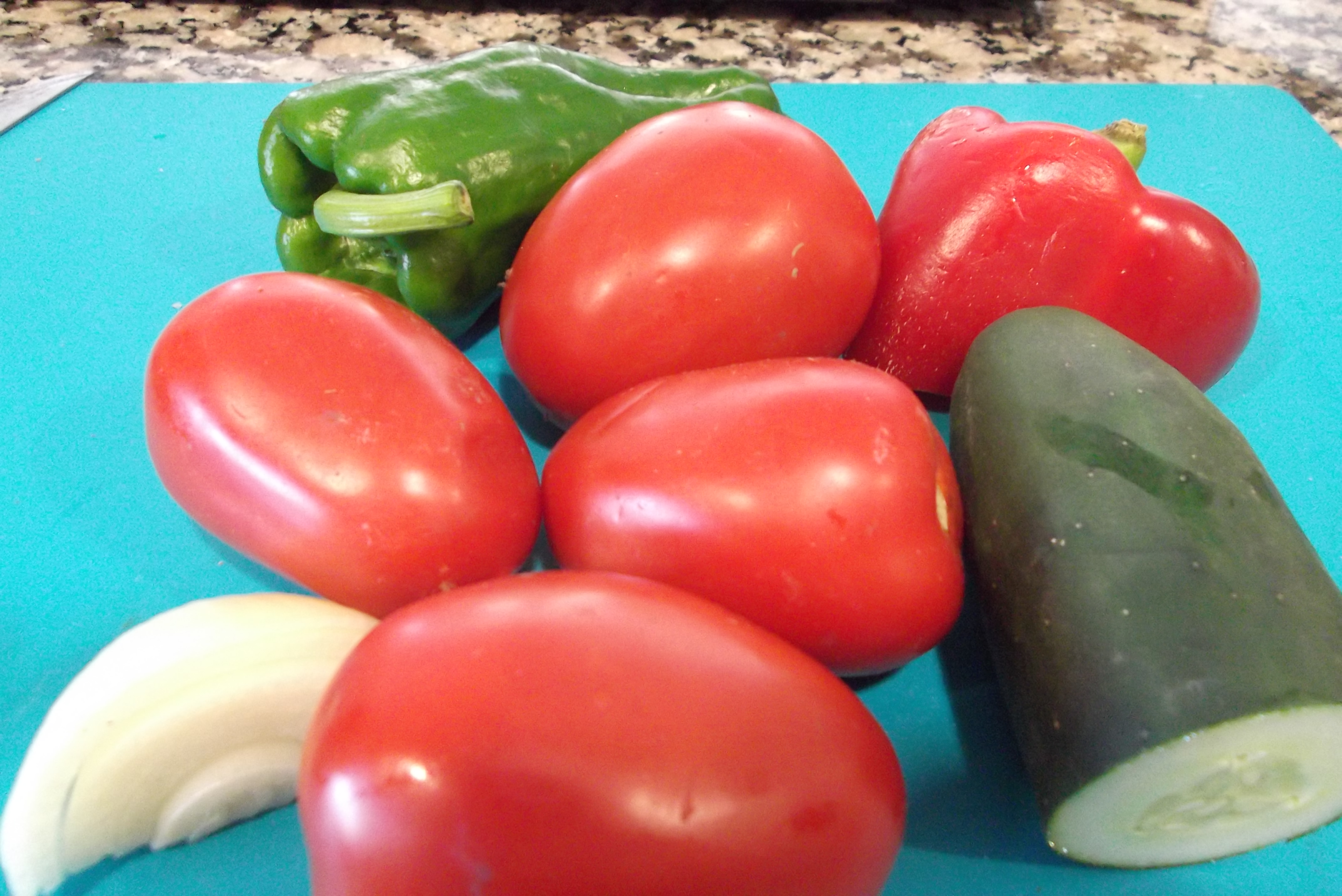
Peeled Tomatoes, Green Pepper, Red Pepper, Onion (optional) Peeled Cucumber, Salt, Water, Olive Oil, White Wine Vinegar.

It´s difficult to give quantities. If my tomatoes are lovely and red, I use less red pepper. Sometimes I don´t use onion.  But the green pepper and the cucumber do give it that distinctive fresh taste, so try not to leave them out.

A few simple ingredients

Today I used 4 large plum tomatoes, one thin green pepper, a small amount of red pepper and a small chunk of onion and half a small peeled Spanish cucumber.

Put all the vegetables into a jug or the food processor.

Put into your jug or blender

Start with one level teaspoon of salt, 3 tablespoons of vinegar, 1 tablespoon of olive oil and about half a litre of water.

Add water, vingegar, oil and salt

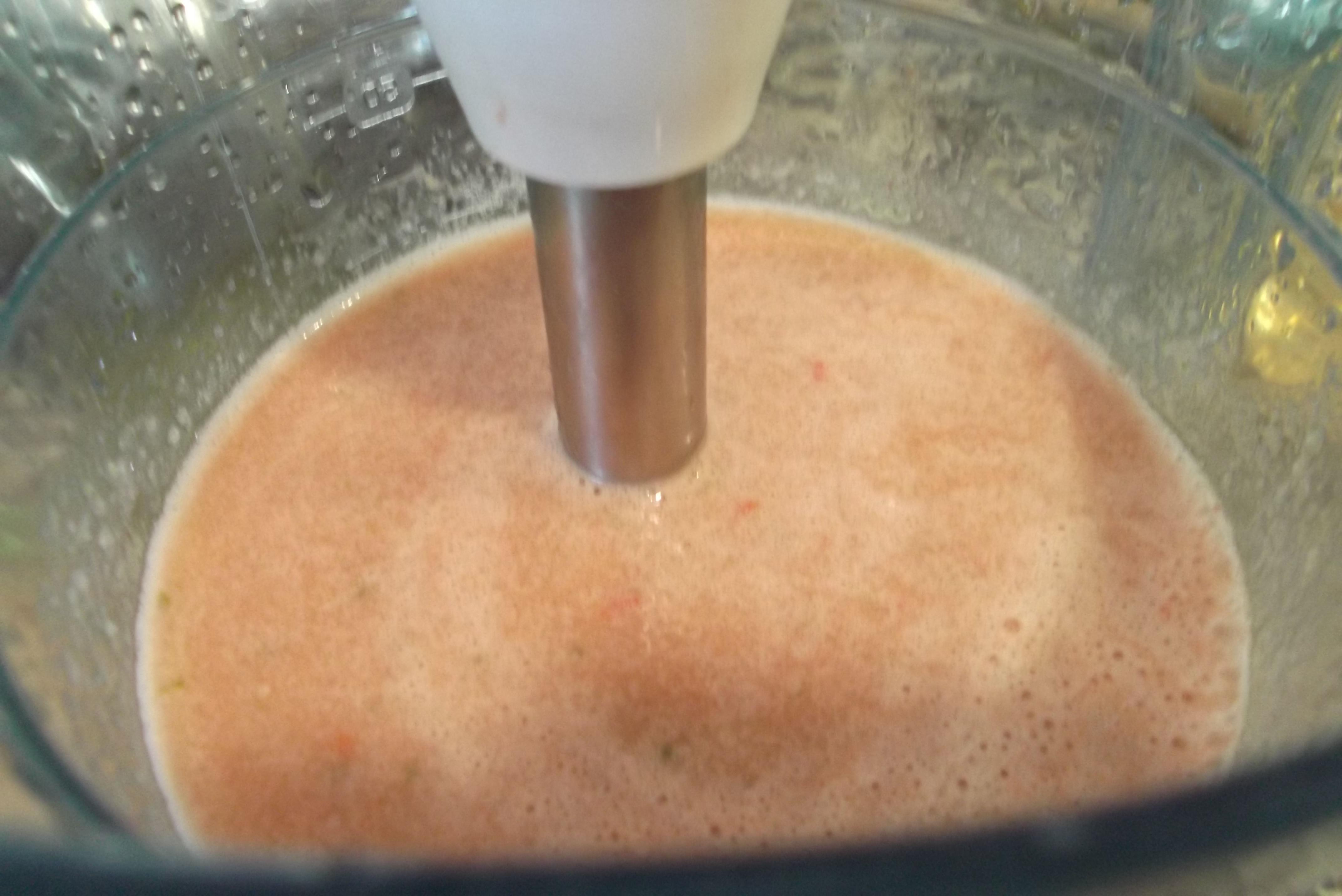
Now it´s time to start blending.  Add more seasoning, vinegar and water as you go along if you want to.  Today I added another tablespoon of vinegar (you remember they like it “alegre” or lively here right?!) and about another 250ml of water to thin it a little.

...and blend!

Then chill until you need it.  If you have put onion in it´s fine on the day you made it but I find it starts to “ferment” a little if you have any left over.  Also, while standing in the fridge it may start to separate a little with the water at the bottom and the vegetables on top – just give it a stir before serving and it will be fine.

Big Man gets arty with the vegetables

Now, go and put on a straw hat, a paso doble on the cd and lie back in a shady spot and sip on your ice cold Gazpacho.  Or ga-pacho, as they tend to say here! These Andaluces and their habit of dropping the “s” sound….most confusing!

Ensalada Cateta – Country Salad

¡Ay que rico!

Before I start this quick post, I have to tell you that I´m having a giggle.  The word cateto or cateta translates perhaps more literally as “Peasant”, but not in an offensive way.  Before I started typing I just thought I´d do a quick translation check to see if there was another word I could use and all the on line translation tools, bizarrely come up with the word “leg”!  Not quite sure what is going on there…but I decided to call it Country Salad.

It´s another celebration of that most Andalucían of fruits, the orange.  Again, typically a poor person´s salad it was originally made with salt cod as it was cheap and you didn´t need to use much.  A few other bits of country produce like potatoes, peppers and olives, a good soak in olive oil and you were done.

Of course, nowadays you can get all sorts of glorified versions, but the one I´m giving you here is the one you´ll find in all my local bars and homes around here.  It´s served as tapas in bars, and as a light meal at home.  Of course, some people make their own little tweaks, and why shouldn´t they?  They might leave out the peppers and add tomatoes.  Some people like tomatoes or onions in it, others don´t.  And complete heathens, like me, sprinkle chopped fresh chili all over it to the amazement of their other halves….each to his own I say!

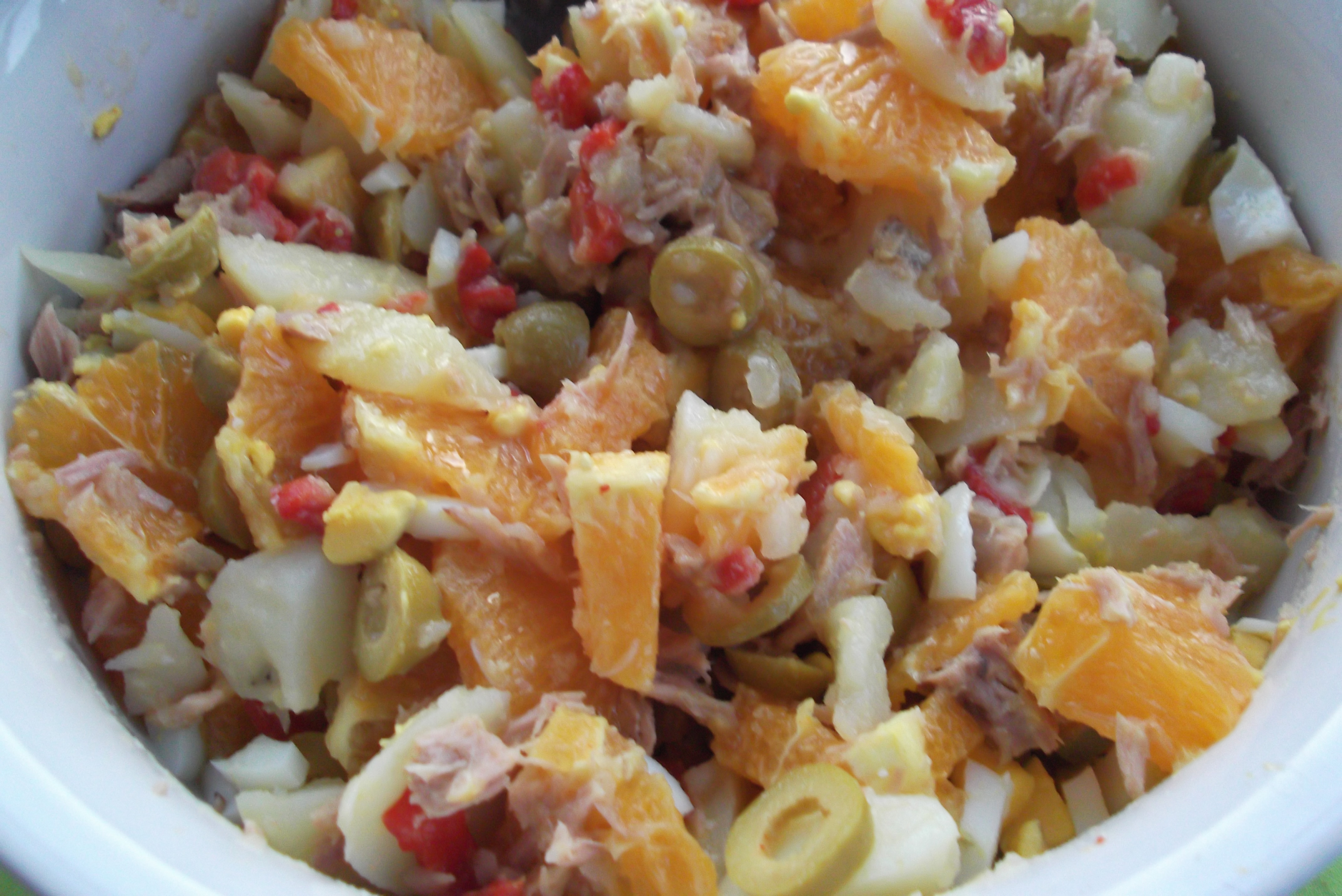
A delicious serving of “Leg” Salad!!

This is what you´ll need (approximately) per person as a light main dish servng size

  • 1 hard boiled egg, finely chopped
  • 2 medium potatoes (boiled in their skin) peeled then chopped into chunks
  • 1 small tin of tuna (I use tuna in brine and drain it, but use your favourite)
  • 1 roasted red pepper, chopped
  • 2 medium oranges (bitter if possible) peeled and cut into chunks
  • About 2 tablespoons of pitted olives sliced (or use ones with stones, your choice!)
  • Optional – chopped onion, chopped tomato, small flakes of salt cod (or use whatever you have available)
  • Salt & Pepper
  • Olive oil
  • White wine Vinegar (optional) but I like to use it

All you need to do it combine everything in a bowl, season and dress it and leave it for at least half an hour in the fridge so that the potatoes can soak up some of the lovely olive oil.

Good to serve at a party or buffet as it can be prepared ahead and does not suffer from being forgotten in the fridge for several hours.  Hope you enjoy it!

Chicken Pinchito Salad

A tickle of spices...

Pinchos, or Pinchitos, are Spain´s answer to Kebabs.  Despite their “Moorish” (i.e. Arabic) origins, they are usually made of pork, but you can also find them made of chicken.  This is typical Feria food, cooked in front of you at the bar, speared with a slice of bread, and if they use metal skewers, you just hand them back when you´ve finished eating!

The spices which the cubes of meat are rubbed in can vary slightly, shops and butchers sell their own mixes.  Typically though it´s a mix which is like Ras el hanout, which is used widely in North Africa, from which Andalucía receives many food influences. 

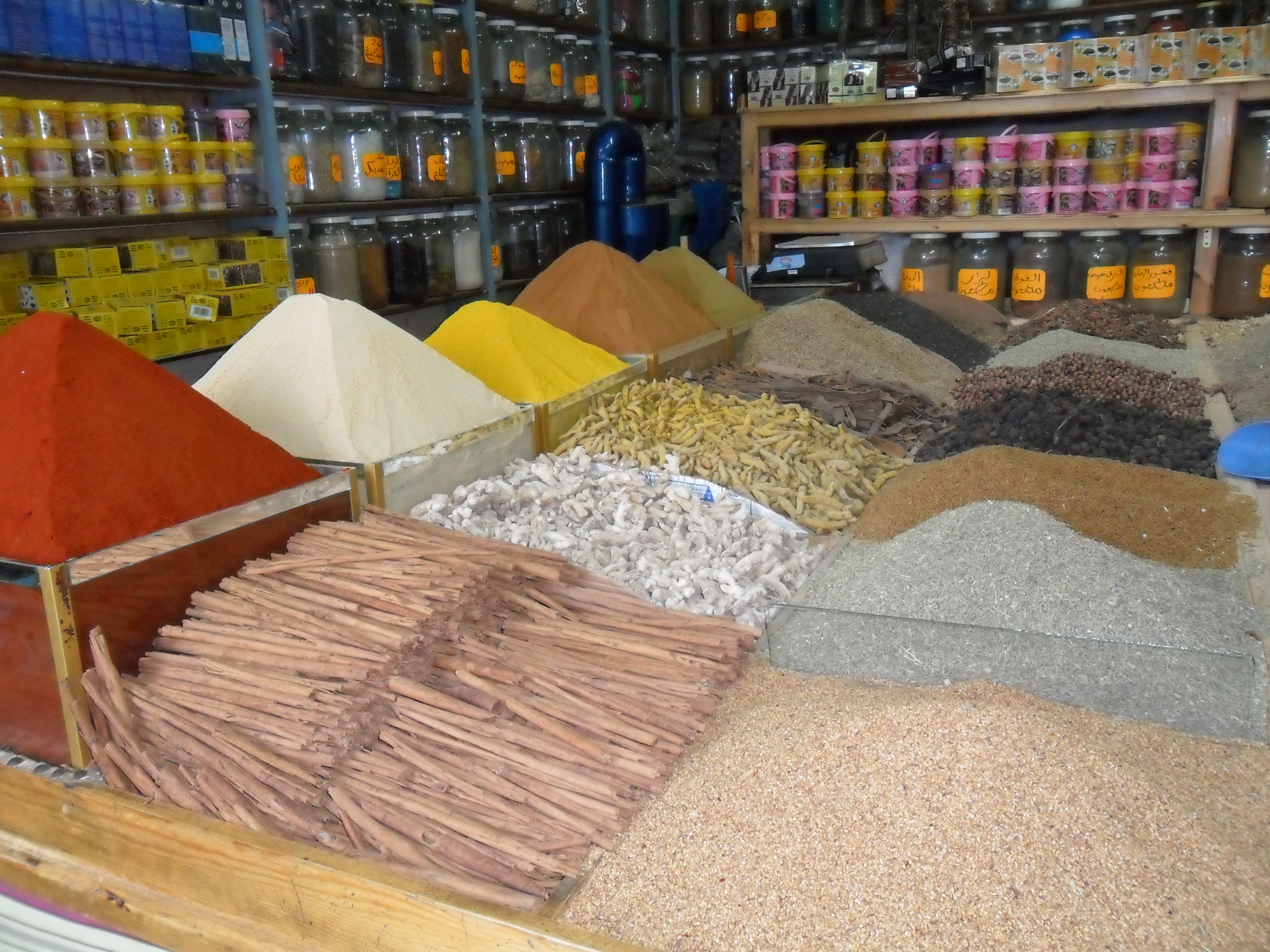
When we went to Morocco earlier this year, we bought a supply of spices to see us through a few months and because it´s so good, I didn´t want to just save it for kebabs. 

Beautiful Spices...

Here´s an easy salad, which (if you have any kind of spice mix you like to use on meat) you can pull together from store cupboard ingredients.  This recipe made a light supper for two.

For the salad

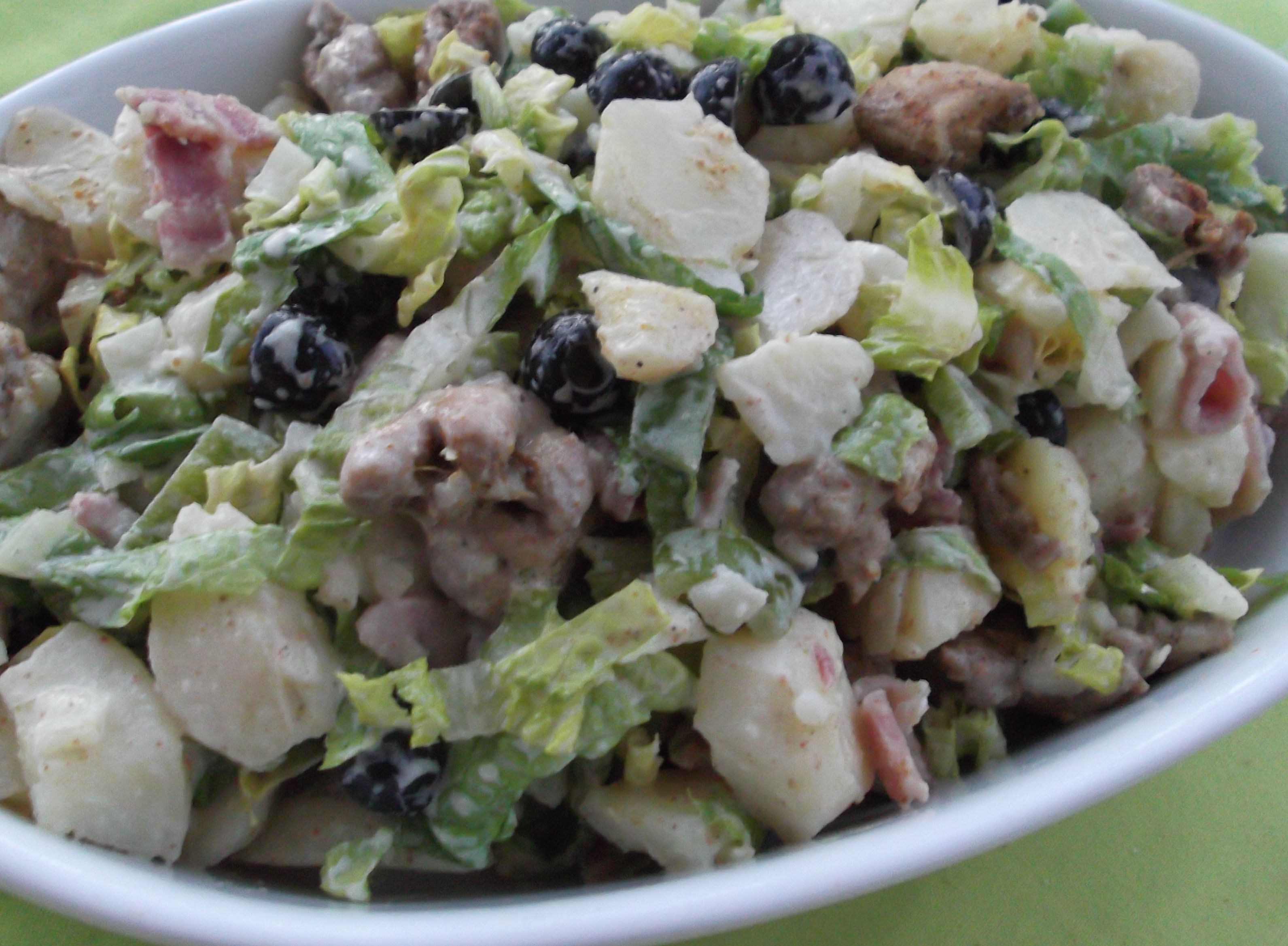
  • Two chicken thighs deboned, cubed and rubbed in 1 heaped tablespoon of spice mix and seasoned with salt.  These are then cooked on the griddle (plancha) with a small amount of olive oil and left to cool
  • 6 rashers of streaky bacon cooked for 6 minutes in the microwave then left to cool and roughly chopped
  • 2 medium cooked potatoes, peeled and cubed
  • Half a cos lettuce finely chopped
  • Half a cup of pitted black olives, roughly chopped
  • One small green pepper, finely sliced

For the dressing

  • Half a cup of mayonnaise
  • Two tablespoons of milk
  • An additional teaspoon of spice mix
  • A squeeze of lemon juice
  • Salt and Pepper

Mix all the salad ingredients in a large bowl then in a jar shake together all the dressing ingredients.  Pour over the salad and toss well to get all the dressing into the leaves.  Would also be good with some croutons.

Merluza A La Barbacoa y Ensalada Arcoiris – Barbecued Hake & A Rainbow Salad

Dressed For Dinner

Fish Man came up trumps the other day with a whole hake in the back of his little van. It was rather large, too much for just Big Man and me, so as it was fresh it went into the freezer.

A few days later friends were coming over for lunch, and the sun promised to shine, so I decided to barbecue it.  A quick visit to the garden to gather mint and lemons, and out into the olive grove for the tops of the wild fennel which is everywhere, and I was set.

I had to gut and clean the fish, but if you´re buying from a fishmonger, I´m sure it will be cleaned for you.  It´s not that tricky (wear kitchen gloves though, or you´ll smell like a hake for the rest of the day!) but not for the squeamish.

Pat the fish dry with kitchen paper and salt the inside slightly.  Stuff it with bunches of herbs and thin slices of lemons, then sprinkle the outside with coarse sea salt.  No oil needed, but the salt will protect the fish and you´ll end up with lovely charred skin which I personally love to eat, but I know some people don´t.

Then it´s on to the barbecue for your hake.  We cooked it on a low heat and the lid on for about 15 minutes in total.  If you do use hake, but you could do this with pretty much any fish, it´s firm, so easy to turn when it´s half done.  Check it´s cooked by peeking inside – the flesh will be white when it´s ready.

Ready to eat!

I served this with a delicious salad which was so beautifully coloured, it didn´t matter that the sun went in and a big cloud hovered over us all through lunch!  I used chopped new boiled potatoes, cooked beetroot, oranges, thin slices of raw carrot and chopped chives. I made a simple dressing of olive oil, lemon juice, mustard powder, a clove of garlic, salt and pepper.

With so much colour, it can´t not be good for you...

Food for a sunny, or not so sunny day!

Lechuga con anchoas – Lettuce hearts with anchovies

Oh so simple...

This one is so quick and simple, it doesn´t even need a recipe!  Perhaps just a quick explanation, though.  This is served in Andalucía as a pre meal appetiser in the summer or when unexpected guests pop round and it´s drink time.  Add a plate of slice Spanish cheese, some jamon or salchichon (salami), a cool drink of your choice and you´ve served a super speedy tapas selection without even really trying!

Wash and cut a lettuce heart into eighths, open a tin of anchovies (in olive oil if possible) and lay an anchovy over each slice, pour the oil from the tin over, add a squeeze of lemon or white wine vinegar and serve.  These are picked up with the fingers, or little cocktail forks if you´re feeling refined, then just munched and crunched.

If you can´t stomach anchovies, replace with a strip of roasted red pepper.

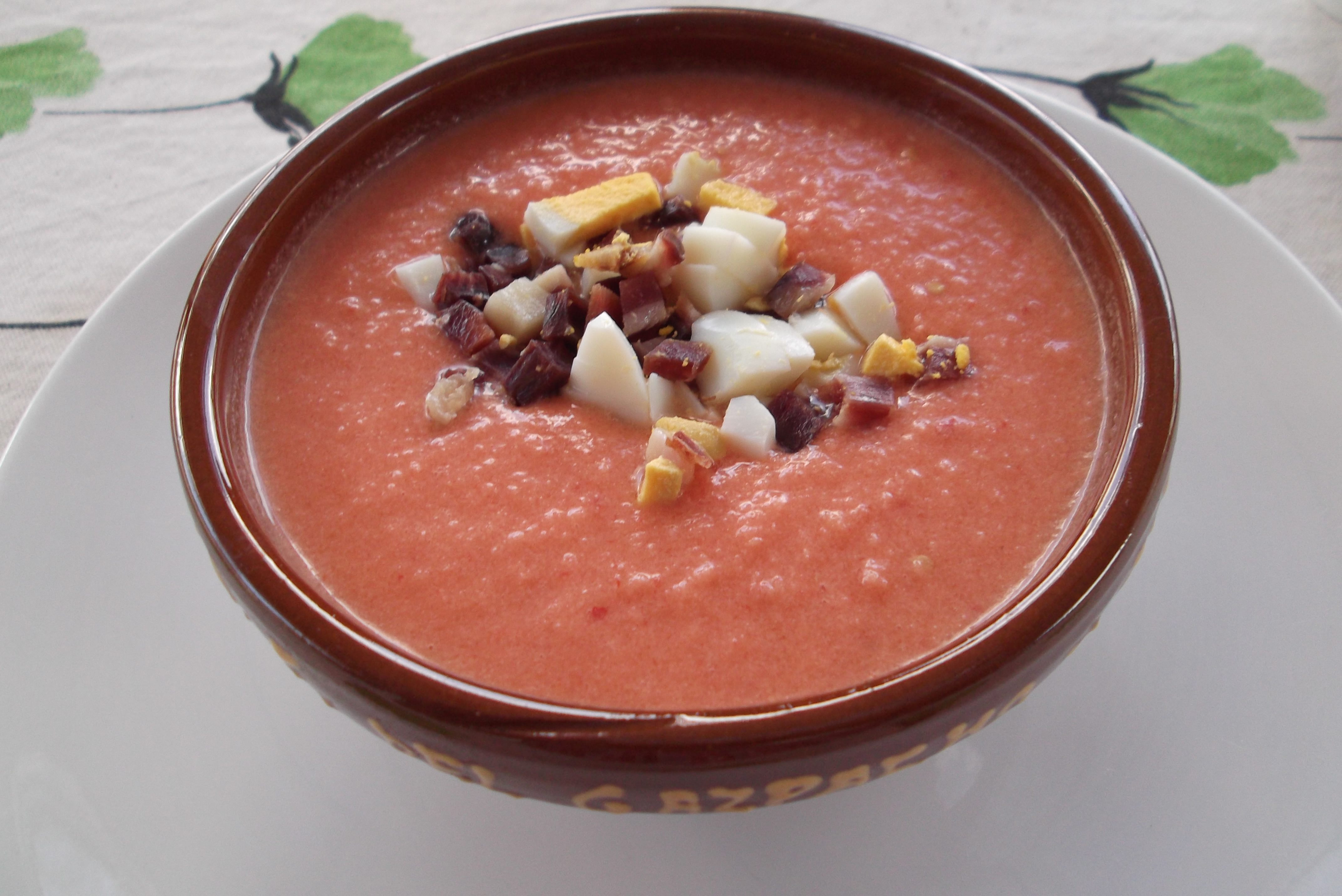
Salmorejo Cordobés – Another kind of gazpacho


Creamy Salmorejo

As promised, another version of the famed Andalucían gazpachos.  This one originates from the beautiful city of Córdoba, and is my favourite version of all.  It is different in that it uses very few ingredients but can be served three ways – very thick as a dip with small breadsticks (known as Picos), medium thick garnished with chopped hard boiled egg and jamon or tuna as a chilled soup starter, or diluted with water as a refreshing drink.  So…three dishes in one!

Ingredients for this are few and it will serve from 6 (as tapas) to 2 (as a soup) approximately:

  • 2-3 slices of stale bread without the crust (should be a fairly dense bread rather than sliced white from the supermarket)
  • About 500g of tomato, cored and peeled (I had one HUGE tomato as you can see in the photo) but usually the volume of the tomato once in the jug is a little more than the volume of the breadcrumbs
  • A chunk of red pepper (optional)
  • Half a clove of garlic (don´t recommend you use more or it will overpower the taste the taste of the salmorejo)
  • Vinegar
  • Water
  • Olive oil
  • Salt

Once again, the holy trinity of water, salt and vinegar appear but we´ll use very little water this time.

Dribble a very little amount of water onto the bread which you will have put into a mixing jug, and leave for a minute or two to absorb it.

Start with bread and water

Add the tomato and pepper if you are using it.  The truly authentic recipe doesn´t use red pepper, but after wondering why my salmorejo never looked as red or tasted as sweet as anyone else´s, I was let into the secret of the locals round here – red pepper!

Tomato and Red Pepper

Add your garlic, a teaspoon of salt, a tablespoon of vinegar and at least two tablespoons of olive oil and start to blend with the hand blender.

Add Vinegar and Salt

You need to get this really smooth, almost like a purée.  The more oil you add, the smoother the mixture will be, although I tend to go easy on it just for the sake of my waistline!  Taste every so often and adjust the salt and vinegar to your liking.  Again, it should be “alegre” or lively in flavour.

Start to blend

When you´re done, leave to chill in the fridge for about an hour.

Get it smooth and thick

Traditionally it´s served in a deep earthenware bowl (to maintain the freshness) with chopped hard-boiled egg and jamon on top.  Some people substitute the jamon for tinned tuna but I guess chopped bacon would also be nice.

It´s also great as a dip or sauce served with little breadsticks (like very short grissini) or croutons.

“Green” Potato Salad

Getting "Cheffy" with the chives!

It´s been a hectic little morning up our mountain.  A nearby complex which offers rural holiday accommodation – http://www.cortijolasmonjas.com/ – just in case you want to have a look at the same lovely scenery I see every day, ran a four hour workshop on distilling aromatic plants.  More of that later in another post.  I got home so relaxed by the lovely smells of lavender, geranium and melissa, I wasn´t really in the mood for “proper” cooking.  Big Man had been tidying up the vine in the vegetable patch, so he was hungry.  I needed something fast and filling.

Well, not being a girl who is ever likely to be caught with her fridge empty, I pulled together a speedy potato salad.  It´s green because of the avocados that are very much in abundance here at the moment, and because I used a big bunch of chives from our garden.

So, here it is, in all it´s delicious simplicity, for two people.

  • Two large potatoes cooked in their skins then peeled and diced
  • Four rashers of grilled bacon, chopped
  • One large avocado, peeled and diced
  • Half a cup of cooked peas or broad beans (guess what I used!)
  • Half a cup of chopped green olives
  • One grilled red pepper, peeled and chopped
  • Some finely chopped chives (I used about 2 heaped tablespoons)
  • One heaped tablespoon of mayonnaise
  • One small tub of natural yogurt (mixed with the mayo)
  • Pepper – you may not need salt because of the bacon, it´s down to you

Mix up all your ingredients, season and then stir in the mayonnaise and yogurt mixture.  Also good as a side dish, but we just dug in and scoffed the lot!