Curried Meatballs

A recent tidy up of my cookery books turned up two Indian books by Anjum Anand which I had hardly read.  Time to put that right I thought, and next thing I was in the butcher´s shop ordering pork mince.

Of course, pork would not typically be a meat used in most Indian curries for religious reasons, but this would be great with any other meat. For a fantastic recipe using minced beef, check out Frugal´s gorgeous Beef Kofta Curry recipe.

As ever, I had to make a few small changes, but not too many. I had no fresh coriander so substituted dried, ground coriander and the same went for fresh ginger. We can get it here, I just didn´t have any to hand and when the craving for curry strikes, you have to go with it!

This recipe is adapted from Indian Food Made Easy.

For the meatballs

  • 300g lamb mince (I used pork)
  • 2 tbsp finely chopped fresh coriander leaves and stalks (I used 1 teaspoon of dried coriander)
  • ¾ tsp garam masala
  • 1 tsp finely chopped ginger (I used ¼ teaspoon of dried)
  • 3 cloves of crushed garlic
  • 1 large egg
  • Salt to taste

For the Curry Sauce

  • 1 medium onion finely chopped
  • Vegetable oil for frying
  • 2 bay leaves
  • 1 small shard of cinnamon
  • 2 ½ medium tomatoes (puréed) – I used 1 ½ cups of my conserva from last summer
  • 800ml water (I used about 300ml)
  • ½ tsp ground turmeric
  • ¼ – ¾ teaspoon of chili powder (to taste)
  • 2 tsp coriander powder
  • 1 tsp garam masala
  • Salt to taste
  • Chopped coriander

Mix all the ingredients for the meatballs together plus 3 tbs of the onion you have chopped for the sauce.

Heat the oil in a deep pan, add the bay leaves, cinnamon and remaining onion and fry until the onion is golden brown.

Add the tomatoes, ginger and garlic and cook gently for about 8 mins then add 200ml of water and cook until thickened.  Add the spices and salt and any remaining water (I didn´t add much as I continued cooking with a lid on my pan) and simmer. Meanwhile roll the meat into walnut sized balls and drop them into the sauce.

Cover and simmer, turning the meatballs gently half way through, for about 20 minutes. Add the coriander and serve with rice, naan bread, popadums…however you like.

We ate ours with my Sort of Saag Aloo made with the first of our spinach which is now ready to eat.

…and a cool and creamy raita (I´ll give you that easy recipe another time)…

This was a warm but not too hot curry with the lovely flavours of cinnamon and ginger, definitely one to make again.

A Walk on the Wild Side

Andalucía is a region of contrasts. Magnificent cities, historic monuments, skiing, countryside and the famous Costa del Sol.  It´s all there and usually not more than a couple of hours away from wherever you are.

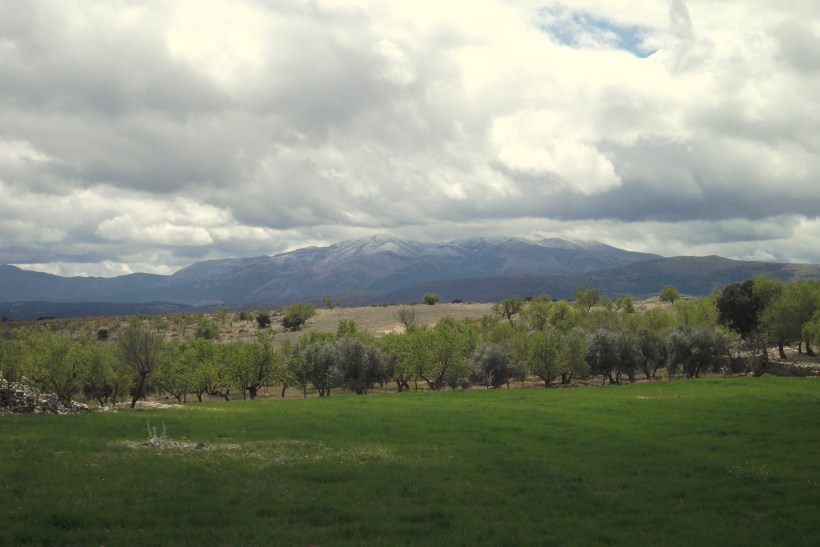
At the weekend we drove slightly north from where we live, over the border from Malaga province into Granada province, Big Man´s heartland and into some wild and rugged scenery.

Near his home town of Ventas de Zafarraya is an area of fertile plains.  A huge amount of vegetables are cultivated and grown there and this provides much needed employment for many people.

Moving north again you come to the beautiful town of Alhama de Granada and between these two towns are a series of lush green plains divided by area of rough, rocky, almost lunar landscapes.

Water comes up through the rocks and provides irrigation and drinking water for plants, animals and Cortijo dwellers.

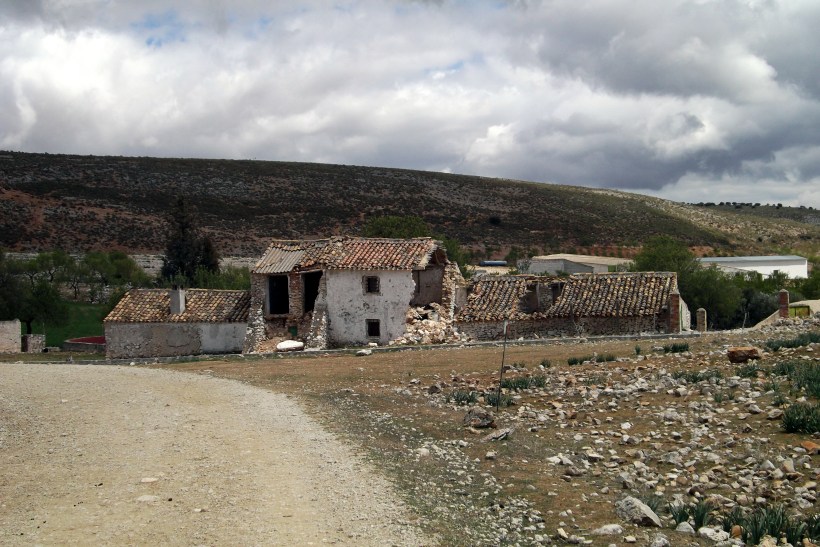
Some Cortijos sadly remain abandoned, mainly due to the inheritance laws here in Spain which pretty much oblige you to leave your property to your offspring. When families have 10 or more children, it´s understandable that families were often unable to come to an agreement regarding whether to sell, divide or buy each other out.

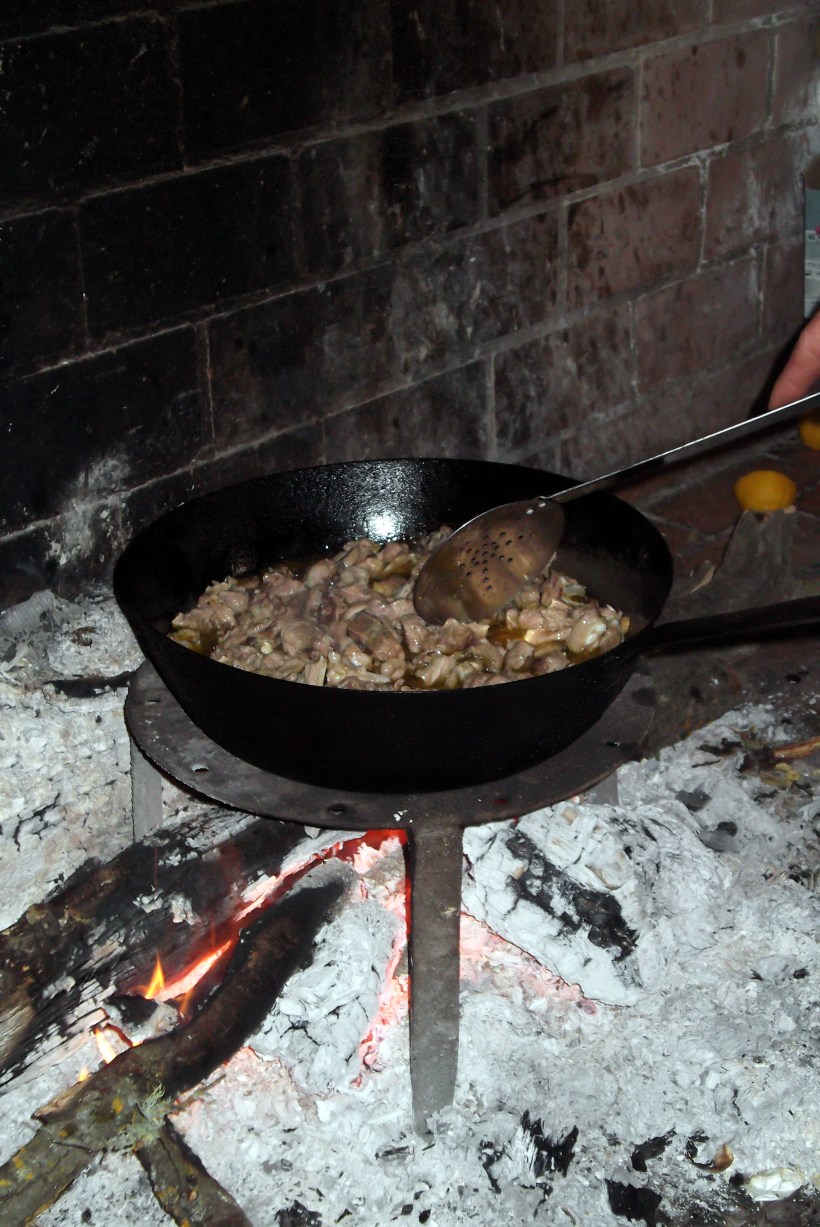
After a magnificent lunch of goat cooked over an open fire we set off to walk to a local goat farm and buy cheese.

There were plenty of goats…

….and it was milking time.

Some of the group also bought milk, luckily I had been given some that morning by one of our local goatherds.

Posh Milk Bottles!

There were one and two week old kids….adorable!

A family of strange looking turkeys were keeping everyone in line out in the yard.

Our walk took us past a tree which the locals called a Millennium tree, because of its supposed age.

It took five women to get their arms around it….and sometimes it´s good to hug a tree!

And finally a walk back to the Cortijo for coffee and cake.  Sometimes the simple things in life are just what you need.

A Cake To Take Visiting – Orange, Almond and Raisin Cake

Wrapped Up and Ready to Travel!

Customs vary immensely the world over, but some are the same regardless of where you are. When visiting friends for a meal, a little gift is customary. If it´s home made, so much the better, especially if it´s edible.

My mum passed a recipe on to me when I was last in London. She thought it would appeal because the finished cake is not too sweet (she knows I don´t have a hugely sweet tooth), uses oil instead of butter (so much easier here where butter is rarely used) and contains ingredients which are local to Andalucía – oranges, almonds and raisins. Perfect, all I needed was a chance to make it.

Easter weekend was a mix of quiet and hectic for us. Saturday found us heading across the “frontier” from Málaga province to Granada, to a remote area to join some friends in their Cortijo for lunch and a walk.  More of the walk another day as I got rather carried away taking photos.

The cake was made the night before and was a huge hit. It´s very moist and is a cross between a cake and a dessert and would also be perfect served with whipped cream, crème fraîche or ice cream.

Ingredients

  • 150g raisins soaked in 50ml of amaretto (warm the amaretto and leave the raisins in soak for at least an hour) If you don´t want to use alchohol, a delicate tea would also be perfect for soaking.
  • 2 oranges (as bitter as you can find)
  • 4 eggs
  • 180g caster sugar
  • 150g ground almonds (I left mine quite coarse, it´s up to you how fine you grind them, this cake the cake a nutty texture and a rougher look on the top)
  • 150g self raising flour (or plain flour with 2 tsp baking powder)
  • 50ml olive oil
  • 2 tsp icing sugar

Preheat oven to 180ºC/350ºF/Gas 4 and line a 24cm springform tin.

Place the whole oranges in a saucepan of water and ensure they are covered. Bring to the boil and simmer for about 15 minutes or until tender. Blitz 1½ oranges until finely chopped, reserve.  Squeeze the juice from the remaining half orange then set the juice aside.

Whisk the eggs until light and fluffy then whisk in the sugar.  Fold in the almonds and olive oil then sieve in the flour then fold in.  Gently stir in the pulped oranges and half the raisins and pour the mixture into the tin, spooning the remaining raisins over the top of the cake.

Bake for about 60 minutes until a skewer inserted in the middle of the cake comes out clean.

Remove the cake from the oven but keep in the tin. Place the juice of half the orange and the icing sugar in a pan and dissolve the sugar.  Pierce the cake all over with a skewer and pour the orange syrup over.  Leave in the tin to cool then remove and enjoy.

PS. I think this would also be great made with polenta!

Hot Cross Buns for Good Friday

Hot cross buns,
Hot cross buns,
one ha’ penny,
two ha’ penny,
hot cross buns.

If you have no daughters,
give them to your sons,
one ha’ penny,
two ha’ penny,
Hot Cross Buns

So, Easter is upon us and Lenten fasting and abstinence for those who participate is soon at an end. One of the delights of this time of year when I lived in the UK was to eat Hot Cross Buns. They are sweet, spiced buns marked with a cross to commemorate the Crucifixion.

Finally...lovely buns!

Mad Dog did an excellent post last week about the same subject, and I wish I had gone to his recipe suggestions when I first decided to make some.  I have made them here in Spain a few times and I have several recipes…but do you think I could remember which one I had used?

First of all I tried Delia Smith´s recipe – aside from deciding to make the dough in my bread maker then forgetting it was in there on a bake programme…well, the result was a hugely over risen loaf that was raw in the middle.

Oh no Delia...you let me down!

Next up a Rachel Allen Recipe….they would have been good to use as missiles in a Mediaevel battle recreation.

Finally I turned to the BBC Good Food Website. Here is the original recipe, but my version is below as I found the dough a little too wet and I wanted more spices.

For the Dough

  • 300ml of full fat milk
  • 50g butter
  • 550g strong bread flour
  • 1 tsp salt
  • 100g caster sugar
  • 1 x 7g sachet of easy blend yeast
  • 1 small egg, beaten
  • 75g sultanas
  • Up to 100g of chopped mix peel
  • Grated zest of half a lemon and one orange
  • 2 tsp mixed spice
  • ½ teaspoon of ground ginger

For the Cross

  • 4 tablespoons of flour gradually mixed with drops of water until a thick paste is made

For the Glaze

  • 4 tablespoons of sieved, warmed apricot jam

Bring the milk almost to the boil, drop the butter in and stir until the butter has melted and then put aside to cool to hand temperature.

In a bowl mix the flour, salt, yeast, spices and sugar and add the milk mixture and egg.  Mix with a wooden spoon, then with your hands then remove from the bowl and begin to knead. I still found it overly sticky but my egg was very large so I added small amounts of flour gradually until the dough was workable. Knead for about 5mins and then put into a lightly oiled bowl, cover with a clean tea towel and leave to rise for about an hour or until doubled in size.

When risen, knock it back and add the fruits and peel, knead again and leave to rise a second time. This is not for people in a hurry!

After the second rise, knock the dough back again and dived into equal sized balls for the buns. The original recipe suggests 15, I got 24 good sized buns from my mix.

Place the buns, slightly spaced apart on lined baking trays, cover with tea towels and leave for another hour.

Heat the oven to 200 degrees C (the recipe says 220 but I did the first batch at this temp and the bottoms burnt slightly). Now you need to pipe the flour paste over the buns into crosses. I used a sandwich bag with a point cut off the end to do this.

Bake for about 15 minutes until golden and gorgeous. Warm the jam and brush over the still warm buns to glaze.

Enjoy as they are or split (toasted or not) with butter. Happy Easter to you All!

Parpuchas – Salt Cod Fritters

Salt cod is a typical Lenten Food in Spain. Whilst the country is not considered as strictly Roman Catholic as it once was, some traditions still remain.

This week is Holy Week, most towns and villages as well as the major cities join in the commemoration with what some might consider quite excessive displays of idolatory. I admit it´s not for me, and I find the penitents who carry the statues around dressed in outfits many of us associate with the Klu Klux Klan  quite disturbing, but I respect the traditions and am happy to join in the with eating and drinking.

Holy Week Procession in Ubeda April 2011
Barefoot Penitent

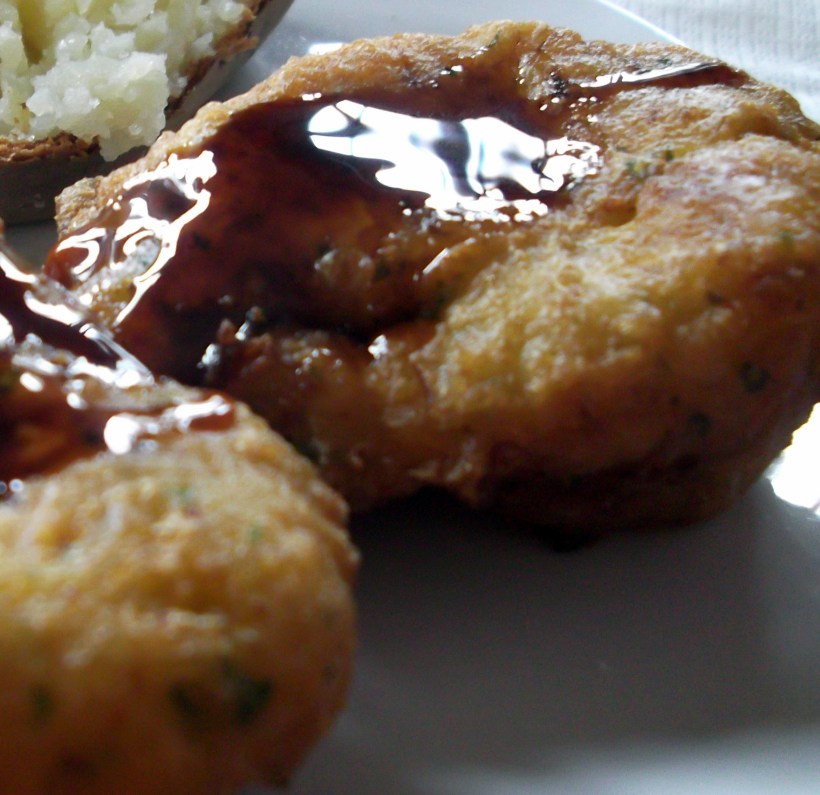
Parpuchas are known more widely as Tortitas de Bacalao, but they are a very typical dish of Andalucía.  This name may well just be specific to this area.

They are easy to make and if you don´t have de-salted salt cod, fresh cod or any other firm fish would still give you some tasty fritters.  Here they are typically served with Miel de Caña, or Molasses, in the same way as Berenjenas Fritas (Fried Aubergines),but if you prefer lemon…well, I won´t tell anyone!

To make about 15 large fritters or 20 smaller ones

  • 200g salt cod, shredded into small flakes
  • 2 eggs, beaten
  • 1 cup of milk
  • 1 teaspoon of bicarbonate of soda
  • 1 cup of flour (approx)
  • 2 large tablespoons of finely chopped parsley
  • 1 finely chopped or crushed clove of garlic
  • Salt to taste if you are not using salt cod
  • Oil for deep frying

Add the milk, bicarbonate, parsley, garlic and fish to the beaten eggs and then gradually add the flour until you have a thick batter.  It needs to be about the texture of thick lumpy custard (not that any of you, I am sure, have ever made lumpy custard!).

Heat the oil until a cube of stale bread turns brown quickly when dropped in and then drop spoonfuls of batter into the oil. I used a tablespoon and it gave me rather large parpuchas – I´d recommend using about half a tablespoon full as they will puff up slightly. When they are brown on the bottom (and they will float to the top), flip them over and cook on the other side. They will not be in the oil for long.

Remove with a slotted spoon, drain and sit them on kitchen paper for a few moments and serve hot, drizzled with Miel de Caña (to be typical) but also good with  lemon or tartare sauce. If you make too many, they are still very tasty cold as they retain their texture.

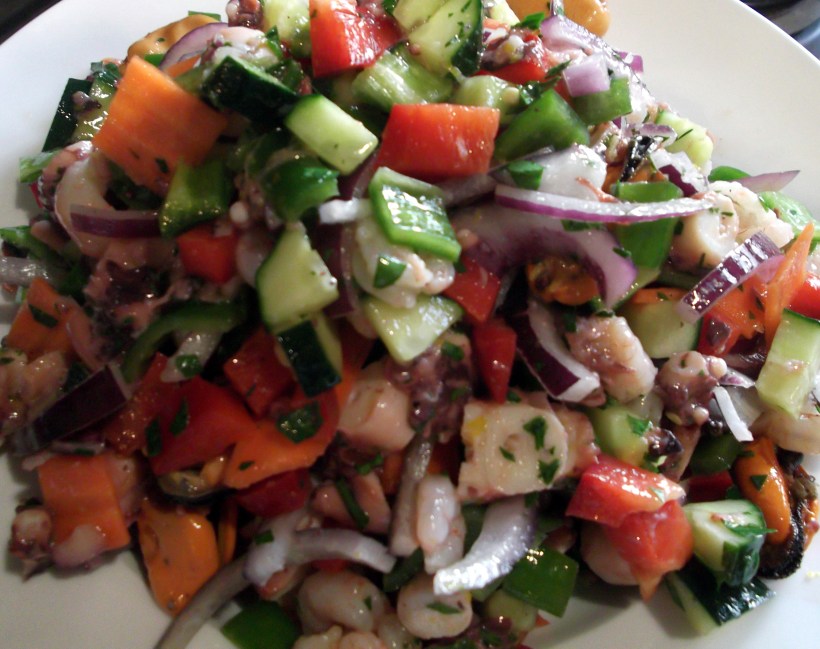
Salpicón De Mariscos – Seafood Salad

So many colours!

A typical tapas here which offers the best from the sea and the best from the salad garden is a Salpicón de Mariscos. We also enjoy it as a light lunch or supper dish or a starter.  Of course, there are many ways of making it, depending on what you have available.  Avocado? Yes, put some in. Don´t like cucumber? Leave it out.

Here´s my version which I also made a lemon vinaigrette for.  Typically though it would just be dressed with salt, white wine vinegar and olive oil.

Serves four as a starter or two as a main course.

Vegetables (all to be chopped into roughly 1cm squares)

  • Two long thin green peppers or one green bell pepper
  • Half a large red bell pepper
  • One medium red onion (or a sweet white onion). Tip…if you thinly slice and then leave in iced water for about 30 minutes and then drain before adding to your salad, it will remove any harshness of flavour
  • One small cucumber, partly peeled
  • Two carrots peeled and cut into thin strips with a peeler (this is not typical, but I enjoy the crunch and colour) and then cut into smaller pieces
  • One large salad tomato (add this just before serving)
  • Two heaped tablespoons of chopped flat leaf parsley

Seafood

  • A mixture of cooked prawns, octopus, mussels – I had about 2 cups in total

Dressing

  • One clove of crushed garlic, half the juice of a lemon, olive oil (you want 3 measures of oil to one of lemon), salt, pepper, half a teaspoon of sugar, a quarter teaspoon of English mustard powder (or use half a teaspoon of made up mustard)

Also – the grated zest of one lemon

Method

Mix together the salad and seafood.  If you are using tomato (and/or avocado) add just before serving.

Shake the dressing ingredients in a jar, taste and adjust seasoning to your preference.  Pour over the salad and mix gently.

This benefits from sitting somewhere cool  (but not cold) for at least an hour before eating. Otherwise you can make ahead, store in the fridge and then remove it an hour before serving.  Add the tomatoes and/or avocado if using, grate over the lemon zest and give it one final stir.

Have plenty of crusty bread to hand to mop up all those lovely lemony juices.

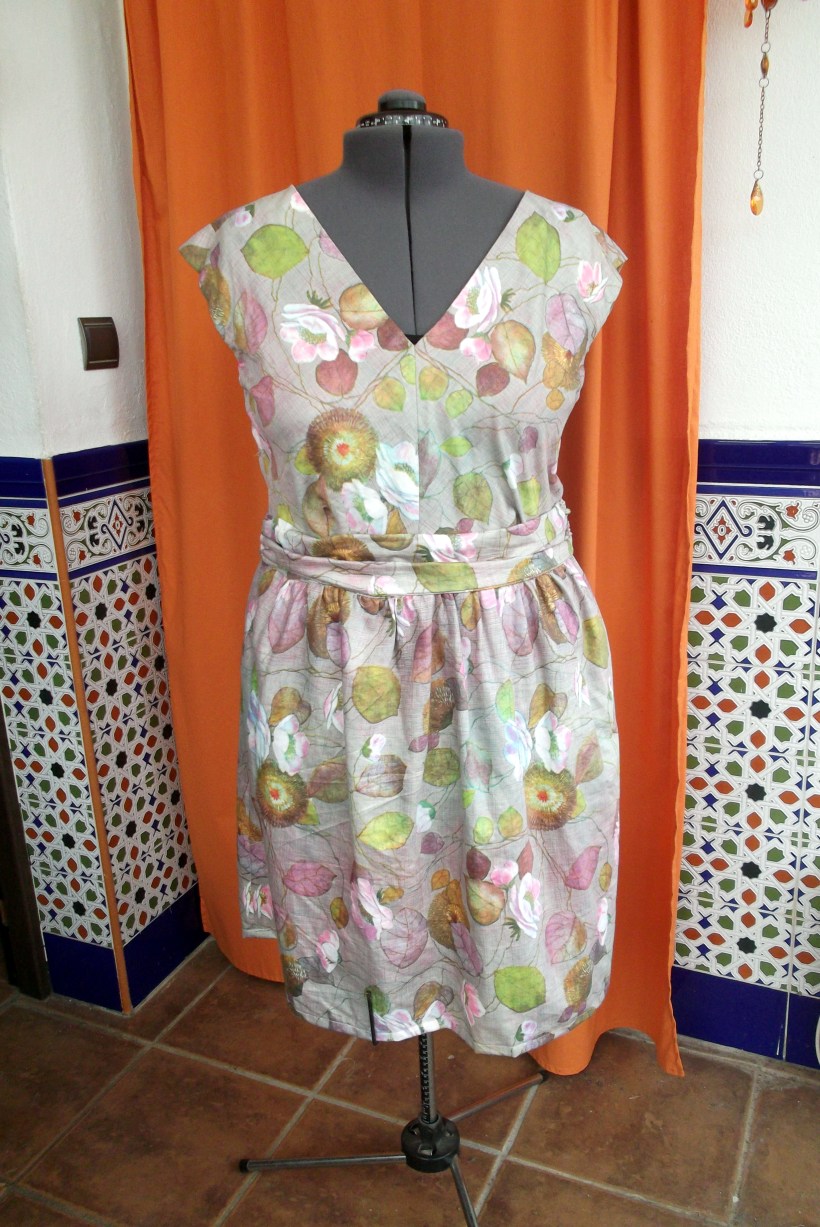
Sewing Sunday – Vogue V8789 Dress

So, look away now if you don´t want to read about sewing!

Still with me? Good! On my last trip to London I treated myself to two very nice dress patterns and some fabric with the idea of making myself dresses to wear to weddings. There are an awful lot of large weddings to attend each summer as it´s typical to invite the whole village. Factor in the fact that Big Man is one of 10 children and you can imagine how many nieces and nephews there are to be married off over the years!

Wish I had a waist like that!

Last year I was in the UK and stumbled across a find of vintage fabrics which the shop owner told me had been found packed neatly away in a suitcase. The lady who had bought the fabrics had died and her son had been going through her things, a sad thing to have to do, but I am glad that her fabrics have seen the light of day again.
New and Vintage Fabrics

The son believed they dated from the mid 1950s, a time when rationing in the UK was being eased off and the rules which applied to dressmaking during the war we done away with. This is true, because of the chronic shortages of pretty much everything, there were even rules about how wide skirts and trousers could be, restrictions on pleats and darts..because it all used up so much fabric. Think about the tailored looks during the 1940s and then (especially for women) the full skirts of the 1950s. I can imagine a young woman going out and choosing some lengths of brightly coloured fabrics anticipating what she would make with them. I wonder why they were never made up?

There was not enough fabric for me to make up the Vogue pattern I chose with a full skirt, so I adapted. The photo doesn´t really do the fabric of the dress justice. It´s a grey Sunday here in Spain so the photos look a little dull.

Should have ironed it before snapping it!

The dress is a trial run for the Going to the Wedding Dress. The second one will be made out of a gorgeous orange and brown fabric and will be fully lined, and I will be using some techniques which are new to me. French seams, a grosgrain waistband and a horsehair braid hem.

I should finish it this week, so as soon as it´s done, I´ll post more photos.

Back to the 70´s – Prawns in Lettuce Cups

Getting Groovy with the Prawns

Do you remember the 1970s? Well, I am sure some of you do, even if you were only babes in arms.  I was a young teenager at the end of the 1970s but it was a time in London when great changes were afoot in the world of food.  The height of sophistication at the time for a dinner party was probably something along the lines of prawn and avocado cocktail, steak with pepper sauce and Black Forest gâteau for dessert. And nothing wrong with any of that I say…but the 80s were soon going to herald the advent of Nouvelle Cuisine (or really tiny portions) and strange mixtures of ingredients such as Loin of some Obscure and Almost Extinct Creature Marinated in a Gooseberry and Guinness Jus. Well, you know what I mean.

Having watched a DVD of Abigail´s Party (I wish I knew how to insert video clips), I was clearly feeling nostalgic and decided to go a bit retro with my peeled prawns. Sometimes you just have to go with the flow and accept you´re getting old…

Ingredients for 4 people as a starter

  • Two lettuce hearts (use 8 of the bigger outside leaves and use the rest for salad)
  • 1 cup of peeled prawns, cooked and cut in half if large
  • 2 hard boiled eggs, chopped (not too finely)
  • 1 ripe avocado (chopped into small cubes)
  • 1 tablespoon of chopped parsley
  • Salt & pepper to taste
  • Half a cup of Marie Rose sauce (I made mine using 3 tablespoons of tomato ketchup, 3 tablespoons of mayonnaise, 1 heaped teaspoon of horseradish sauce, 1 teaspoon of Lea & Perrins Worcestershire Sauce and 1 tablespoon of sweet chili sauce)
  • Pimentón to taste

Simply mix all the ingredients together and spoon into the lettuce leaves.  Sprinkle with hot or sweet Pimentón.

Now, put some groovy 1970s dinner party music on the built in Hi-fi, slip into a glamorous kaftan and enjoy the evening….

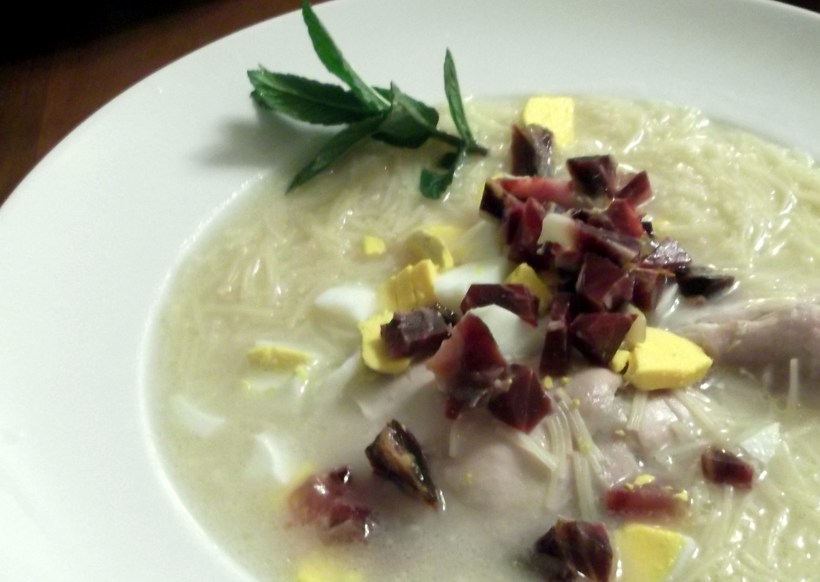
Sopa de Picadillo – Chicken Soup Spanish Style

Cloudy is good, clear is bad!

The first time I ate a bowl of chicken soup in Spain, I was a little surprised by the way it looked. I was staying in my rented Cortijo in the middle of nowhere, with my lovely, crazy landlords living in the adjacent house and popping in on me at weekends to make sure I was fine. In true Spanish Mama style, my landlady often bought me things to eat, just to make sure I was going to stay nice and well rounded.

One lunchtime she came over with a bowl of chicken soup. I was surprised because in the UK a good chicken stock is clear, transparent…and highly valued for these attributes. What I had been presented with was cloudy, almost a yellowy white in colour. It smelt amazing and the bowl was packed full of other goodies too. Pieces of chicken, fine noodles, chopped hard boiled egg and jamon and some pieces of fresh mint. I was also instructed to squeeze lemon juice into my soup.  Then off she trotted, happy to have kept her (not so) starving tenant alive to see another sunny Andalucían day.

Of course, once I had tasted it, I was in love. Such deep chicken flavours, quite a salty (but not disagreeably so) taste and the tang of lemon and mint. The name of the soup, Picadillo, comes from the verb Picar. This means to chop finely or into small pieces. Hence the final additions of hard boiled egg and jamon.

This is not a recipe, more a method. Spanish chicken stock is made with whole joints of chicken (I use thighs and legs usually), salted pork bones and salted pork belly with plenty of fat on it.  If you can´t get the last two ingredients use a couple of pork ribs and a piece of normal pork belly or a thick slice of pancetta.  Add a couple of bay leaves, about 4 cloves, 1 or 2 dried chilies (optional) and cover with water. I also add in a few carrots and sticks of celery, but this is not typical. If you have not used salted bones, add salt to taste and check again at the end of cooking.

Now boil it fast for about 10 minutes, this is when the water will turn cloudy, then turn down the heat and simmer for at least an hour. Strain the stock and leave it to cool, you will then be able to remove the layer of natural fat from the meat which will set on the surface.

Remove the bones, bay leaves, cloves, chilies and discard. To serve a typical Sopa de Picadillo, boil up the stock, add some fine angel hair noodles and the chicken (pork belly too if you used unsalted)  and cook until the chicken is warmed through and the noodles are cooked. Sprinkle over hard boiled egg and jamon (or use lardons or pancetta) and if you have some fresh mint to infuse in the soup it really adds a special touch. Don´t forget the squeeze of lemon too!

Like most chicken soups, it is claimed to be the cure for all ills, but you don´t need to be feeling under the weather to enjoy it.

Baked Cherry Cheesecake

A slightly sad looking final slice of cheesecake....

I am sure we all have “go to” recipes for times when we are in a hurry, or just want to return to an old favourite.  I adore baked cheesecake and have been using an adapted version of a BBC Good Food one for several years now.
When I found out that I had been asked to make a dessert for lunch with friends, I got out my cream cheese and eggs and quickly got to work. Apologies for the photo, I forgot to snap it in all its glory before we attacked it!

Ingredients

  • 12 crushed digestive biscuits (graham crackers)
  • 50g melted butter
  • 600g cream cheese
  • 2 level tablespoons of flour
  • 175g sugar
  • 3 eggs
  • 150ml whipping cream (or heavy cream)
  • 1 teaspoon vanilla essence
  • 1 jar of cherry jam plus I used some of my cherries in brandy (drained)
  • 1 sachet of flavourless gelatine or vegetarian substitute

Heat the oven to 180º C or gas mark 4.  Mix the crushed biscuits with the butter and press into a springform tin. Bake for 10 minutes and leave to cool.

Beat the cream cheese, flour, sugar and eggs together then add the cream and vanilla essence and then any fruit filling (not the jam).  Blend gently, pour into the tin and bake for 45 minutes.  It will still be slightly wobbly in the centre but leave to cool out of the oven.  It will continue to cook slightly.  I have to confess mine always cracks, I don´t know if there is a way around this – I´d be happy to learn!

For the topping you can either just cover with fruit or make a jelly fruit topping.  I did this by adding a sachet of powdered gelatine to about 4 tablespoons of cold water.  In a small pan warm the jam until it starts to bubble then pour it over the gelatine and mix well until all the granules have dissolved.  Leave it to cool down until almost cold and starting to set then pour over the cheesecake (still in the tin).  Refrigerate for at least 2 hours and remove from the fridge an hour before serving to reach room temperature.