Split Mung Bean Curry

I do enjoy curries made with pulses, they’re so good for you, economical and wonderfully tasty. I had bought a packet of split mung beans in a local shop and wanted to try them out. I came across a recipe online which inspired my own version, but of course, didn’t keep track of the original source. Apologies to the owner of the original recipe, I’d be happy to credit you.

Mung Bean Dhal (4)

The quantity I made filled 4 plastic tubs, so I shared the curry love with my mum and my best pal. Feel free to scoff it all yourself or make less! This gives a gentle tasting curry, you may want to increase the quantities of the spices (I think I will next time) for a little more punch!

Ingredients to serve 4-6

  • 400g yellow split mung beans (yellow moong dal), well rinsed
  • Water, to cover the beans
  • ½ teaspoon turmeric powder
  • Approx 4 tablespoons vegetable oil
  • 1/2 teaspoon cumin powder
  • 2 small red onions, finely chopped
  • 1 level teaspoon chilli powder or to taste
  • 1 level teaspoon of coriander powder
  • 1 teaspoon grated ginger
  • 2 cloves of garlic, peeled and crushed
  • 1 tomato, peeled and finely chopped
  • 200g frozen spinach (or 400g fresh, finely chopped)
  • Salt, to taste
  • Some finely chopped coriander

In a deep pot, combine about 4 cups of water, the turmeric, and 1 tablespoon of the vegetable oil. Bring to the boil, then add the mung beans. Add more water if necessary, you want about 5cm of water above the beans.

Reduce the heat to medium-low and cook, uncovered and stirring occasionally, for 30 minutes or until the lentils are very soft. If the water starts to dry up, add another ½ cup of water. Remove from heat and set aside.

In a medium-sized frying, heat the rest of the vegetable oil and add the red onions. Sauté for 7 to 8 minutes or until the onions are browned.

Mung Bean Dhal (9)

Add the ginger, garlic, cumin, chilli powder, frozen spinach and tomatoes. Continue cooking gently until the tomatoes are soft. If using fresh spinach, add once the tomatoes have softened. Mix in the cooked beans.

Add the salt (it needs a fair amount, keep tasting) and coriander and mix well. Delicious served hot, but makes a fantastic dip served cold as it thickens as it cools.

If you enjoy curries like this, take a look at my Split Pea and Squash Curry or my Green Lentil Curry.

Sesame Crusted Tuna Steaks

I have to confess to a love of tinned tuna. In salads especially. But I had only ever had indifferent experiences of fresh tuna – probably frozen for a long time and then cooked for too long resulting in dry, tasteless fish. My lovely fishmonger had some beautiful looking tuna steaks in recently and I decided to give it another chance.

Sesame Crusted Tuna 001

I looked at recipes online and came to the conclusion that simple was probably better. It’s not a cheap fish to buy, and because I had been assured the flavour would be amazing, I wanted to let it shine through. Having a fancy for something with an Asian twist, I packed some zingy flavours into the salad I served with it. What a great decision. The only problem is now I need to win the lottery to fund my (ethically caught) tuna habit!

Ingredients to serve 2

  • 2 tuna steaks
  • About 4 tablespoons of sesame seeds
  • 1 egg white, lightly beaten
  • Salt & Pepper
  • A little oil for frying
  • For the salad – some roughly chopped cucumber, avocado, spring onion and coriander
  • For the dressing – mix together 2 tablespoons of olive oil, ½ teaspoon of fish sauce, ½ teaspoon of sesame oil, 1 teaspoon of light soy sauce, ½ teaspoon of white sugar and the juice of half a lime. Adjust the salt (with the soy sauce), sugar and lime to taste.

Season the tuna steaks or fillets with salt & pepper and dip them first in the egg white then in the sesame seeds to coat evenly.

Heat a very little oil in the pan – you don’t want it searingly hot or the sesame seeds will burn. The length of cooking time will depend very much on personal taste and the thickness of your fish. Bear in mind that it will continue to cook gently from the residual heat once it is served. My steaks took about 2 minutes on the first side and a minute on the second. It’s a very quick dish to prepare.

Toss the salad ingredients with the dressing and serve the tuna steak on top.

Loving our French neighbours …. but not the cold wind along the channel!

Life has been getting in the way generally the last few weeks. It hasn’t left much time for posting or visiting your blogs, but I’m playing catch up this week.

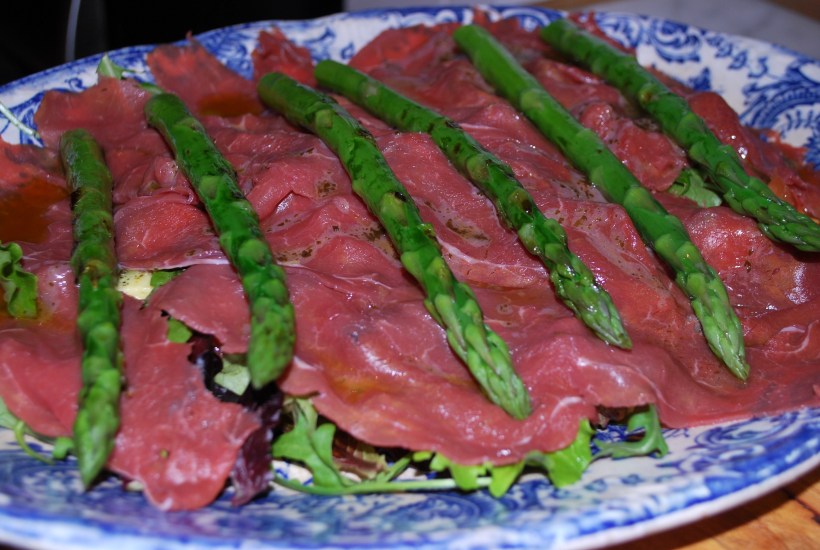
Last week we managed a speedy hop over the channel. Well, under the channel, to be more precise as we travelled via the Eurotunnel. We spent a night in Boulogne-Sur-Mer and stayed in the old town – very picturesque but I can’t get the photos off my phone to show you. We also stocked up on lots of wonderful wine, cheese and other delicious goodies like all good Englishers on a “booze cruise”. So many wonderful things to choose from and I had to smile as I bought some freshly sliced beef carpaccio – thin slices of raw beef which I served over a salad with griddled asparagus and drizzled with lemon oil. (If you want a chuckle at my not so successful attempt at making octopus carpaccio, take a look at this post).

Carpaccio (4)

I was smiling because in England a few weeks ago with some pals we went to a Steak Grill and one of us ordered a burger which they wanted served rare. “Sorry” we were told “local restrictions only allow us to serve minced beef when it is cooked through”. Couldn’t they rely on the quality of the beef they buy and their suppliers we asked? “Legislation” we were told. So a finger up to whoever in England decides how we should eat our meat, and a big round of applause to our French cousins for letting us make our own choices.

Beachy Head (3)

In an effort to work off some of the cheese calories we had consumed, yesterday we took the pups off to nearby Beachy Head for a walk.

Beachy Head (4)

Perhaps not such a good idea to visit this beautiful headland with amazing views across the south coast on quite such a windy day, but (as my granny used to say), it certainly blew the cobwebs away!


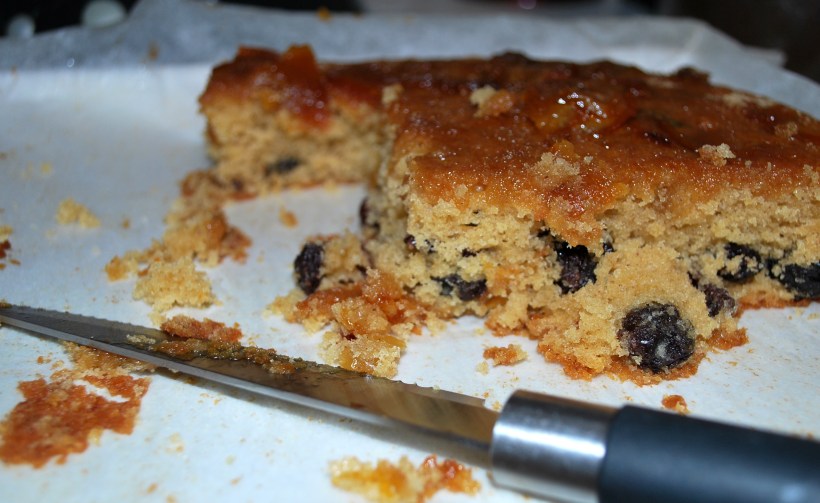
Sticky Citrus and Marmalade Tray Bake

My mum had a bit of a marmalade making session last week and gave us several jars of her delicious marmalade to enjoy. Thanks Mamma! Putting the marmalade in the cupboard, I came across a jar of my own marmalade from last year which I decided to use up quickly so that I could get onto enjoying the fresh batch more quickly. I decided to make a quick cake and at the same time try out a new baking tin I had just bought – well…why not?!

Going, going....nearly gone!
Going, going….nearly gone!

A BBC Good Food recipe caught my eye, I substituted a mild olive oil for the butter which (I think) makes this cake suitable for vegans as it contains no egg. The vinegar in the recipe sounds odd, but don’t leave it out as it helps the cake to rise and it won’t taste of vinegar, I promise!

Ingredients (to fit a baking tray approx 28 x 23 cm)

  • 200g self raising four
  • ½ teaspoon each of ground ginger and cinnamon (original recipe uses 1 teaspoon of mixed spice which I didn’t have)
  • 100g golden caster sugar
  • Zest of 1 orange and ½ lemon
  • 100g mixed dried fruits
  • A pinch of salt
  • 100g of olive oil (original recipe calls for 140g butter which is then melted), weigh the oil as you add it to the mix
  • 5 tablespoons of marmalade
  • 125ml milk
  • 1 teaspoon of white wine vinegar
  • 2 tablespoons of icing sugar
  • 1 tablespoon of brown sugar

Heat the oven to 160c/140c (fan)/gas 3 and line your baking tray. The original recipe uses a 900g/2lb loaf tin and cooks it for 60 minutes.

Place the flour, spices, sugar, zests, dried fruits and a pinch of salt into a bowl and mix. Put the oil (or butter) into a saucepan with 2 tbsp of the marmalade and melt. Mix well, add the milk and then pour over the dry ingredients. Add the vinegar and mix well.

Pour the mixture into your prepared baking tin and bake for about 45 minutes, or until an inserted skewer comes out clean.

Sticky Citrus and Marmalade Tray Bake (3)

While the cake is baking heat the remaining marmalade with 2 tablespoons of water and the icing sugar. Pour this over the cake when it comes out of the oven then sprinkle it with brown sugar and leave to cool in the tin. You’ll end up with a delicious, citrusy, sticky cake which best pal Ria suggested would also be great served warm with custard. Now you’re talking….

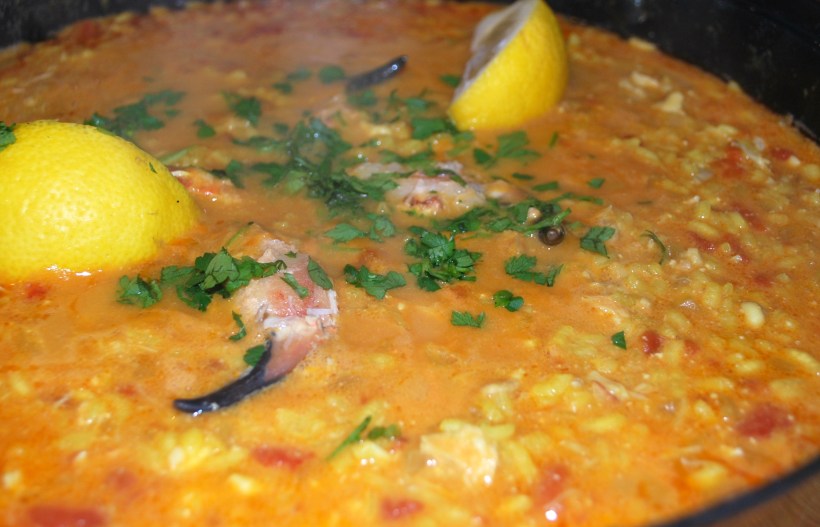
Arroz Caldoso con Cangrejo – or Holidays, Romance and Crabs

Any of you who have followed my blog since way back when may recall a trip we made a few years back to the north of Spain. To Galicia and Asturias more precisely. An insanely beautiful part of the country, lush and green. Lush and green because, like in Scotland or the English Lake District, it rains a lot. And rain (and rain) it did. Which left us plenty of time for eating and drinking. Always look on the bright side, I say.

DSCF1371_picnik

I don’t know why it surprised us that it rained, even though it was only the tail end of summer, as holidays and special occasions are generally a complete disaster for Big Man and me.

DSCF1298

Our anniversary falls on 11th November so aside from the fact a lot of folk are quite rightly marking a very solemn memorial to all those who lost their lives in conflict, it’s a dreadful time of year for good weather in the Northern Hemisphere. Christmas and Birthdays generally involve some sort of disaster or a member of the extended family falling ill so we’ve now accepted that we’ll not get ourselves too worked up over celebrations and holidays and just enjoy the everyday joys.

There is a point to all this reminiscing. Today I bought two cooked and dressed crabs at the local fishmonger intending to boil some potatoes, make a salad and call it lunch. Big Man began to talk about an amazing meal we’d had on our trip to the north of Spain. The rain poured down, the wind howled and the first hotel we stayed in was nice but miles out of town. After a long, long drive we decided to do something we rarely do and EAT IN THE HOTEL RESTAURANT. What a good decision that was. The food was incredible and we made the most of it, ordering their speciality of Arroz Caldoso con Bogavante (which translates as brothy rice with lobster) for our last night there. Why didn’t I make “brothy” rice with crab he asked? Why not indeed, so I did, and absolutely wonderful it was too.

If you have an earthenware cazuela to make and serve this in, use it (Celia, I’m talking about you!). It really makes a difference to the flavour and is more authentic.

Ingredients (to serve 4)

  • The meat from 2 cooked crabs (white and brown) which will weigh about 260g – although you can use raw too but will need to cook them first
  • About 1.2l of fish stock made from the crab shells and any other bits of fish you can beg from your fishmonger and with a few strands of saffron added
  • 400g paella rice
  • 1 small onion finely chopped
  • 3 cloves of garlic, finely chopped
  • 200g chopped, peeled tomatoes (if using tinned, and why wouldn’t you, make sure to drain them first)
  • A splash of brandy
  • Salt & Pepper
  • A lemon, quartered
  • Some finely chopped parsley to serve
  • Olive oil

Gently fry the onion in a little olive oil until it is softened but not browned then add the garlic and cook for a minute. Add the tomatoes and cook gently for about 10 minutes and add the splash of brandy. Next add the rice and stock.

Arroz Caldoso con Cangrejo 006

(A little reminder, if you’re making paella you’ll need 100g of rice per person approximately and for every 100g of rice you need about 210ml of liquid. For brothy rice you need the same amount of rice but 3 times the amount of liquid, so approx 300ml to every 100g of rice.)

Cook gently, half covered until the rice is almost done, add more stock if it’s drying out too much, then add the cooked crab meat, stir and taste and add seasoning if necessary at this point. Turn the heat off, cover the pan and let the rice rest for at least 5 minutes and to let the rice finish cooking. Serve with a little parsley sprinkled over and wedges of lemon to squeeze over the food.

This is a dish made with a few ingredients but which lets them shine, it tastes luxurious and decadent. Which made me think it would be good for a Valentines meal – very romantic. Unless you happen to be us and also have Valentine’s Disasters…but more of that in a few days.

If you want to see more of the North of Spain, do check out the links at the start of the post, which I hope you’ll enjoy.

Morrete de Setas – Mushrooms with Potatoes

If like me, you are the sort of person who is not put off by strange translations into your native tongue of a dish you encounter on your travels, this one is for you. Coming across this dish in a small local restaurant near our mountains in Southern Spain, you’d probably read something like “Mushrooms to the wild, cooking with soft potatoes of the saffron dressing up in vinegar”. Or some such bizarre description.

It doesn’t even look that pretty, as the end dish is indeed “with soft potatoes” and has rather a look of mush about it. What you would be served with, however, is a dish with simple ingredients combined in a way you’ve probably never tasted before, and a flavour that makes you say “ooh, that’s so good…I really didn’t expect that”!

Morrete de Setas 004

Around our neck of the woods (or Up Our Mountain), the most commonly eaten mushrooms are Oyster mushrooms. We have grown them ourselves in the past and Big Man would often come home with a crate of them for me to turn into dishes like Mixed Mushrooms with Cinnamon and Lemon or Braised Mushrooms. This dish is made across Andalucía but is probably known by other names outside of the radius of our local villages. Here’s our local version, the simplicity of the ingredients hides a wonderful combination of flavours. It is vegetarian/vegan and can be served alone as a tapa or starter, or alongside other dishes as part of a meal. A poached or fried egg is a wonderful accompaniment.

Ingredients (to serve 6-8 as a tapa, 4 as a starter or 2 as a hearty main course)

  • 1 kg peeled and cubed potatoes (cut into small cubes)
  • About 600g of thickly sliced mushrooms (I used a mix of Shitake, Chestnut and Forestiere Mushrooms)
  • Olive oil for frying
  • 1 level teaspoon of sweet pimentón
  • ½ level teaspoon of hot pimentón
  • A pinch of saffron or turmeric (in Spain though you find they usually use food colouring)
  • About 60g of stale bread
  • 2 cloves of garlic, peeled
  • About 240ml water
  • About 2 tablespoons of white wine vinegar
  • Salt and pepper

You will need 2 frying pans (or you will need to cook the potatoes and mushrooms separately. In one pan with about ½ cm of oil to cover the bottom, slowly cook the potatoes until they are soft and just starting to brown at the edges. Mix occasionally as they cook. You don’t want them to be crispy like chips.

In another pan, add a little oil, the mushrooms and some salt and cover with a lid. Slowly braise the mushrooms until soft and releasing their juices. The potatoes and mushrooms both take about 20 minutes to cook.

Meanwhile, put the bread, water, garlic, spices and 1 tablespoon of vinegar into a blender jug and blend (I use a hand blender) until you get a mix which resembles slightly runny porridge.

Drain the potatoes from the oil and add to the mushrooms and pour in the bread/water mix. Cook gently for about 10 minutes until it all thickens up (you may need to add a splash more water). Just before serving, taste and season and add a further tablespoon of white wine vinegar. Think of the resulting taste in the same way that you would use lemon juice to “lift” a dish.

Serve with plenty of crusty bread and if you’re feeling a bit cheffy, some chopped parsley on top makes it look pretty. But don’t tell the local village ladies I said that as they’d be horrified at any such nonsense.

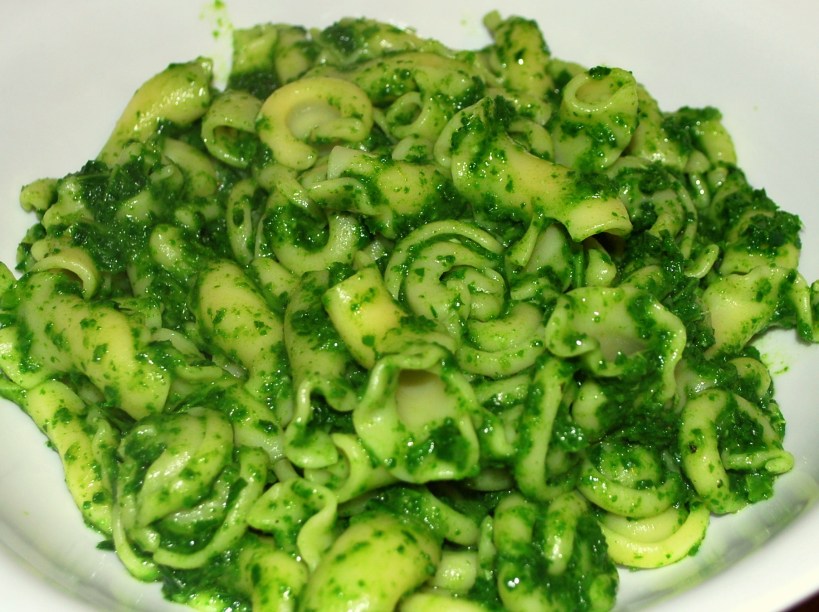
Pasta with Kale (in the absence of Cavolo Nero)

January is a dark, gloomy month for those of us in the Northern Hemisphere. For many of us it is a month of tightening the financial belt and loosening the trouser belt (whilst making plans to get fit) after the excesses of Christmas.

This is a dish which ticks all those resolution boxes – healthy, economical and it looks like Spring in a bowl, which is no bad thing. The garlic will ward away germs (or so my old Italian aunties always told me), it’s quick to prepare and you’ll feel comfortably full but without the feelings of guilt after eating this. Sounds good to me!

Even looking at it fills you with vitamins!

This dish was food for the poor folk…simple ingredients (although if you can afford to use your best olive oil, I’d highly recommend it) and no fuss to make.

Quantities are easily halved or doubled, I used regular kale as I didn’t have cavolo nero (also known as black leaf kale), and it was delicious. The colour was a more vibrant green than the almost black-green you get with cavolo nero.

Ingredients (to serve 2 people very generously)

  • 200g of kale leaves
  • Approx 100ml of extra virgin olive oil
  • 3 cloves of garlic, peeled
  • Maldon (or coarse) sea salt and black pepper
  • Grated parmesan to serve (optional)

Bring a large pot of salted water to boil and cook the kale and 2 of the garlic cloves for about 5 minutes until soft. It needs to be slightly more than wilted, but not soggy. Drain and put into a food processor.

As you start processing the kale, add slugs of olive oil to the mix until you have a slightly sloppy paste – rather like pesto.

Pasta with Cavolo Nero (1)

Crush the remaining clove of garlic with a teaspoon of rough salt and add 2 teaspoons of olive oil then stir this into the kale mixture. Taste and season with extra salt and black pepper if necessary and then stir into your favourite pasta, making sure you keep a little of the cooking water to loosen up the pasta if necessary once you have added the kale.

To serve, add grated parmesan if liked and some folk even add a little extra drizzle of olive oil. Go on, I won’t tell anyone!

If you’d like to see how we make our olive oil in Spain, click here.

No cooking…but some patchworking and quilting

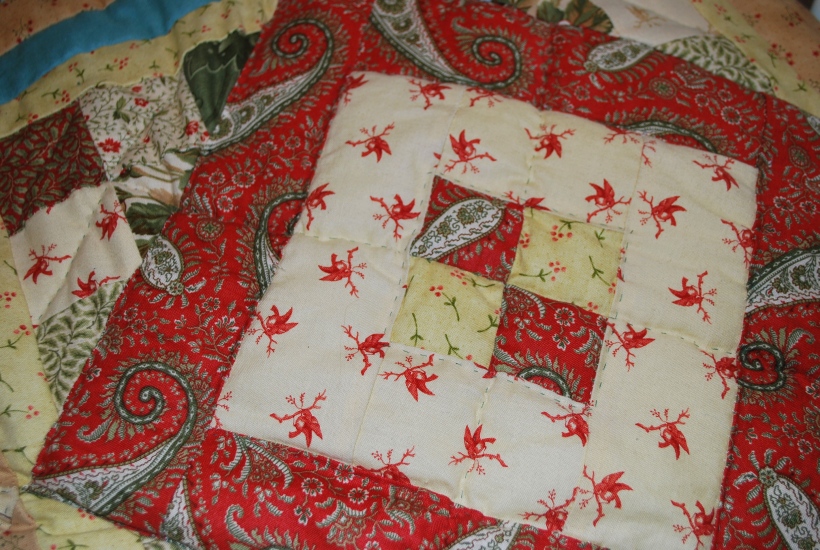
So, the quilt was completed the day before Christmas Eve. A special present to me and Big Man made by my own fair hands. And the terrible thing is that now I’m hooked!

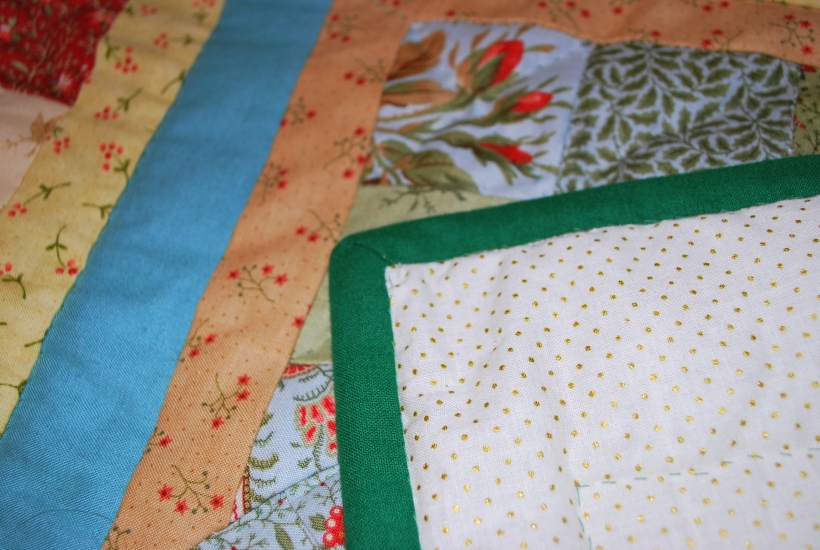
The Road to Health Quilt (5)

It was made entirely by hand apart from the strips I added to widen it and the first run round of the binding.

The Road to Health Quilt (11)
The strips are green, not blue as they look in the photo – and just look at that binding…thanks Kate!


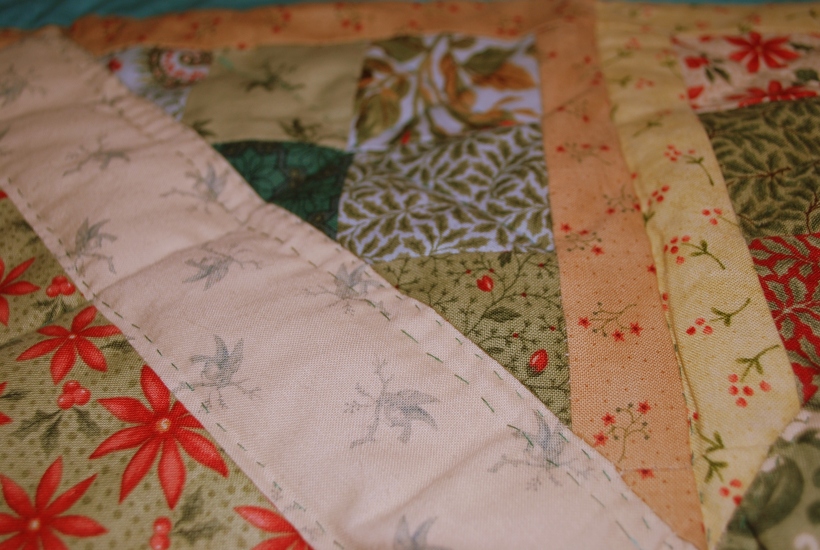
Ok, so it’s not perfect and I had to restitch the initial quilting as it was so awful. But I did keep one line of it in, next to the final attempt to show myself that practice makes better (but not yet perfect!).


Dodgy Big Stitches next to slightly less dodgy and a bit smaller stitches...
Dodgy Big Stitches next to slightly less dodgy and a bit smaller stitches…

There are plenty of wonky lines, but hey, that adds to the charm. And I’m sticking with that (wonky) line.

The Road to Health Quilt (10)

For details of the quilt pattern and fabric, take a look here and here.

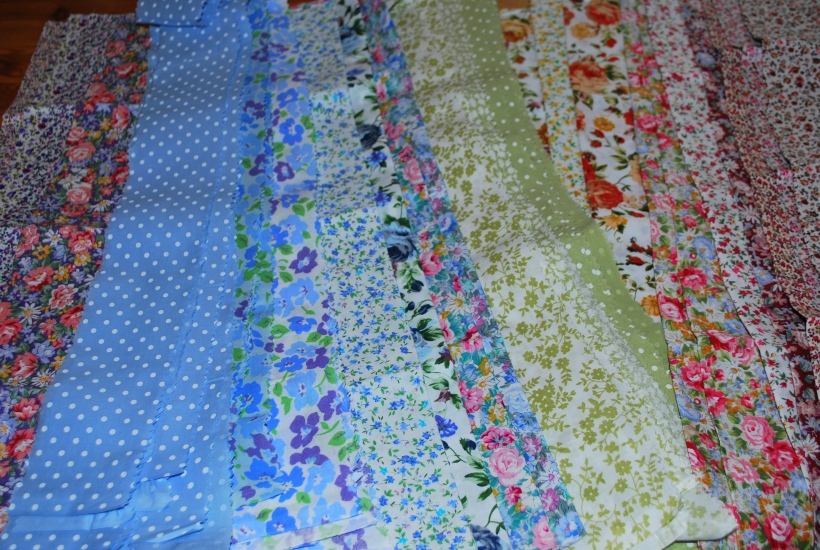
And now that I’m hooked, I just couldn’t help myself when these fabrics on sale called out to me…was it Oscar Wilde who said “I can resist everything except temptation”?!

The Road to Health Quilt (1)

A big thank you to both Kate from talltalesfromchiconia (especially her quilt binding tutorial) and Evie  (check out the link for her Chateau Quilt) over at Pendle Stitches for their advice and encouragement, especially when I started the hand quilting of the quilt top – I was all set to give up, but thanks to their kind words I pushed on and gradually became addicted…

Syrian Style Roast Leg of Lamb

I was very lucky to have been given some fabulous cookbooks by my best buddy Ria. Ah she knows me so well! One is titled Almond Bar, written by Sharon Salloum, co-owner and chef of Almond Bar restaurant in Sydney, who was bought up in a traditional Syrian household. Ooh I’d love to go and eat there! Her recipes are based on family traditions, but adapted for the modern kitchen.

Syrian Lamb

As soon as I saw her recipe for roast leg of lamb, I knew I would make it for New Year’s Eve. We had family visiting from Spain and were going to have a fairly typical Spanish Family Celebration meal – masses of seafood and shellfish to start, lamb for main course, flan (or crème caramel to us!), fruit, Spanish biscuits, turrón and 12 grapes at midnight. The lamb was not typically Spanish because of the spices, but it was a big hit with everyone. The meat is cooked on high to start with then slowly cooked to tender perfection. Don’t wait until next New Year’s Eve to try this, I know I won’t be waiting that long!

(Apologies for the photo, it’s a cropped section of a family snap which also featured the lamb…)

Serves 8-10 (but you can scale it down for a smaller leg of lamb)

  • 2.5kg leg of lamb, bone in
  • 60ml olive oil
  • ¼ teaspoon ground cinnamon
  • ¼ teaspoon freshly grated nutmeg
  • ¼ teaspoon ground cumin
  • ¼ teaspoon sweet paprika
  • ¼ teaspoon freshly ground black pepper
  • ¼ teaspoon ground cardamom
  • 8 cloves crushed with a pestle and mortar
  • 3 teaspoons salt flakes
  • 6 cloves of sliced garlic
  • About 10 small sprigs of rosemary
  • 1 glass of white wine (not in the original recipe)

Preheat the oven to 200C (fan)/425F/Gas 7

Mix the oil with the spices, salt and pepper in a bowl. Rub the mix all over the leg of lamb then cut small incisions all over the lamb with a sharp pointed knife. Push the garlic and rosemary sprigs into the incisions.

Place the lamb in a deep oven dish and bake on high for an hour, turning after 30 minutes to brown on both sides. Pour the wine over the meat, cover the dish with foil to make a tent and reduce the oven temperature to 170C (fan)/375F/Gas 5 and return to the oven. Cook for another 2 ½ – 3 hours, basting every 20 minutes (but don’t stress if you do it a little less).

When the lamb is cooked, remove from the oven, keep it warm (I wrap it in foil and a couple of towels) and leave to rest for 15-30 minutes and serve with all the beautiful juices you will have left in the pan.